Infrared Filter Market Trends 2026: Automotive, Security and Medical Drive Growth
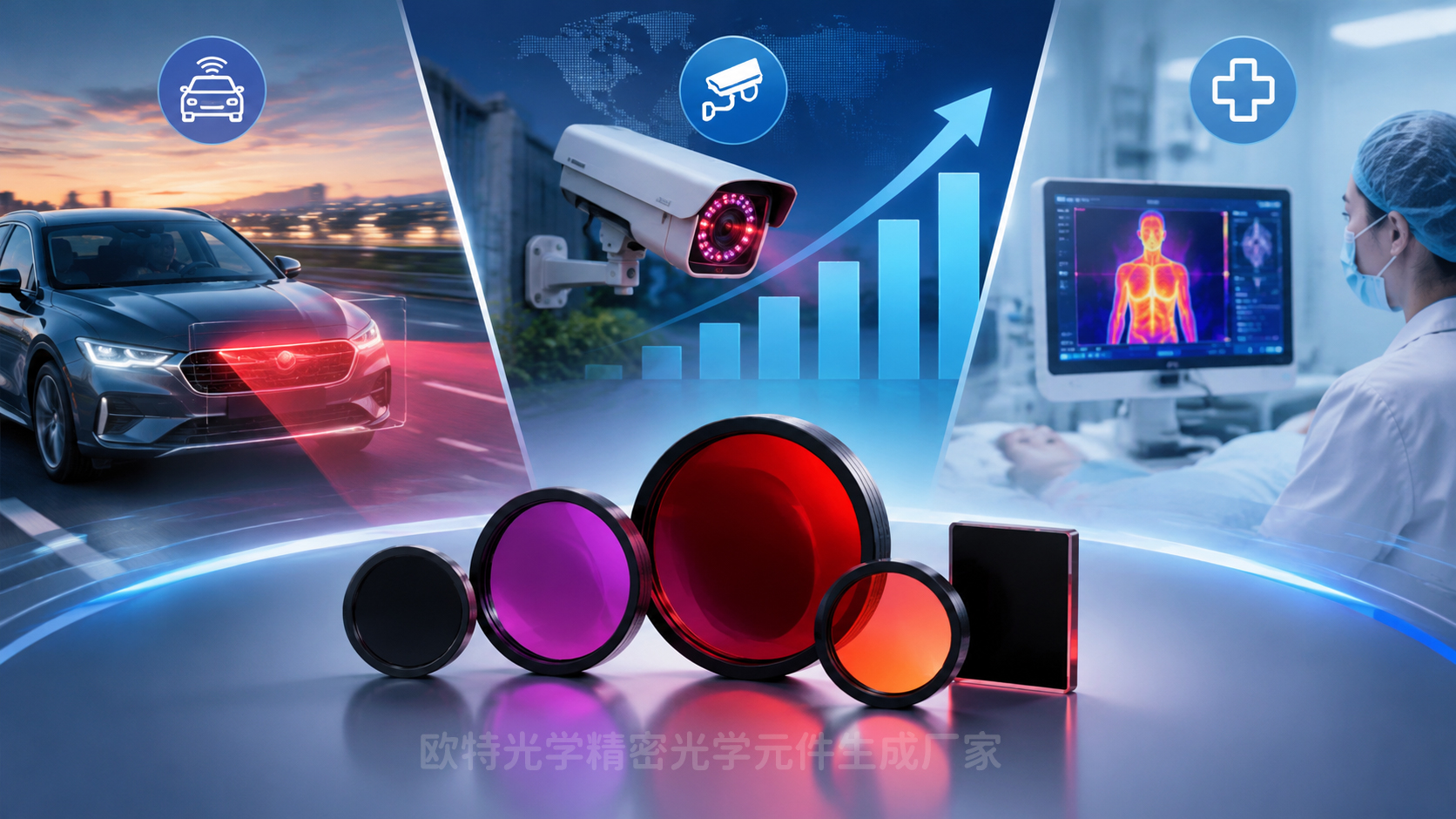
Infrared filters used to serve mainly industrial thermometry and night-vision security. Over the past two years the demand structure has shifted visibly: automotive LiDAR, smart security and medical endoscopy have become the three new growth engines, pushing technical requirements to a new level.
Three Applications Pulling Demand
Automotive LiDAR
905 nm and 1550 nm are the two dominant receiver wavelengths. The receiver filter passes the return signal while suppressing solar background, which calls for narrow bandwidth (1–5 nm), high peak transmission and blocking of OD6 or better across a wide range. As Level 2+ driver assistance penetration rises, this segment is growing fastest of the three.
Smart Security
The dual-filter switcher (IR-cut) remains standard in surveillance cameras: by day an IR-blocking filter ensures colour fidelity, by night a fully transmitting filter raises sensitivity. Evolution is toward smaller, longer-life switching mechanisms and a move from soft to hard coatings for weather resistance.
Medical Endoscopy and Surgical Navigation
Near-infrared fluorescence imaging such as ICG-guided surgery requires filters that combine high transmission with deep blocking in the 800–850 nm band. This segment demands the highest consistency and reliability, and has the longest qualification cycles.
Three Technology Directions
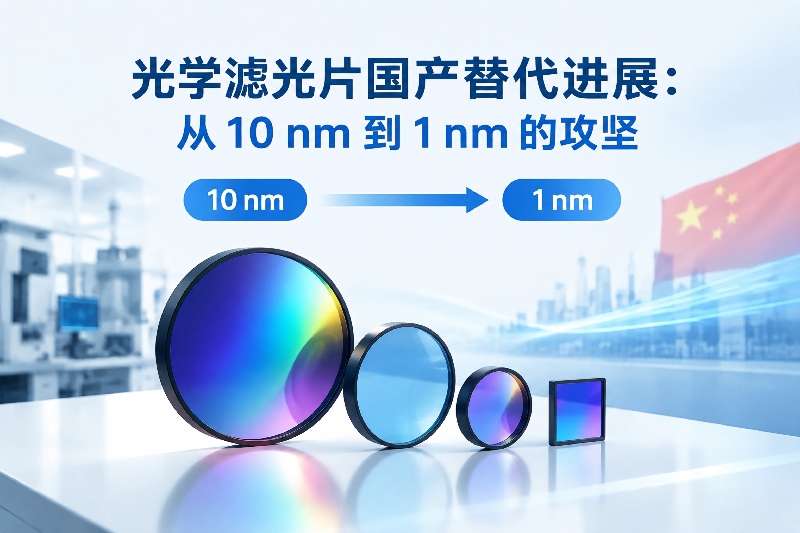
- Narrower and steeper: from 10 nm-class bandwidths toward 1–3 nm, with edge steepness becoming a core competitive factor.
- Wider blocking: extending from 200–1100 nm to 200–1700 nm for broadband detectors.
- Higher environmental reliability: automotive grade demands 85 °C / 85% RH thousand-hour testing, making coating stress control and substrate matching critical process skills.
Where Localization Opportunities Lie
High-end narrowband filters used to come mostly from European, US and Japanese suppliers, with long lead times and high prices. Domestic accumulation in coating equipment (ion-assisted deposition, magnetron sputtering) and design software now allows stable volume delivery of 10 nm-class bandwidths at OD6, cutting lead times from 12 weeks to 4–6 weeks. The real gap remains in 1–3 nm ultra-narrowband and automotive-grade reliability qualification — the hard problems domestic makers must solve next.
OOTEE Optics has full coating design capability and volume delivery experience in the infrared. Our longpass filter series covers 700–2000 nm and can be customized in bandwidth and cut-off depth for automotive, security and medical scenarios. Talk to our engineering team about your project.