Product Category / Symmetrical · short focus
A biconvex lens is convex on both sides. Its symmetrical form gives the lowest spherical aberration near a 1:1 conjugate ratio, which is why it appears in imaging and relay systems and in re-converging a diverging beam. At the same focal length a biconvex element tolerates a larger relative aperture than a plano-convex one, but is more sensitive to centring during assembly.
| Focal length | ±5 to ±1000 mm (typical, to be confirmed) |
|---|---|
| Clear aperture | φ3-φ100 mm |
| Surface figure | λ/2-λ/10 (at 632.8 nm) |
| Surface quality | 60–40 to 10–5 (MIL-O-13830A) |
Typical processing ranges for this line. Requirements outside these can be evaluated to drawing; final specifications are confirmed by sample and datasheet.
Send the model or drawing — quote and lead time within one business day. Wavelength, bandwidth and size are all customisable.
Request a quote Browse all 0 models →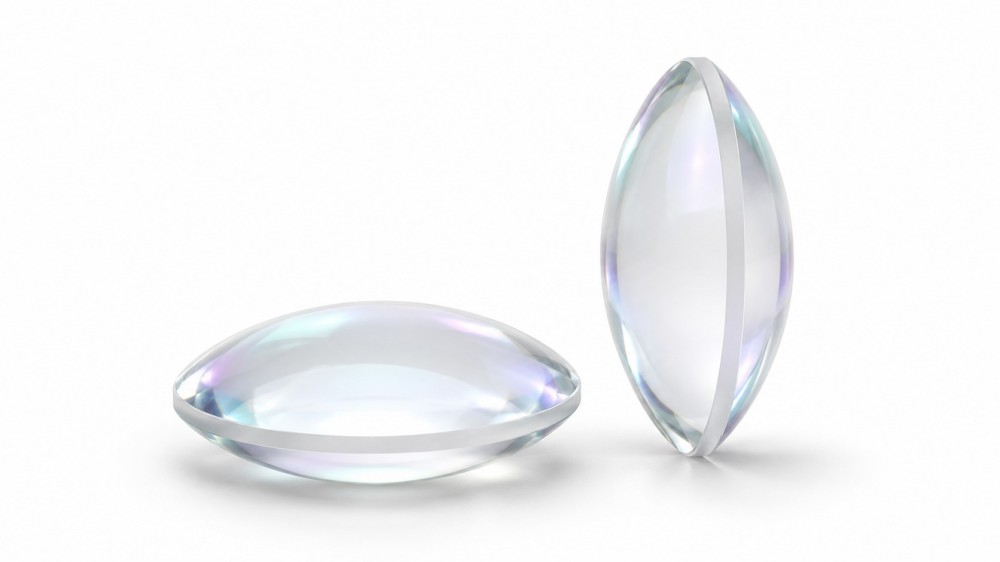
IN STOCK
Made to order — no stock models listed yet, ask about availability.
No matching models yet. Adjust the filters, or contact us for selection advice and samples.
Reset filtersChoose which categories of cookies you allow. Essential cookies are always active because the site cannot run without them. Your choice is stored for 12 months and can be changed at any time from the footer.
Required for core functions such as language selection, security, and remembering your cookie choice. These cannot be turned off.
Would help us understand how visitors use the site so we can improve it. No analytics service is currently enabled on this website.
Would be used to measure campaigns and show relevant content. No advertising or remarketing service is currently enabled on this website.
This site currently sets no advertising, tracking or third-party cookies. Your consent choice is kept in your browser local storage, not in a cookie. See the Cookie Policy for details.