 05:08
One beam, one piece of glass: what a filter actually does, why white light comes out as a narrow blue band, how absorptive and interference types differ, and why two "bandpass" filters can differ tenfold in price. A three-minute primer for buyers and hardware engineers.
This is the first episode of our optics explainer series, and we start with the most basic question: what is an optical filter?
Picture a sensor that sees everything — visible, infrared, even UV. Most of the time you only care about a tiny slice of that, say the green emission of a fluorophore. Everything else is noise.
A filter decides which wavelengths pass and which are blocked. It looks like a piece of glass, but it is actually dozens or hundreds of thin-film layers.
The principle is straightforward. Alternate high- and low-index materials, each about a quarter-wave thick at the target wavelength. Every interface reflects a little light. For the target wavelength those reflections add in phase and the light passes; for other wavelengths they cancel and the light is reflected away.
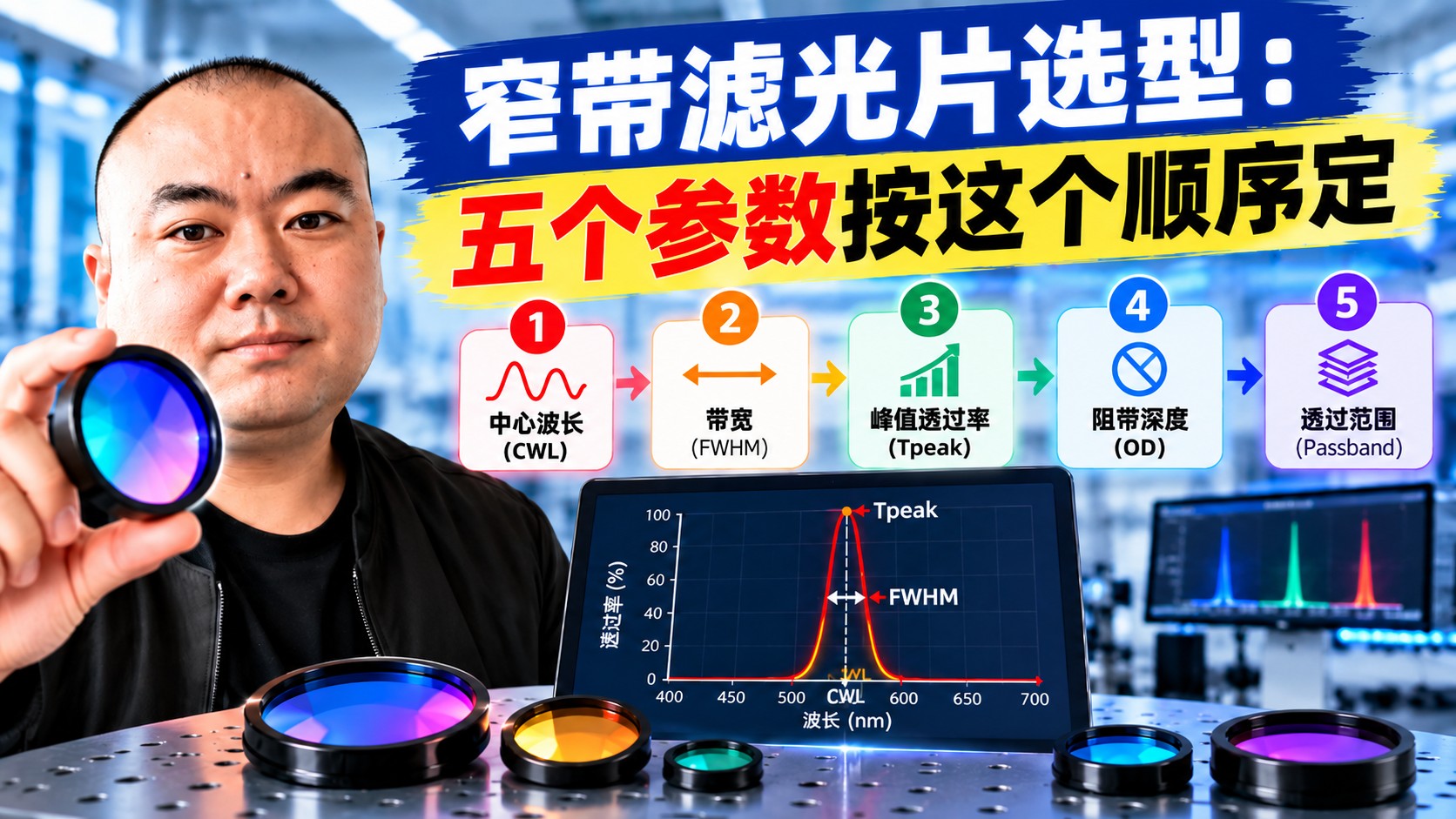
So every filter answers three questions: which wavelength passes, how wide is that band, and how deeply is the rest blocked. Those are the centre wavelength, the bandwidth and the blocking OD.
One thing people often confuse: there are two families. Absorptive filters rely on the material itself — cheap and tough, but with slow edges. Interference filters rely on thin-film interference — steep edges and deep blocking, but expensive and sensitive to angle.
Why angle? At oblique incidence the optical path shortens and the whole curve shifts blue. About one to two nanometres at ten degrees, more at larger angles. That is the most common reason a sample measures differently from the datasheet.
Finally, price. Two bandpass filters, one at tens of dollars and one at hundreds, usually differ in three things: how narrow the band is, how deep the blocking is, and whether the coating is hard or soft. Hard coatings survive wiping and humidity cycling; soft ones do not.
Next episode: how to specify a narrowband filter, with a checklist you can fill in directly.
This video has a full written version
What Is an Optical Filter? Principles, Types and Where to Start
 365nm Narrow Bandpass Filter | Ø50mm | T>90%
OT-HBP3659050
365nm Narrow Bandpass Filter; FWHM 10nm; transmission >90%; blocking OD5; size Ø50mm; AOI 0°.
 450nm Narrow Bandpass Filter | Ø50mm
OT-HBP4509050
450nm Narrow Bandpass Filter; FWHM 10nm; transmission >90%; blocking OD5; size Ø50mm; AOI 0°.
 525nm Narrow Bandpass Filter | Ø50mm
OT-HBP5259050
525nm Narrow Bandpass Filter; FWHM 10nm; transmission >90%; blocking OD5; size Ø50mm; AOI 0°.
Send us your drawing and spectral targets — an engineer replies with a feasibility check and quotation within one business day.