Original content by the OOTEE Optics editorial team, drawn from first-hand production line and inspection data. Please credit the source when republishing.
Given limits in expertise and test conditions, the theories, parameters and conclusions here carry no guarantee of absolute accuracy. For technical learning and exchange only - never the sole basis for design, acceptance or selection. Corrections welcome.
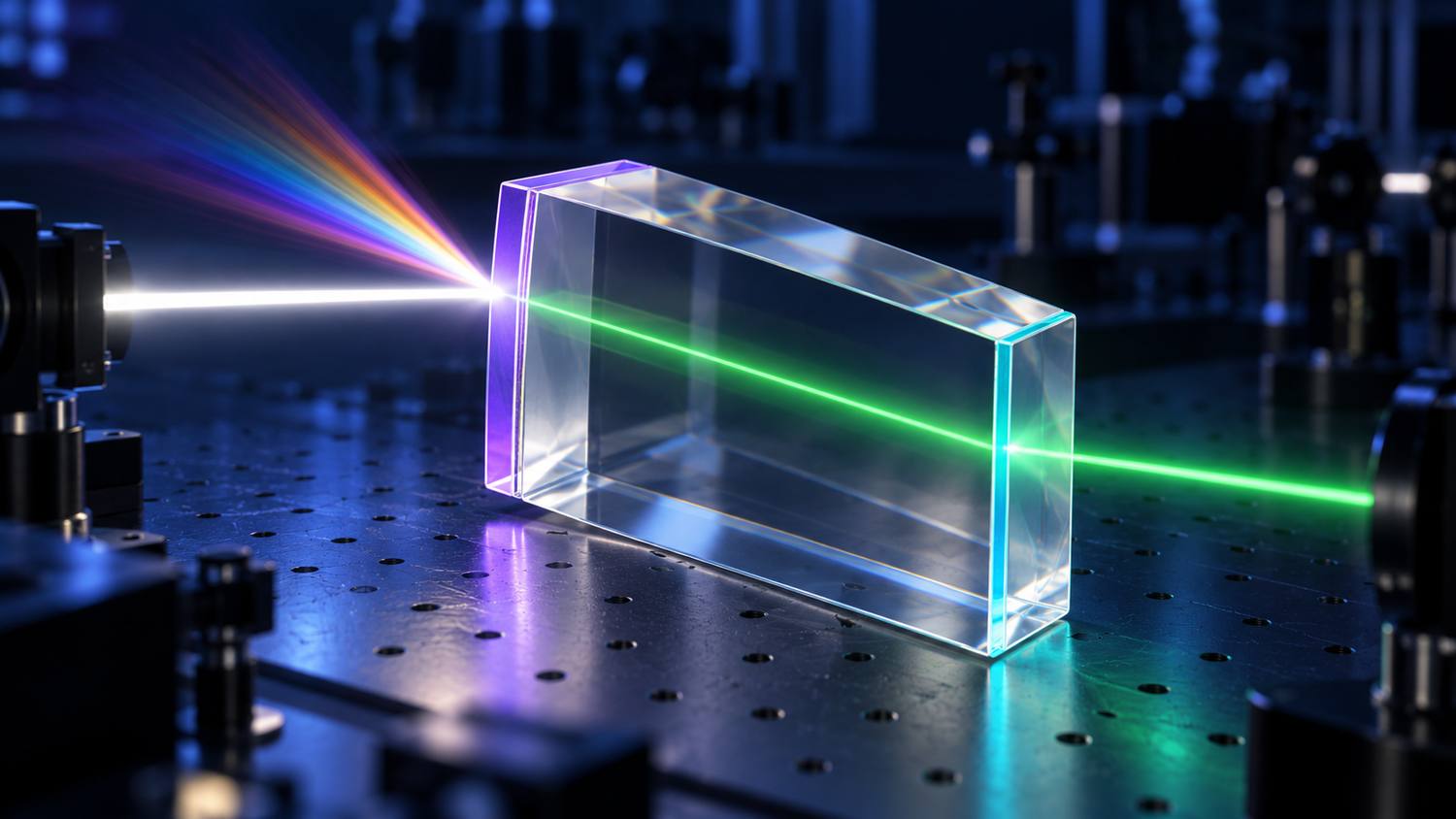
BK7 and K9 commonly appear in substrate specifications for visible bandpass filters. These low-dispersion crown glasses provide a polished, transparent platform for thin-film coatings. An uncoated plate transmits a broad visible range; the coating supplies the narrow spectral selection.
“BK7 or K9” is not a complete material specification. BK7 belongs to a particular designation system, while K9 is often used loosely in purchasing. The delivered grade may carry a fuller designation such as H-K9L. A published database lists H-K9L at $n_d=1.51680$ and $\nu_d=64.20$, with the d-line near 587.6 nm. Similar index and dispersion make grades candidates for substitution, but do not establish identical quality. Record the full grade, source and batch documentation.
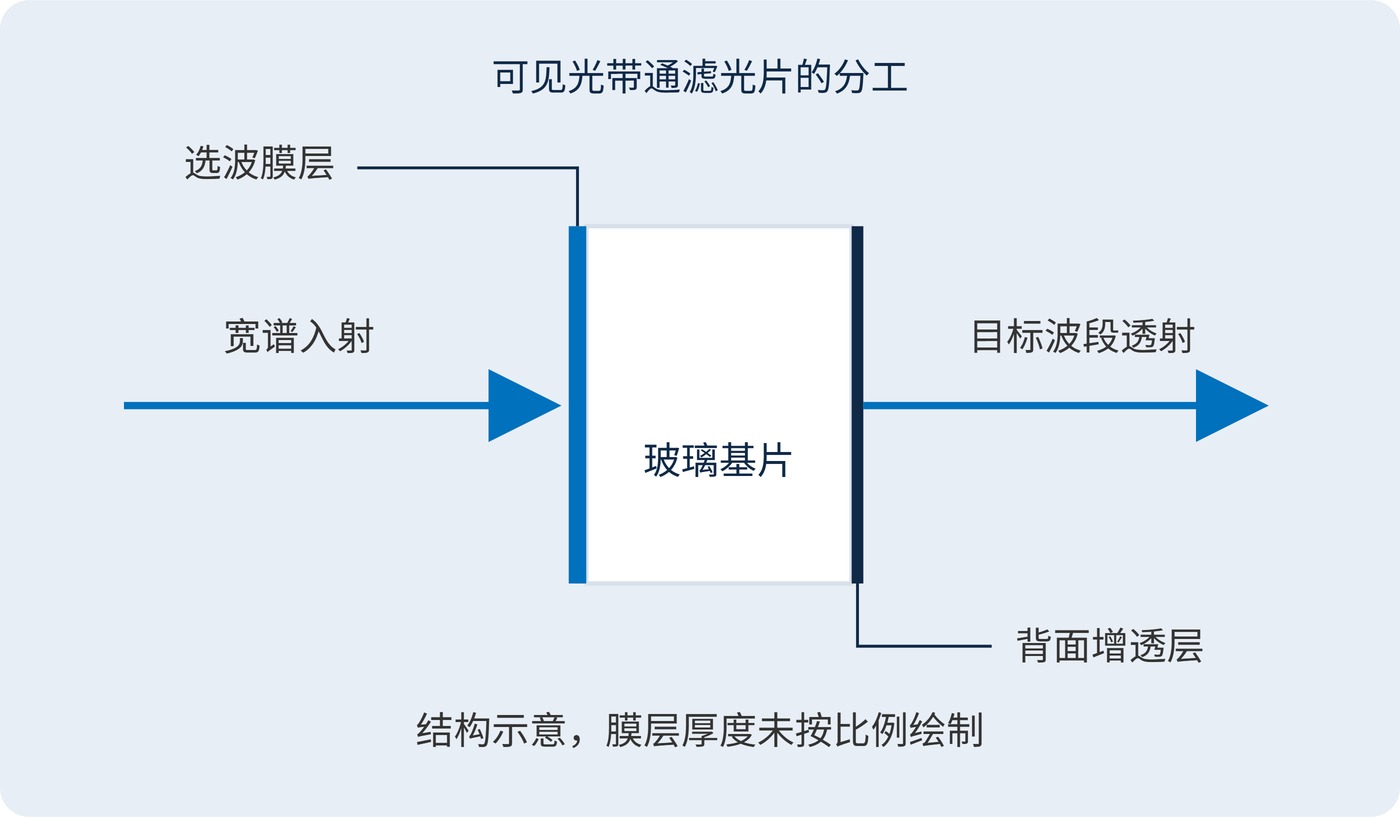
Fig. 1 separates the roles: glass supports the optical surfaces, and the coating selects wavelengths. Qualification must address the actual material and the finished filter. A transparent blank can be suitable for several different coating designs, but that flexibility is not a guarantee that every coating process will produce the same result on it.
Internal transmittance describes losses inside the glass. It excludes reflection at the surfaces. For an uncoated plate in air at normal incidence, single-surface reflectance is:
$$R=\left(\frac{n-1}{n+1}\right)^2$$
With $n=1.5168$, approximately 4.22% is reflected per surface. Neglecting absorption, scattering and repeated reflections, the directly transmitted beam carries $(1-R)^2$, or about 91.7%. Collecting all incoherent multiple transmitted beams raises the total to about 91.9%. Low bulk absorption does not mean an uncoated plate transmits more than 99%. Antireflection treatment reduces interface losses; the finished filter retains its coating-dependent spectrum.
Thickness also affects bulk loss. For homogeneous material, internal transmittance follows the expression below. The absorption coefficient $\alpha(\lambda)$ and optical path length $d$ require compatible units:
$$\tau_{\mathrm{i}}(\lambda,d)=\exp[-\alpha(\lambda)d]$$
Fig. 2 distinguishes internal transmission, surface treatment and finished performance. Center wavelength (CWL), full width at half maximum (FWHM), optical density (OD) and angle of incidence (AOI) belong in the coated-part specification. None follows from a BK7 label alone. Abbe number describes dispersion, rather than filter bandwidth.
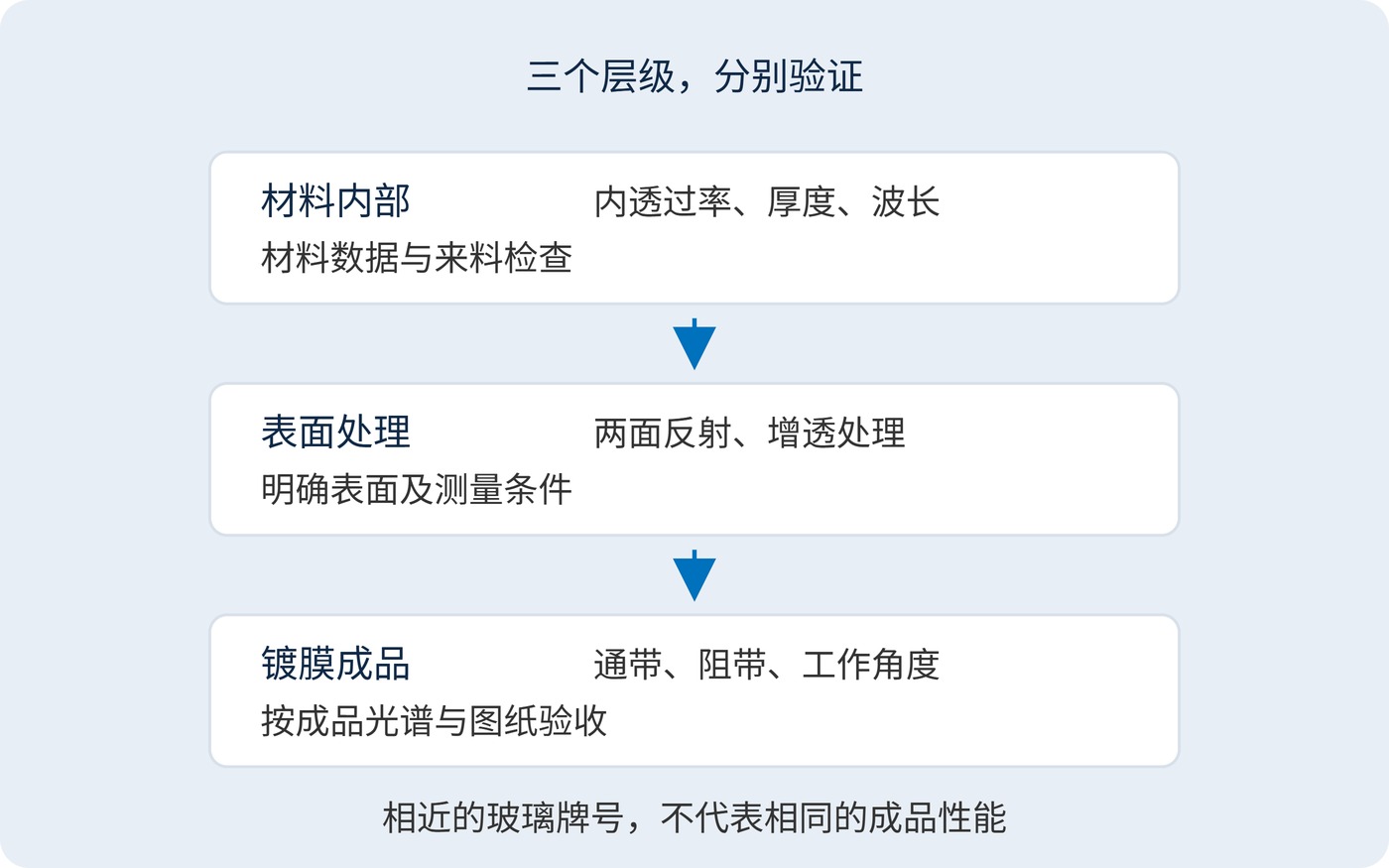
Start with operating wavelengths. These glasses are reasonable candidates for routine imaging between 450 and 650 nm. Near the ultraviolet edge, at longer path lengths, or in weak-signal instruments, review wavelength- and thickness-specific data. Test substrate fluorescence where the signal budget requires it.
| Item | Specify | Acceptance evidence |
|---|---|---|
| Material identity | Full grade, source and substitution conditions | Material and batch records |
| Bulk transmission | Internal transmittance at stated wavelengths and thickness | Catalog conditions and incoming measurements |
| Optics and fit | Thickness, clear aperture, surface figure and wedge tolerances | Drawing and dimensional inspection |
| Finished performance | Passband, blocking bands, AOI and environment | Measured coated-part spectrum |
An illustrative requirement is CWL 550 nm, FWHM 20 nm, peak transmission of at least 90%, and blocking of at least OD4 over 400–500 nm and 600–700 nm, at AOI 0°. This is an engineering example, not a product claim. Transition regions are outside the stated blocking bands. When changing substrates, compare finished parts under identical measurement conditions instead of accepting a cross-reference table as proof.
Green-light machine vision, visible LED spectral shaping and general analytical instruments can use BK7- or K9-type substrates. Their value lies in providing a transparent material that can be shaped, polished and coated. The coating determines the spectral function, while the substrate affects transmission loss, wavefront quality and mechanical stability.
A plate in a converging beam changes focus and belongs in the optical model. Weak fluorescence measurements require attention to excitation-dependent substrate background. High-power operation needs separate checks of absorption, thermal stress and coating damage; a glass designation supplies no power rating.
For procurement, preserve the measurement geometry when comparing samples. A certificate obtained with a collimated beam does not automatically describe performance across the angular cone of an imaging instrument. This distinction becomes especially useful when assessing a material change within an otherwise unchanged assembly.
Reference constants should come from the supplier data sheet for the specified grade, with test wavelength and thickness stated. Acceptance ultimately depends on transmission, blocking and wavefront performance at the specified thickness, beam geometry and operating conditions.
 365nm Narrow Bandpass Filter | Ø50mm | T>90%
OT-HBP3659050
365nm Narrow Bandpass Filter; FWHM 10nm; transmission >90%; blocking OD5; size Ø50mm; AOI 0°.
 450nm Narrow Bandpass Filter | Ø50mm
OT-HBP4509050
450nm Narrow Bandpass Filter; FWHM 10nm; transmission >90%; blocking OD5; size Ø50mm; AOI 0°.
 525nm Narrow Bandpass Filter | Ø50mm
OT-HBP5259050
525nm Narrow Bandpass Filter; FWHM 10nm; transmission >90%; blocking OD5; size Ø50mm; AOI 0°.
Send us your drawing and spectral targets — an engineer replies with a feasibility check and quotation within one business day.