Original content by the OOTEE Optics editorial team, drawn from first-hand production line and inspection data. Please credit the source when republishing.
Given limits in expertise and test conditions, the theories, parameters and conclusions here carry no guarantee of absolute accuracy. For technical learning and exchange only - never the sole basis for design, acceptance or selection. Corrections welcome.
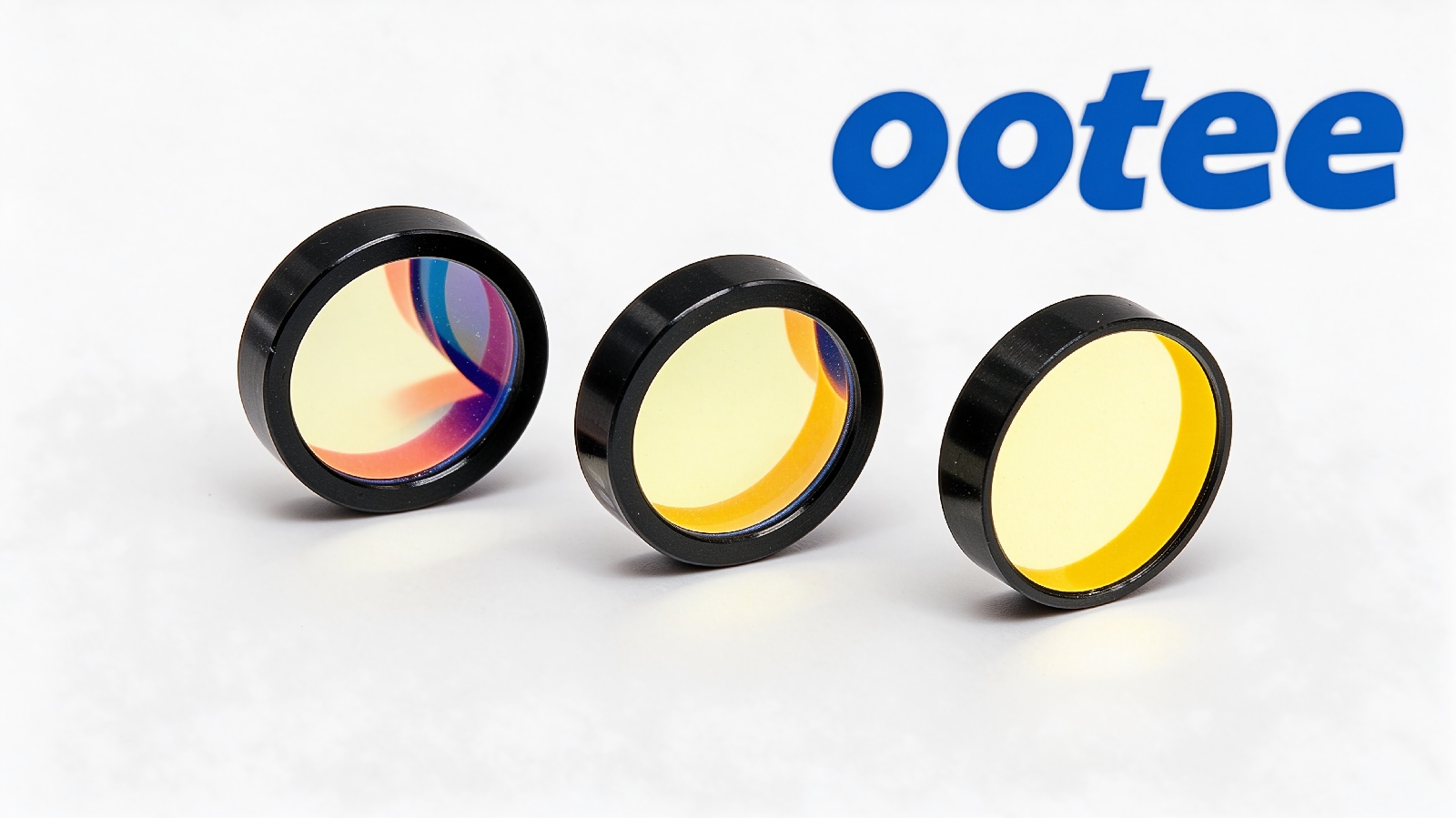
In fluorescence detection, LiDAR and biochemical analyzers, one optical component is nearly ubiquitous: the narrow bandpass filter. It transmits light only within an extremely narrow wavelength range and rejects almost everything else. This guide starts from the coating principle and then breaks down the four parameters that matter most.
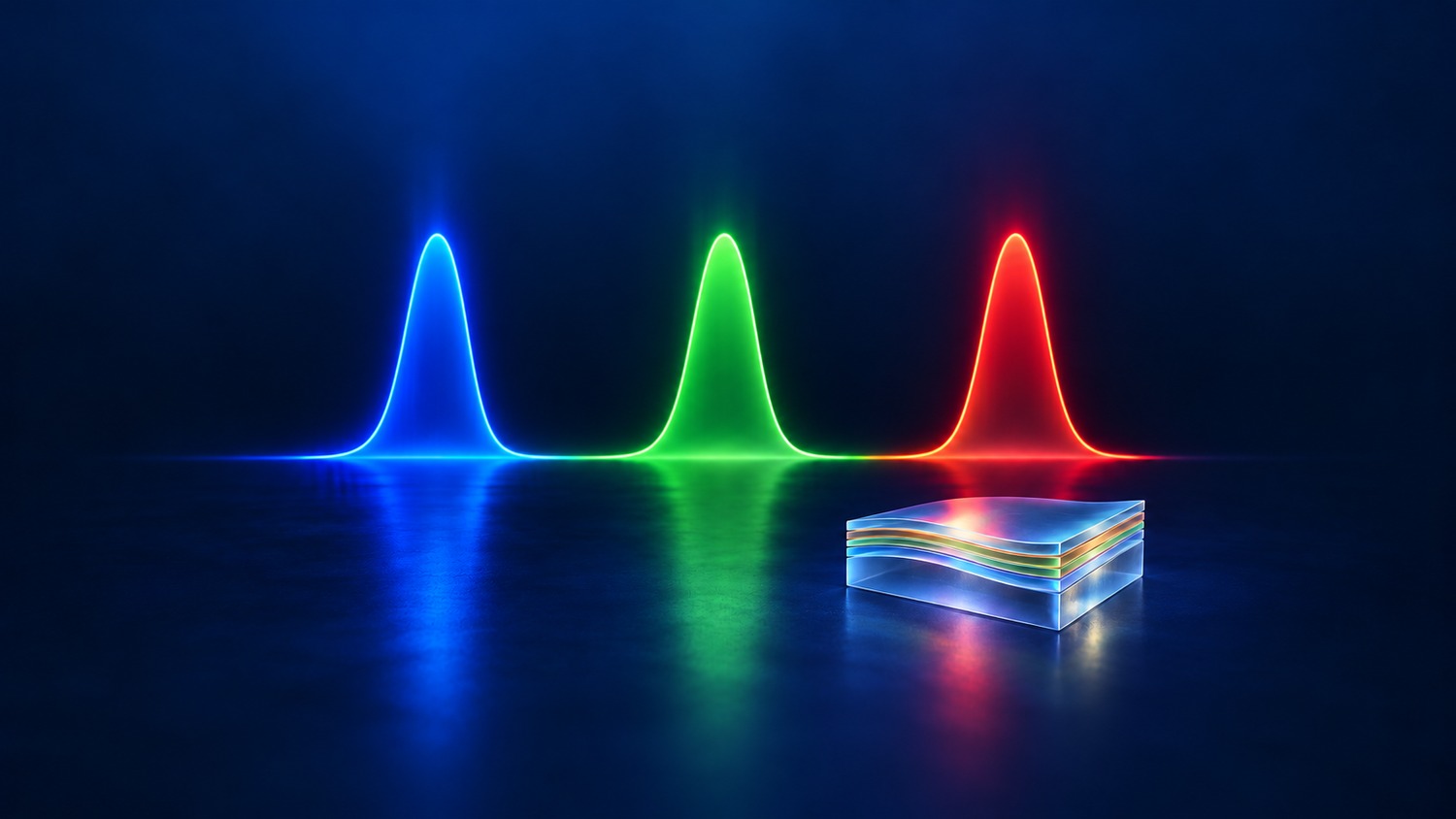
The heart of a narrow bandpass filter is a multilayer dielectric coating deposited on an optical substrate. Dozens — sometimes hundreds — of alternating high- and low-index layers are stacked, each thickness controlled to roughly a quarter of the target wavelength. Light reflected at each interface interferes: at the target wavelength the reflections add up in phase (constructive interference) and pass through; elsewhere they cancel out (destructive interference) and are reflected or absorbed.
By stacking several Fabry-Pérot resonant cavities, the passband becomes flatter and the edges steeper, producing a near-rectangular "flat-top, steep-edge" spectrum. That is the essential difference between a high-performance fluorescence filter and an ordinary bandpass filter.
The wavelength of peak transmission, or the midpoint of the full width at half maximum. It must match your signal wavelength: FITC emits at 520 nm, so you need a CWL of 520 nm. Typical tolerance is ±2 nm; demanding applications require ±1 nm. Our fluorescence bandpass filter series covers emission peaks from 340 nm to 1600 nm.
The wavelength span where transmission is at least half the peak. Narrower bandwidths reject stray light better but also reduce signal reaching the detector. A practical rule: choose a bandwidth 1.2–1.5× the FWHM of the emission peak — enough signal, with adjacent-channel crosstalk well suppressed. Standard products run 10–40 nm; precision multicolor systems use 1–3 nm.
Transmission at the top of the passband. Hard coatings made by ion-assisted deposition (IAD) reach T > 90%, and up to 95% in some bands. Every 5% of extra transmission produces a noticeable signal-to-noise gain in weak-signal detection.
Out-of-band rejection. OD6 means out-of-band transmission of only 10⁻⁶. Fluorescence detection typically needs OD5–OD6; LiDAR and other strong-background applications should specify OD6 or higher. For a deeper dive, see our OD value guide.
| Application | Bandwidth | Peak T | Cut-off |
|---|---|---|---|
| Fluorescence PCR / qPCR | 20–30 nm | ≥ 90% | OD5–OD6 |
| Flow cytometry channels | 10–25 nm | ≥ 93% | OD6 |
| LiDAR receiver | 1–5 nm | ≥ 85% | OD6+ |
| Biochemical analyzer | 8–15 nm | ≥ 90% | OD5 |
Blocking range: many vendors quote OD6 but only guarantee it from 200–1100 nm. If your system has stray light above 1200 nm, confirm wide-range blocking separately. Angle of incidence: the spectrum shifts toward shorter wavelengths as the incidence angle grows — a filter designed for 0° can blue-shift by 5–10 nm at 15°. Tell us up front if your optical path is not normal incidence.
OOTEE Optics has mature coating design and volume delivery experience with PCR fluorescence filters and fluorescence bandpass filters, with full customization of CWL, bandwidth, cut-off depth and substrate size. Contact our engineering team for selection support.
 365nm Narrow Bandpass Filter | Ø50mm | T>90%
OT-HBP3659050
365nm Narrow Bandpass Filter; FWHM 10nm; transmission >90%; blocking OD5; size Ø50mm; AOI 0°.
 450nm Narrow Bandpass Filter | Ø50mm
OT-HBP4509050
450nm Narrow Bandpass Filter; FWHM 10nm; transmission >90%; blocking OD5; size Ø50mm; AOI 0°.
 525nm Narrow Bandpass Filter | Ø50mm
OT-HBP5259050
525nm Narrow Bandpass Filter; FWHM 10nm; transmission >90%; blocking OD5; size Ø50mm; AOI 0°.
Send us your drawing and spectral targets — an engineer replies with a feasibility check and quotation within one business day.