Original content by the OOTEE Optics editorial team, drawn from first-hand production line and inspection data. Please credit the source when republishing.
Given limits in expertise and test conditions, the theories, parameters and conclusions here carry no guarantee of absolute accuracy. For technical learning and exchange only - never the sole basis for design, acceptance or selection. Corrections welcome.
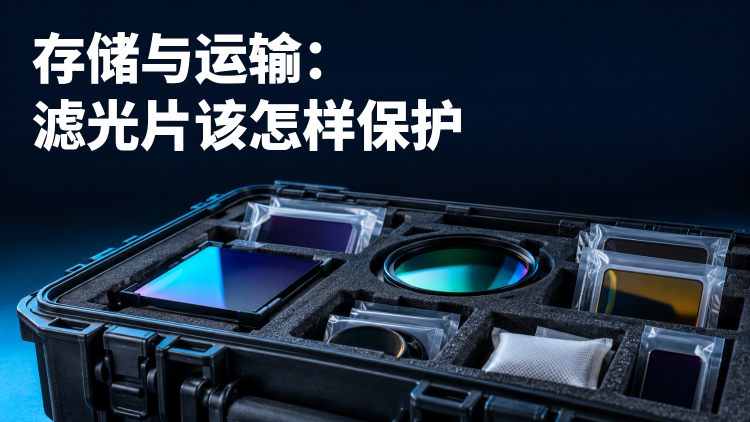
Protection keeps an optical filter’s surfaces and edges intact between inspection and installation. A hard glass substrate still has vulnerable edges, while small movements inside a bag can drag trapped particles across a coating. Effective packaging therefore combines individual isolation, controlled movement and moisture protection.
For common glass-based filters, 15–25 °C and 30–50% relative humidity (RH) are reasonable starting targets for warehouse management, rather than universal product ratings. Keep conditions stable and log excursions. Coatings, bonded assemblies and moisture-sensitive substrates may require different limits; follow the specified storage temperature range, including any separate transport restrictions.
Condensation becomes possible when a cold surface is below the dew point of the surrounding air. Near room temperature, the following approximation is useful. Enter $T$ and $T_d$ as numerical values in °C and relative humidity $r$ as a fraction; the coefficients apply to ordinary indoor conditions over liquid water.
$$\gamma=\ln r+\frac{17.62T}{243.12+T},\qquad T_d=\frac{243.12\gamma}{17.62-\gamma}$$
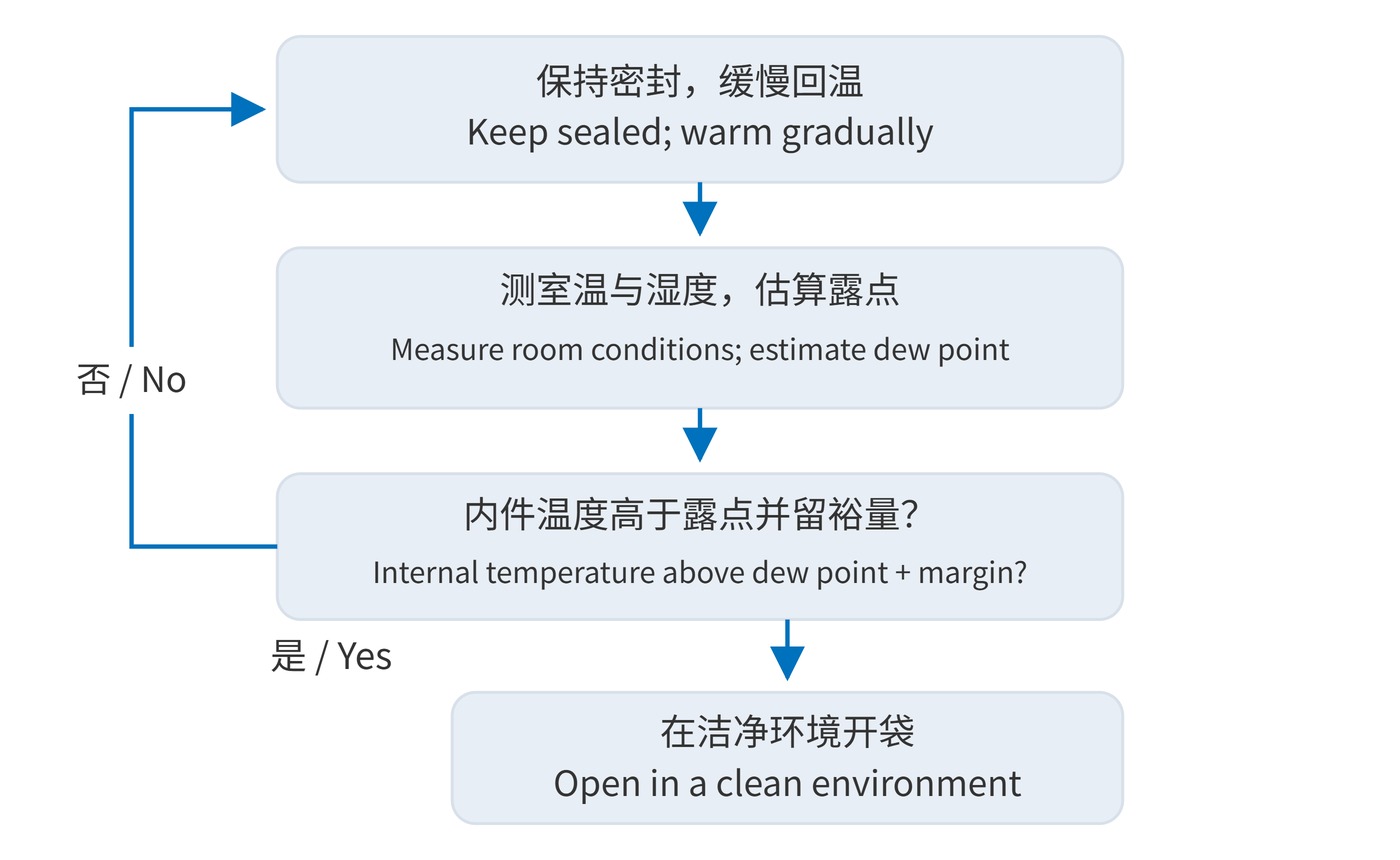
At 25 °C and 60% RH, the dew point is approximately 16.7 °C. Opening a package containing a filter at 10 °C exposes it to condensation risk. Leave the inner bag sealed while it warms in the receiving room. As Fig. 2 shows, opening depends on a representative internal temperature exceeding the room dew point with a margin. A fixed 2-hour wait is insufficient as a general rule: insulation and package mass change the warming time.
Cushioning increases the distance over which an item decelerates. For an internal mass $m$ stopping from speed $v$ over an effective distance $s$, a simplified average resisting force is:
$$F_{\mathrm{avg}}\approx\frac{mv^2}{2s}$$
This estimate neglects rebound and cannot qualify a package for a drop test. Peak force also depends on stiffness, usable compression and orientation. Thin, rigid or fully compressed cushioning provides little stopping distance. Carton strength and internal shock protection need separate consideration.
Fig. 1 shows a conventional contact package: rigid box, cushioning, clean bag, optical-grade lint-free tissue and filter. The tissue must be low shedding, free of abrasive particles and approved for contact with the coating. Lay it loosely rather than pulling it tight. For contact-sensitive surfaces, use an edge-supported holder that leaves the optical faces clear.
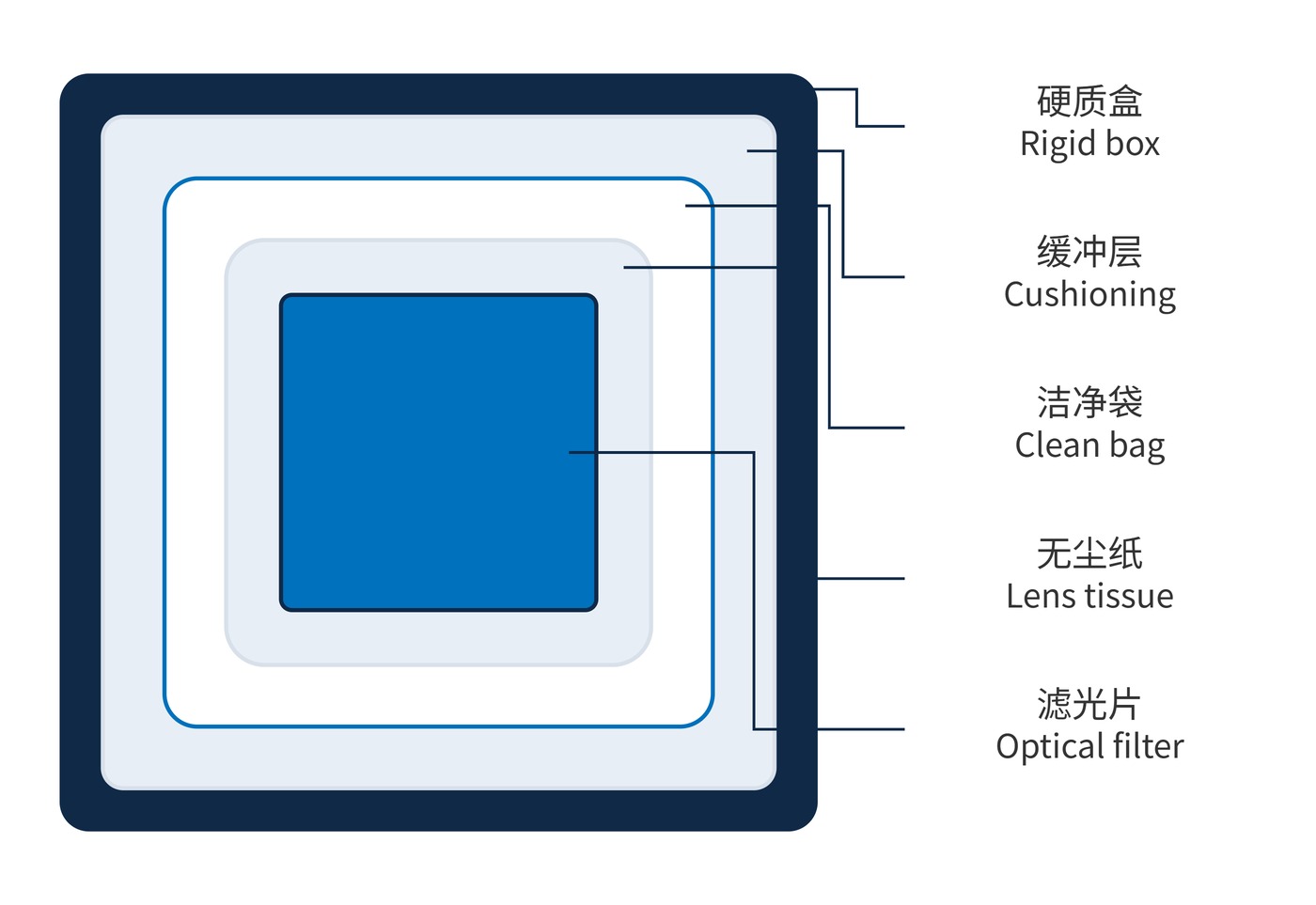
Cushion the bagged part or its holder and restrain sideways movement without point loads on the optical faces. A clean bag provides isolation; long-term humidity control also requires suitable water-vapour barrier performance and a sound seal. An ordinary resealable bag is not automatically a long-term moisture barrier. Keep tape, bubble wrap and exposed foam away from coatings.
Secure an intact, low-dust desiccant sachet inside the sealed moisture-barrier space, separated from the filter and tissue. Size its capacity for bag area, permeability, initial moisture and storage duration, rather than filter count alone. Read humidity indicators according to their instructions. A failed indicator or damaged seal calls for assessment and appropriate repackaging.
Use suitable clean gloves or finger cots and hold only the edges. Soft-tipped tools still require an approved edge contact area. Give each filter its own compartment. Route stacking loads through box walls or structural dividers; prevent both loose movement and excessive compression when closing the box. Basic guidance on edge handling, individual tissue wrapping and controlled, low-humidity storage is available in these optical-component handling procedures.
For laboratory spares, label individually boxed, sealed filters with identification, packing date, environmental targets and inspection history. Retain baseline inspection data for critical spares such as narrow bandpass filters. Later comparisons require equivalent measurement conditions; coating colour alone does not establish performance.
For shipments crossing temperature zones, retain qualified original packaging where practical. Use validated cushioning between inner boxes and the outer carton, secure every inner box, and separate heavy items from thin filters. Temperature, humidity or shock loggers can support acceptance decisions, but their location matters: carton readings do not directly describe the glass surface.
A practical initial schedule is an external package, seal and indicator check every 3 months, with controlled opening and inspection every 6–12 months. Adjust this management schedule to risk; it is not a shelf-life guarantee. Before using critical parts, check edges, surfaces and specified spectral properties. A drop, humidity warning or environmental excursion requires immediate segregation and assessment.
Record each inspection against the individual part or batch. When opening is necessary, prepare replacement packing materials first and keep exposure brief. After inspection, restore the specified dry environment, replace exhausted desiccant and record the new sealing date. Frequent opening itself introduces moisture, so external checks should inform whether a controlled internal examination is warranted.
 365nm Narrow Bandpass Filter | Ø50mm | T>90%
OT-HBP3659050
365nm Narrow Bandpass Filter; FWHM 10nm; transmission >90%; blocking OD5; size Ø50mm; AOI 0°.
 450nm Narrow Bandpass Filter | Ø50mm
OT-HBP4509050
450nm Narrow Bandpass Filter; FWHM 10nm; transmission >90%; blocking OD5; size Ø50mm; AOI 0°.
 525nm Narrow Bandpass Filter | Ø50mm
OT-HBP5259050
525nm Narrow Bandpass Filter; FWHM 10nm; transmission >90%; blocking OD5; size Ø50mm; AOI 0°.
Send us your drawing and spectral targets — an engineer replies with a feasibility check and quotation within one business day.