Original content by the OOTEE Optics editorial team, drawn from first-hand production line and inspection data. Please credit the source when republishing.
Given limits in expertise and test conditions, the theories, parameters and conclusions here carry no guarantee of absolute accuracy. For technical learning and exchange only - never the sole basis for design, acceptance or selection. Corrections welcome.

Mold is biological contamination: airborne spores germinate and form branching hyphae on an optical surface. Fingerprint oils, organic dust, packaging debris and adhesive residues can supply nutrients. An inorganic dielectric coating is not, by itself, food. Moisture, contamination and time determine whether growth develops; darkness is not essential.
A white mark is not a diagnosis. Salt crystals, dried droplets and coating deterioration can resemble fungal spots. Record the pattern and storage history before choosing a cleaning method.
Relative humidity (RH) compares water-vapor pressure with saturation pressure at the same temperature:
$$\mathrm{RH}=\frac{p_{\mathrm{v}}}{p_{\mathrm{sat}}(T)}\times100\%$$
A cabinet sensor does not necessarily describe the filter surface. A cold filter entering warm, humid air can collect condensation. Hygroscopic salts and fingerprints can also sustain local moisture. Log temperature and RH near the stored parts rather than relying on a single reading taken when the door opens.
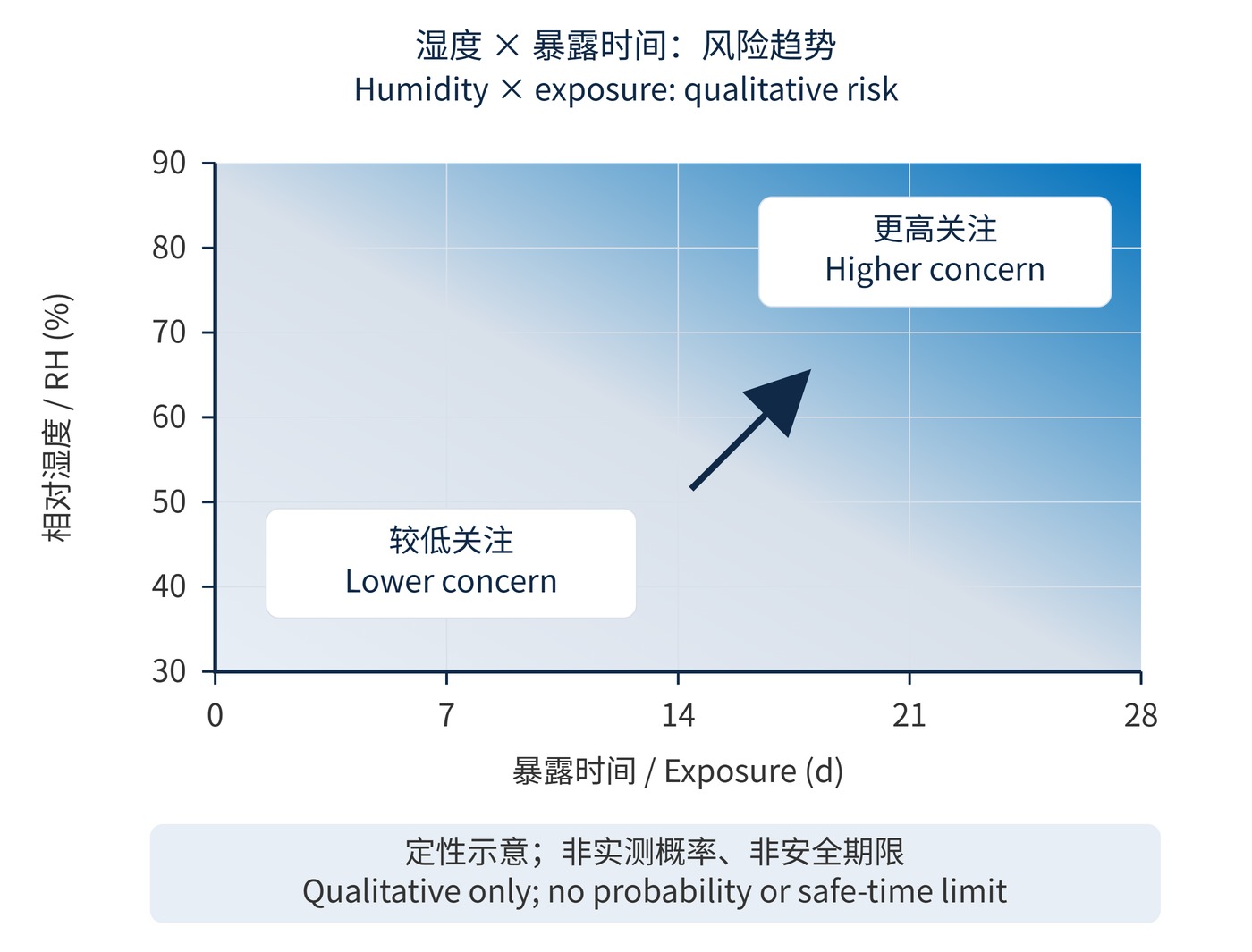
Fig. 1 illustrates the combined effects of sustained humidity and exposure. The Canadian Conservation Institute's mold prevention guidance reports visible growth after 2 weeks to 3 months at 75% RH in the material studies discussed. Those results are not a coating lifetime specification. Species, nutrients and temperature prevent a universal safe exposure time.
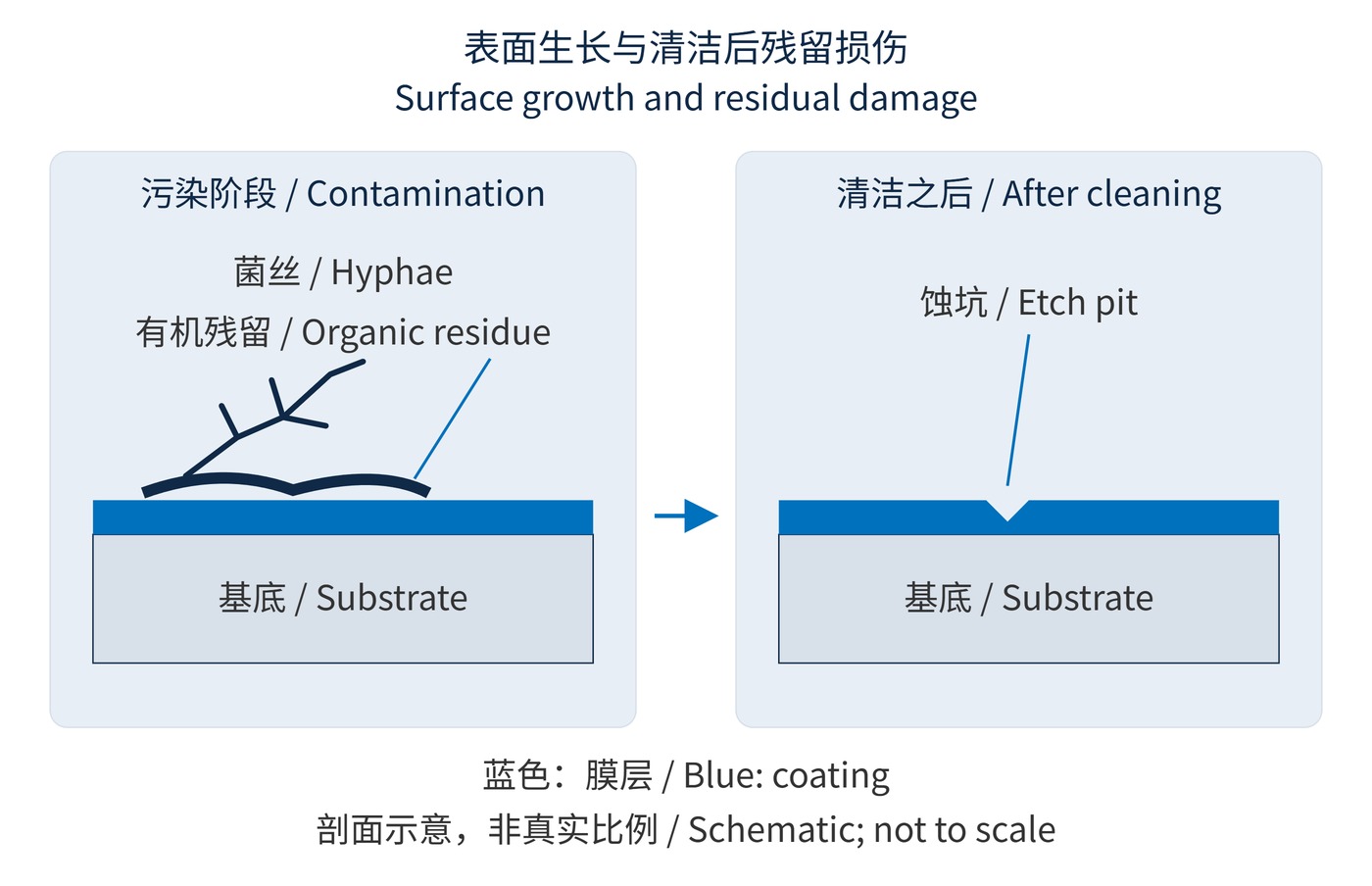
Hyphae and residues scatter light and reduce contrast. Acidic metabolites can alter the local chemistry and attack susceptible coatings or glass. The outcome depends on materials and contact conditions; one specific acid should not be assumed for every organism. As Fig. 2 shows, removing growth may leave permanent pits or coating loss.
A practical management target for clean storage at room temperature is 35%–50% RH, with investigation triggered by sustained readings of 60% RH. These are conservative operating values, not biological thresholds. Follow supplier limits for bonded assemblies, special substrates and packaging. Humidity-induced wavelength drift is a separate failure mechanism.
Specify storage conditions, permitted cleaning agents and reinspection criteria together. Review coating durability when establishing material compatibility. Desiccant removes moisture, not oil or existing etch damage.
Base the service interval on the actual package and access pattern. A sachet inside a frequently opened container faces a different moisture load from one inside a sealed barrier pouch. Neither the number of sachets nor a cabinet setpoint establishes the humidity experienced by the optic. Check the recorded conditions after changes to packaging or storage practice.
Idle machine-vision equipment, spare laboratory filters and coastal instruments need attention during downtime. Isolate suspect parts, photograph the marks and inspect holders, inserts and neighboring optics. Avoid dry brushing or dispersing residues in a clean area.
Surface-only contamination may be removable using a coating-approved process. Unknown coatings, bonded edges and lifting films require specialist assessment. Avoid improvised bleach, strong acids or alkalis, soaking and repeated dry wiping. After cleaning, inspect the clear aperture for pits, scatter and coating changes, then repeat spectral measurements under matching conditions.
Consider a filter with center wavelength (CWL) 780 nm, full width at half maximum (FWHM) 20 nm and angle of incidence (AOI) 0°. Optical density (OD) must also be checked over the specified blocking range:
$$\mathrm{OD}(\lambda)=-\log_{10}\!\left(\frac{I_{\mathrm{out}}(\lambda)}{I_{\mathrm{in}}(\lambda)}\right)$$
OD6 means a transmitted fraction of $10^{-6}$, or 0.0001%. Verification requires sufficient instrument dynamic range and stray-light control. A clear-looking passband does not establish blocking performance. Reject or replace parts with unacceptable pits, delamination or spectral deviations.
For an imaging assembly, also evaluate contrast or scatter in its working geometry. Localized damage may affect an illuminated region differently from a full-aperture transmission measurement. Retain the inspection images and measurement conditions so that a reuse decision can be traced to the application's acceptance limits.
| Assumption | Better assessment |
|---|---|
| Every white deposit is mold | Salt fog can leave angular crystals or drying rings; fungal growth often branches. Morphology is a clue, with microscopy or composition analysis used when needed. |
| Dissolving in water proves it is salt | Do not test a finished optic with a droplet. Water can spread salts into bonded edges, and solubility alone does not identify a deposit. |
| Drying or ultraviolet exposure repairs damage | Inactivation leaves residues and pits. Additional light and heat can also damage adhesives or coatings. |
| A dry cabinet guarantees prevention | Check power loss, door opening, damp incoming packaging and sensor error. Judge condition using records, inspection and optical requalification together. |
 365nm Narrow Bandpass Filter | Ø50mm | T>90%
OT-HBP3659050
365nm Narrow Bandpass Filter; FWHM 10nm; transmission >90%; blocking OD5; size Ø50mm; AOI 0°.
 450nm Narrow Bandpass Filter | Ø50mm
OT-HBP4509050
450nm Narrow Bandpass Filter; FWHM 10nm; transmission >90%; blocking OD5; size Ø50mm; AOI 0°.
 525nm Narrow Bandpass Filter | Ø50mm
OT-HBP5259050
525nm Narrow Bandpass Filter; FWHM 10nm; transmission >90%; blocking OD5; size Ø50mm; AOI 0°.
Send us your drawing and spectral targets — an engineer replies with a feasibility check and quotation within one business day.