Original content by the OOTEE Optics editorial team, drawn from first-hand production line and inspection data. Please credit the source when republishing.
Given limits in expertise and test conditions, the theories, parameters and conclusions here carry no guarantee of absolute accuracy. For technical learning and exchange only - never the sole basis for design, acceptance or selection. Corrections welcome.
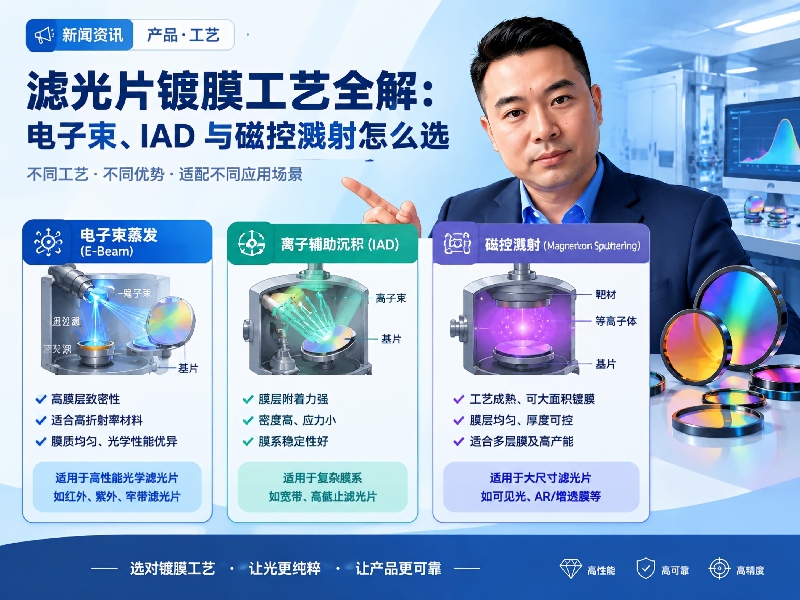
A filter's theoretical performance comes from the coating design, but whether it can be manufactured — and how long it stays on spec — depends on the deposition process. The same design, deposited two different ways, gives two different curves.
Bare glass reflects about 4% and selects nothing. Stack alternating high- and low-index materials at roughly a quarter-wave optical thickness and reflections from each interface interfere: the target wavelength adds in phase and passes, everything else cancels out. A high-performance narrowband filter often carries 50–150 layers, several micrometres thick.
| Process | Density | Wavelength drift | Best for | Cost |
|---|---|---|---|---|
| E-beam evaporation | Low, columnar and porous | Larger, moisture dependent | General bandpass, cost-sensitive work | Low |
| Ion-assisted deposition (IAD) | High, close to bulk | Small | Fluorescence filters, precision optics | Medium |
| Magnetron sputtering | Very high, uniform | Very small | Volume hard-coated filters | Medium-high |
Ion beam sputtering gives the lowest loss but is slow and expensive; it belongs to laser mirrors, not routine filters.

Hard coatings from IAD or sputtering survive wiping, adhesion tests and humidity cycling. Soft e-beam coatings do not. The difference shows up in wavelength stability (soft coatings drift a few nm as they absorb moisture), cleanability, and whether the part passes automotive or medical environmental testing.
Dozens of layers can accumulate several hundred MPa of stress. On thin or large substrates that bends the part — a λ/10 surface can become λ/2 after coating. Compensate in the design by balancing tensile and compressive materials, anneal after deposition, or thicken the substrate. If wavefront matters, say so at the quotation stage.
Put all three into the purchase specification rather than writing "to sample". It saves both sides a lot of arguing later.
 365nm Narrow Bandpass Filter | Ø50mm | T>90%
OT-HBP3659050
365nm Narrow Bandpass Filter; FWHM 10nm; transmission >90%; blocking OD5; size Ø50mm; AOI 0°.
 450nm Narrow Bandpass Filter | Ø50mm
OT-HBP4509050
450nm Narrow Bandpass Filter; FWHM 10nm; transmission >90%; blocking OD5; size Ø50mm; AOI 0°.
 525nm Narrow Bandpass Filter | Ø50mm
OT-HBP5259050
525nm Narrow Bandpass Filter; FWHM 10nm; transmission >90%; blocking OD5; size Ø50mm; AOI 0°.
Send us your drawing and spectral targets — an engineer replies with a feasibility check and quotation within one business day.