Original content by the OOTEE Optics editorial team, drawn from first-hand production line and inspection data. Please credit the source when republishing.
Given limits in expertise and test conditions, the theories, parameters and conclusions here carry no guarantee of absolute accuracy. For technical learning and exchange only - never the sole basis for design, acceptance or selection. Corrections welcome.
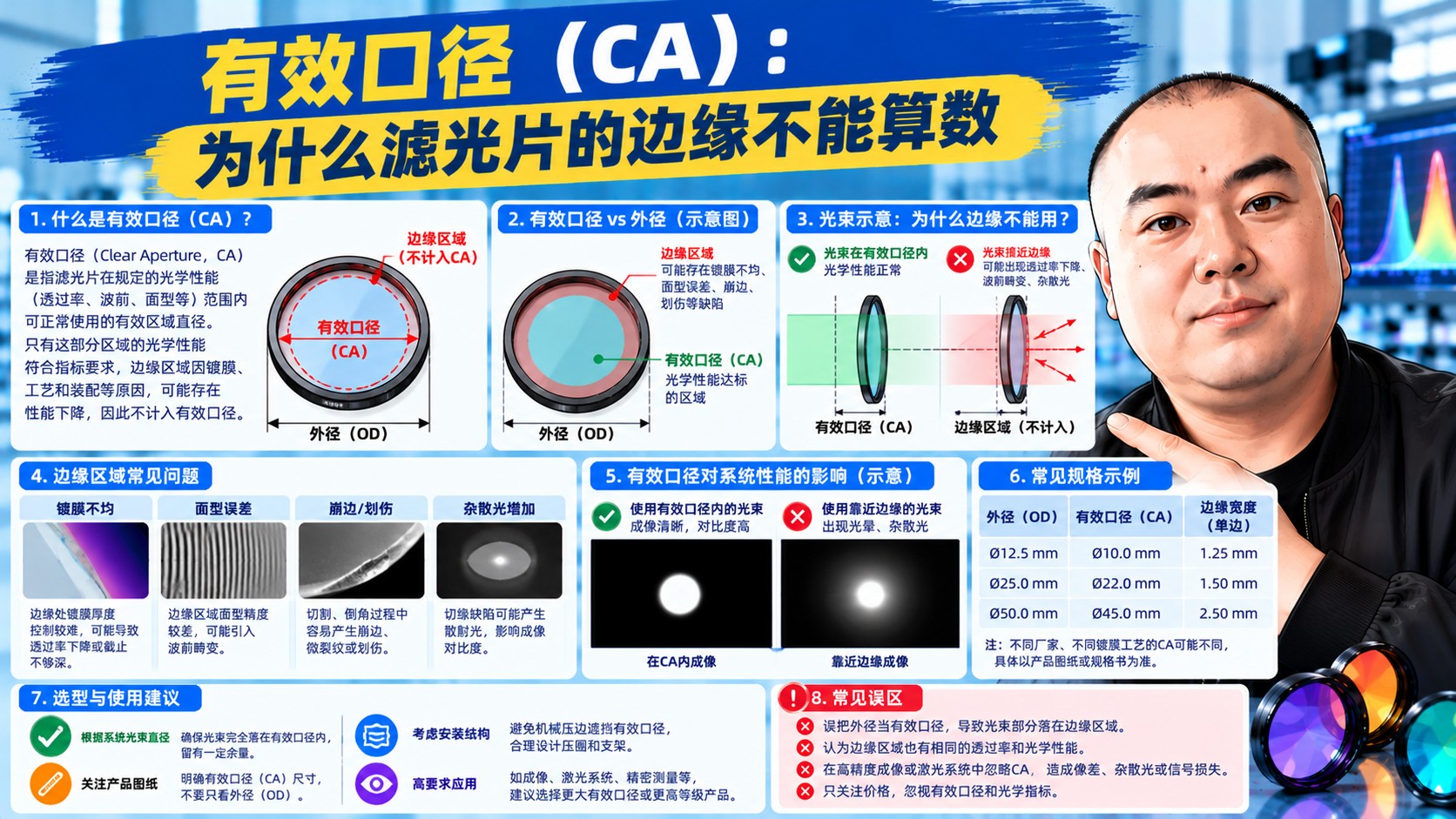
Clear aperture (CA) is the region over which the optical performance is guaranteed, given in mm (central 22 mm diameter, for example) or as a percentage of the outer dimension (CA at least 90%).
In other words: outer size decides whether it fits; CA decides whether it works. Two 25 mm filters, one at CA 95% and one at CA 70%, differ by nearly a factor of two in usable area - and in price.
Four causes, almost all unavoidable in production:
| Notation | Meaning | Character |
|---|---|---|
| CA at least 90% | Central 90% guaranteed | Most common; a 1-2 mm rim allowance |
| CA at least 80% | 2-3 mm rim not guaranteed | Low-cost route, or very large parts |
| Central 22 mm (on 25 mm) | Absolute value | Exact, easy to check against a design |
| Full aperture (CA 100%) | Whole part guaranteed | Needs special process; clearly more expensive |
Caution: "CA at least 90%" is not consistently defined as diameter or area. Most makers mean 90% of the diameter (central 22.5 mm on a 25 mm part), some mean area. Write the absolute dimension to avoid arguments.
A simple rule: beam diameter no larger than CA minus twice the alignment tolerance. Example:
Do not forget beam divergence: a converging or diverging beam changes diameter at the filter, so size it for the largest cross-section.
"25 mm diameter, CA at least central 22 mm; mounting: retainer covers 1.5 mm of the rim."
Stating the mounting coverage tells the maker what you really need, and they may recommend a larger outer size.
Want your CA checked? Send beam diameter, alignment tolerance and mounting method to sales@ootee.cn and we will size it for you.
 365nm Narrow Bandpass Filter | Ø50mm | T>90%
OT-HBP3659050
365nm Narrow Bandpass Filter; FWHM 10nm; transmission >90%; blocking OD5; size Ø50mm; AOI 0°.
 450nm Narrow Bandpass Filter | Ø50mm
OT-HBP4509050
450nm Narrow Bandpass Filter; FWHM 10nm; transmission >90%; blocking OD5; size Ø50mm; AOI 0°.
 525nm Narrow Bandpass Filter | Ø50mm
OT-HBP5259050
525nm Narrow Bandpass Filter; FWHM 10nm; transmission >90%; blocking OD5; size Ø50mm; AOI 0°.
Send us your drawing and spectral targets — an engineer replies with a feasibility check and quotation within one business day.