Original content by the OOTEE Optics editorial team, drawn from first-hand production line and inspection data. Please credit the source when republishing.
Given limits in expertise and test conditions, the theories, parameters and conclusions here carry no guarantee of absolute accuracy. For technical learning and exchange only - never the sole basis for design, acceptance or selection. Corrections welcome.
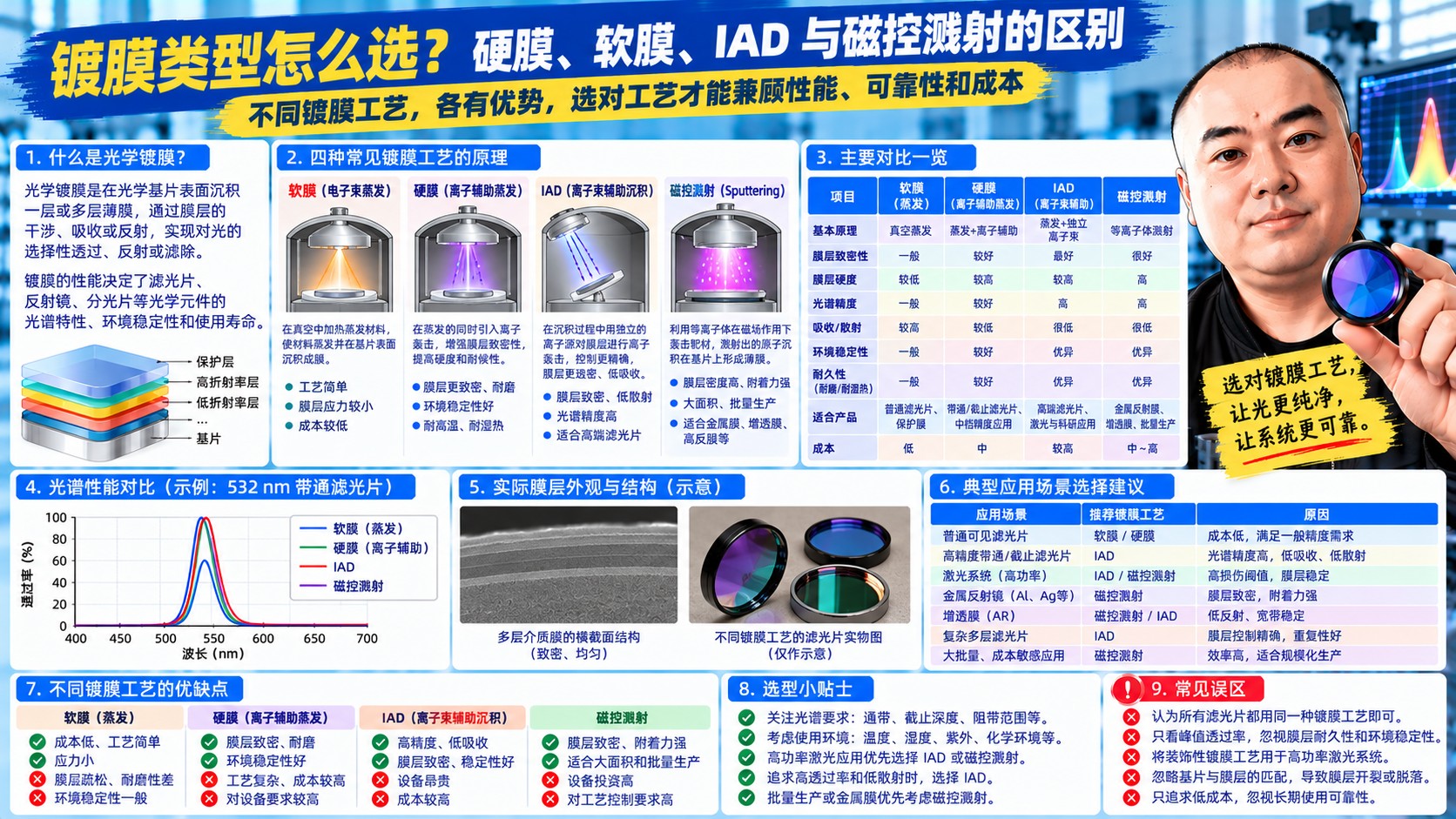
Nine tenths of a filter's performance comes from the coating, and most of that comes from the deposition process. Two parts both labelled "532 nm narrowband, OD4" can differ severalfold in stability, lifetime and price depending on how they were made.
| Process | Principle | Film character | Typical use |
|---|---|---|---|
| Thermal evaporation (soft) | Heat the material in vacuum until it evaporates and condenses | Porous columnar structure with voids; absorbs water | Decorative films, low-cost filters, general lighting |
| Ion-assisted deposition (IAD) | Bombard the substrate with an ion beam during evaporation | Much denser, harder and more stable | Industrial filters, fluorescence filters, machine vision |
| Magnetron sputtering (MS) | Ions knock atoms off a target, which deposit on the substrate | Densest and most repeatable; stress controllable | High-end narrowband, laser coatings, telecom |
| Ion beam sputtering (IBS) | A separate ion source sputters the target | Ultra-low loss, outstanding stability | Ultra-low-loss laser mirrors, precision metrology |
| Atomic layer deposition (ALD) | Growth one atomic layer at a time | Pinhole free, perfectly conformal | Complex shapes, special barrier layers |
In thermal evaporation the arriving atoms carry little energy and pile up like snowfall into a columnar structure full of nanoscale voids. Those voids:
IAD and sputtering deliver far more energy to the arriving atoms, compacting the film and closing the voids, which fixes all three issues at once.
A useful discriminator: ask how far the center wavelength drifts with humidity.
For bandwidths above 10 nm that drift may not matter; at 1-3 nm a soft-coated part is simply unusable.
| Need | Recommended process | Why |
|---|---|---|
| Cost first, mild environment, wide band | Thermal evaporation | Cheapest, performance adequate |
| Industrial or outdoor duty, stability needed | IAD hard coating | The best value mainstream choice |
| Narrowband (5 nm or less), fluorescence, lasers | IAD or sputtering | Stable wavelength, deep blocking, repeatable |
| High power lasers, ultra narrow, telecom | IBS or magnetron sputtering | Lowest loss, best stability |
If you are unsure which process to name, specify the result, not the process:
"IAD or equivalent hard coating; center wavelength shift no more than 0.5 nm between 23 C/45% RH and 40 C/90% RH; pass 48 hour damp heat test."
Verifiable requirements beat process names and leave the supplier room to optimize. For process detail see the complete guide to optical coating processes.
Need a process and cost comparison? Send band, bandwidth, environment and quantity to sales@ootee.cn.
 365nm Narrow Bandpass Filter | Ø50mm | T>90%
OT-HBP3659050
365nm Narrow Bandpass Filter; FWHM 10nm; transmission >90%; blocking OD5; size Ø50mm; AOI 0°.
 450nm Narrow Bandpass Filter | Ø50mm
OT-HBP4509050
450nm Narrow Bandpass Filter; FWHM 10nm; transmission >90%; blocking OD5; size Ø50mm; AOI 0°.
 525nm Narrow Bandpass Filter | Ø50mm
OT-HBP5259050
525nm Narrow Bandpass Filter; FWHM 10nm; transmission >90%; blocking OD5; size Ø50mm; AOI 0°.
Send us your drawing and spectral targets — an engineer replies with a feasibility check and quotation within one business day.