Original content by the OOTEE Optics editorial team, drawn from first-hand production line and inspection data. Please credit the source when republishing.
Given limits in expertise and test conditions, the theories, parameters and conclusions here carry no guarantee of absolute accuracy. For technical learning and exchange only - never the sole basis for design, acceptance or selection. Corrections welcome.
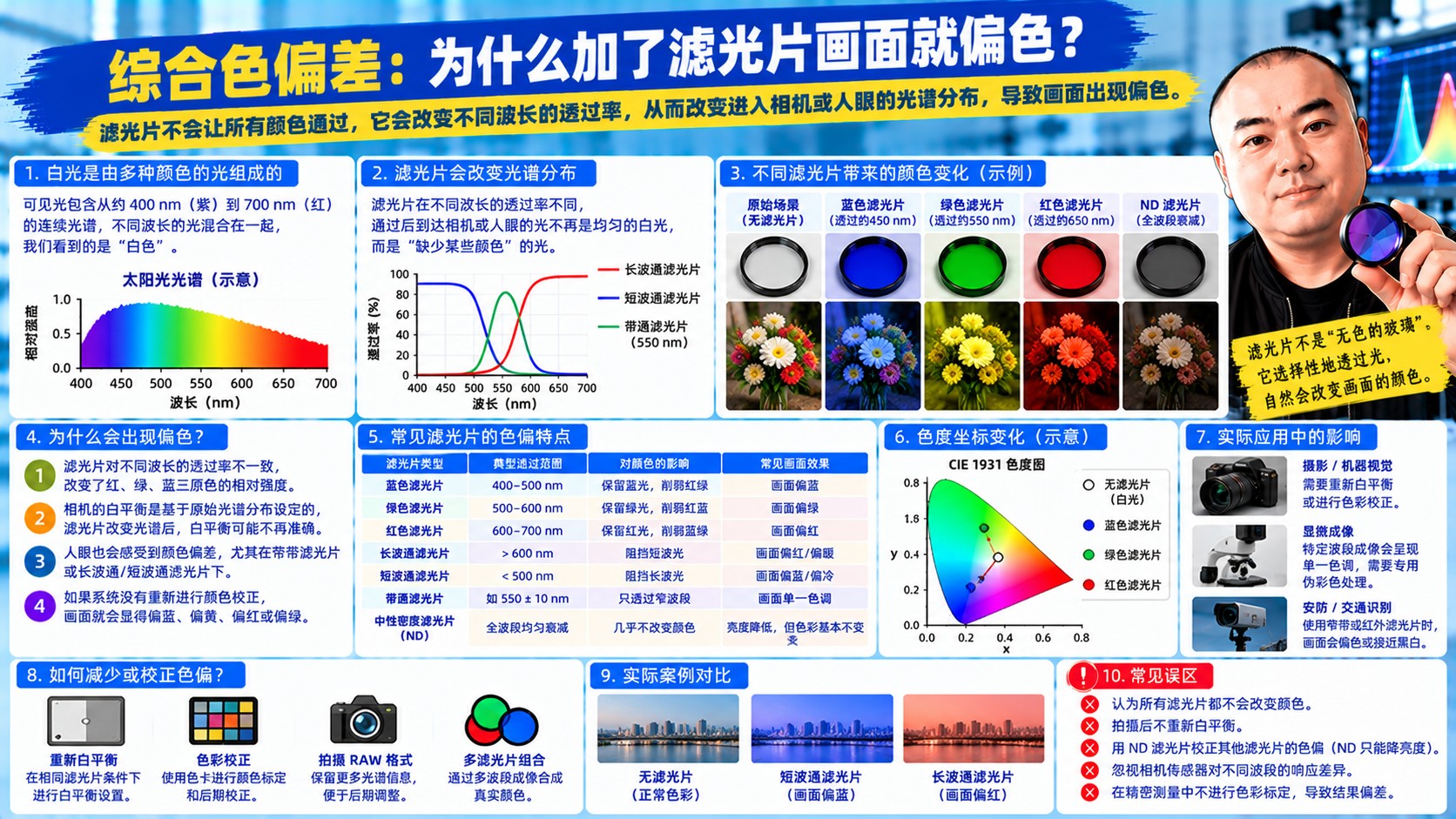
Color deviation describes how much a filter changes the color of the light passing through it. In photography, displays and color measurement - anywhere color is the product - it often matters more than transmission level.
White light is a mixture of wavelengths, and the eye (or camera) reads a particular mixing ratio as "white". A filter, by definition, changes that ratio selectively by wavelength:
Example: a filter passing 90% at 450 nm (blue) and only 60% at 650 nm (red) makes the whole image blue; reversed, it turns warm.
| Metric | Meaning | Used in |
|---|---|---|
| Color temperature shift (K) | Movement of the white point | Photography, lighting |
| CIE chromaticity shift (delta x, delta y) | Displacement on the chromaticity diagram | Displays, LEDs |
| Delta E | Perceived color difference | Color management, printing |
| Color rendering index (CRI / Ra) | Fidelity of object color rendering | Illumination sources |
The usual engineering method is to measure the chromaticity of a standard white tile with and without the filter and compute the shift. A rule of thumb: delta E below 2 is practically invisible; 2 to 5 is visible to trained eyes; above 5 is obvious.
Separate "defect" shift from "functional" shift:
"Application: photography or display, must stay color neutral; transmission flatness within plus or minus 5% from 400 to 700 nm; tested with a standard white tile under D65, delta E no more than 3."
State application, flatness, test illuminant and pass criterion, and the maker knows which way to optimize the design.
Troubleshooting a color shift? Send the part number, measured curve and a sample image to sales@ootee.cn and we will tell you whether substrate, design or angle is to blame.
 365nm Narrow Bandpass Filter | Ø50mm | T>90%
OT-HBP3659050
365nm Narrow Bandpass Filter; FWHM 10nm; transmission >90%; blocking OD5; size Ø50mm; AOI 0°.
 450nm Narrow Bandpass Filter | Ø50mm
OT-HBP4509050
450nm Narrow Bandpass Filter; FWHM 10nm; transmission >90%; blocking OD5; size Ø50mm; AOI 0°.
 525nm Narrow Bandpass Filter | Ø50mm
OT-HBP5259050
525nm Narrow Bandpass Filter; FWHM 10nm; transmission >90%; blocking OD5; size Ø50mm; AOI 0°.
Send us your drawing and spectral targets — an engineer replies with a feasibility check and quotation within one business day.