Original content by the OOTEE Optics editorial team, drawn from first-hand production line and inspection data. Please credit the source when republishing.
Given limits in expertise and test conditions, the theories, parameters and conclusions here carry no guarantee of absolute accuracy. For technical learning and exchange only - never the sole basis for design, acceptance or selection. Corrections welcome.

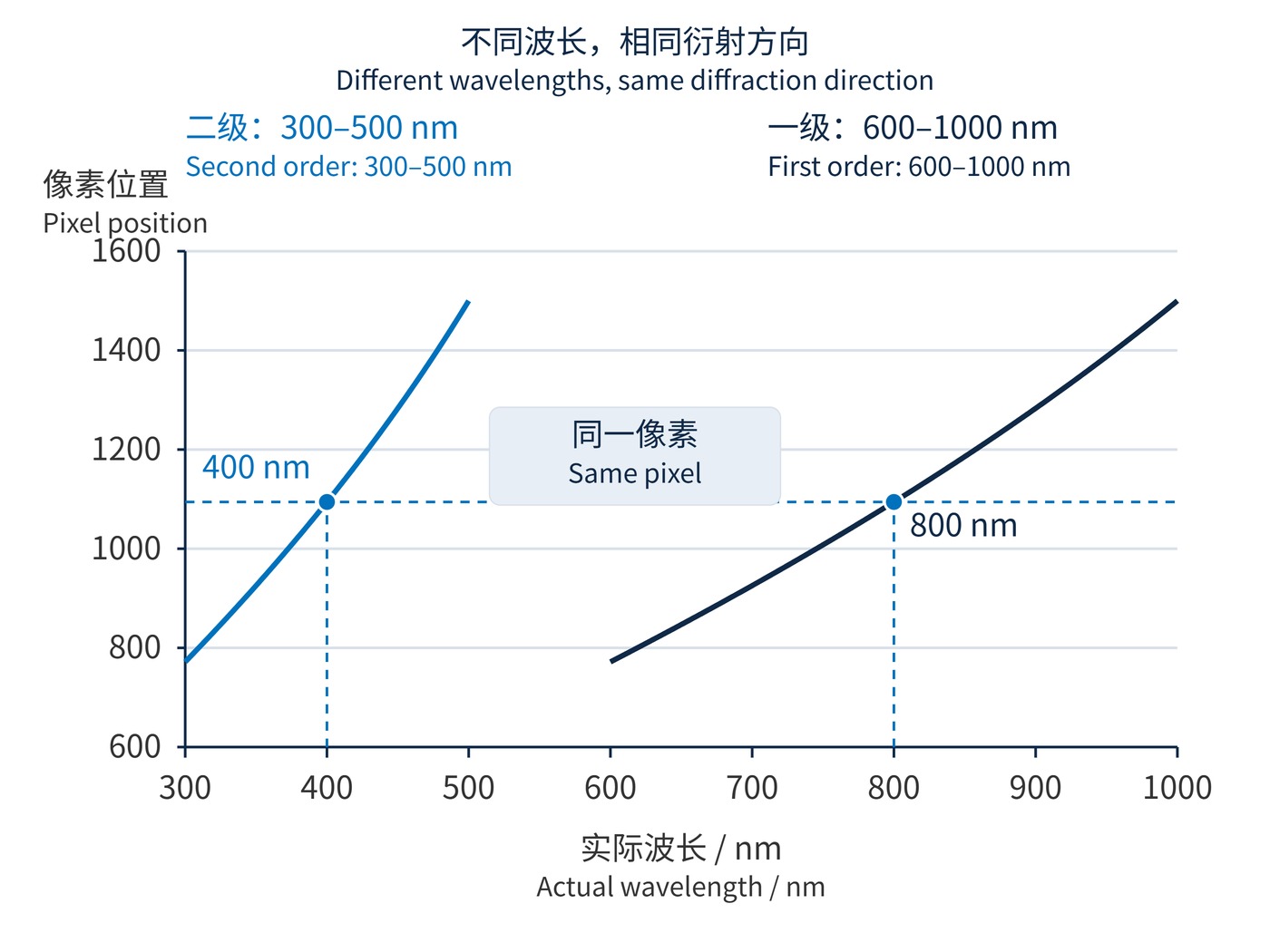
A grating spectrometer assigns wavelength from detector position within a chosen diffraction order. A pixel calibrated as 800 nm in first order can also receive second-order light at 400 nm. This order overlap can create a false peak or raise the baseline. The photons retain their wavelengths; the ambiguity comes from their shared arrival position.
An order-sorting filter restricts the spectrum before the grating disperses it. The filter sets the admitted wavelength range, while the grating separates wavelengths within that range. The discussion here assumes in-plane diffraction with a common input direction and first-order operation, rather than a cross-dispersed, two-dimensional instrument.
For a plane grating with a consistent angle convention:
$$m\lambda=d(\sin\alpha+\sin\beta)$$
Here $d$ is groove spacing, $\alpha$ and $\beta$ are measured from the grating normal, and $m$ is an integer order. A fixed geometry selects the product $m\lambda$, so $1\times800\,\mathrm{nm}=2\times400\,\mathrm{nm}$. The grating principles reference describes this order ambiguity.
In Fig. 1, second-order 400 nm and first-order 800 nm reach the same pixel row. This is a position map, not an intensity spectrum. Contamination depends on source power, order efficiency, optical throughput and detector response.
Optical density (OD) specifies blocking through fractional transmission $T$, expressed on a 0–1 scale:
$$\mathrm{OD}(\lambda)=-\log_{10}T(\lambda)$$
If $r_0$ is the second-order signal divided by the desired first-order signal before filtering, the remaining ratio is approximately:
$$r=r_0\frac{T(400\,\mathrm{nm})}{T(800\,\mathrm{nm})}$$
For $r_0=100$ and 90% transmission at 800 nm, keeping contamination below 0.1% requires $T(400\,\mathrm{nm})<9\times10^{-6}$, or OD greater than 5.05. OD6 provides illustrative margin, not a universal requirement. Scattering, light leaks and measurement uncertainty need separate allowances.
A first-order window of 700–900 nm overlaps second-order input at 350–450 nm. Check third-order input around 233–300 nm too if the system responds there. A longpass filter could be specified for OD6 throughout 350–450 nm and at least 90% transmission throughout 700–900 nm. Its transition belongs between those windows; a nominal cutoff alone does not establish adequate rejection.
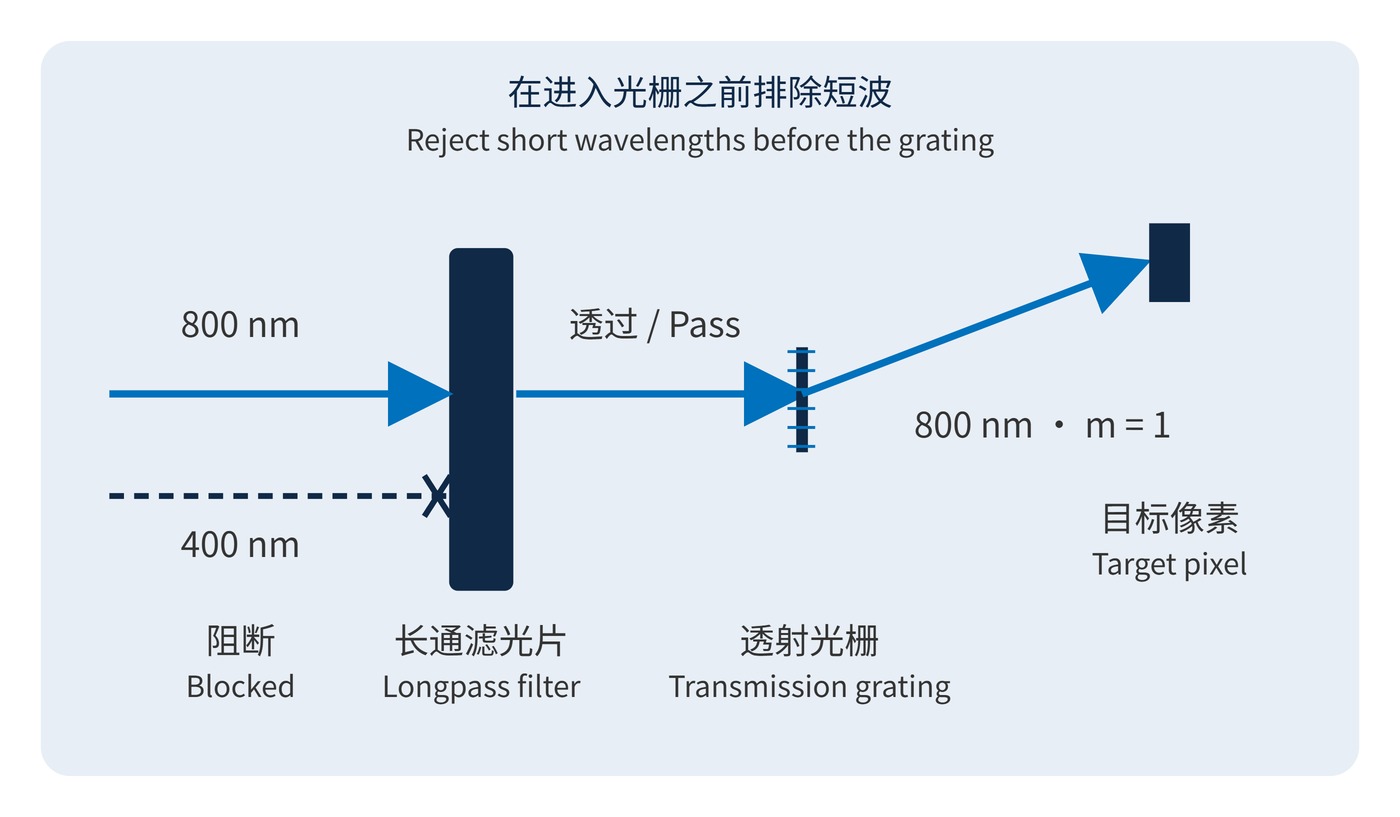
Fig. 2 shows 400 nm blocked before dispersion while 800 nm passes. A collimated section ahead of the grating is a useful starting location. Installation before the entrance slit requires checks for focus shifts, aberrations and clear aperture. Specify angle of incidence (AOI), beam cone, temperature and polarization for acceptance; normal-incidence data alone may not describe the installed performance.
For a fixed narrow window, a bandpass filter can limit both ends. An example with center wavelength (CWL) 800 nm and full width at half maximum (FWHM) 40 nm still needs a separate blocking specification over 380–420 nm, minimum working-window transmission and edge margin. FWHM does not define the entire usable passband.
A scanning monochromator can change sorting filters as its scan advances. An overlapping usable interval allows a reference source to reveal intensity steps at the changeover. Acquire a new reference spectrum after switching so that throughput differences are not mistaken for sample changes. Around 800 nm, a suitable longpass can reject second-order contamination from 400 nm excitation, although ordinary scattered light remains a separate problem.
A broadband array instrument may also need the genuine first-order 400 nm signal. A longpass across the whole input removes that signal too. Options include separate optical channels, sequential acquisitions or spatially segmented sorting filters near the detector, with calibrated boundaries. One fixed longpass cannot preserve short-wave first-order input while eliminating its second-order contribution at long-wave pixels.
A narrower slit or higher groove density cannot separate two orders with exactly the same diffraction direction. A blaze optimized for first order does not make higher-order efficiency zero. Software subtraction requires a validated, stable relationship between source spectrum and instrument response.
For acceptance, inject a narrow 400 nm line and compare the response at pixels calibrated near 800 nm with and without the filter. Then use 800 nm input to verify desired throughput. Record dark signal and scattering background separately. An undetected residual establishes only an upper bound set by the measurement limit; compare that bound with the operating error budget.
 365nm Narrow Bandpass Filter | Ø50mm | T>90%
OT-HBP3659050
365nm Narrow Bandpass Filter; FWHM 10nm; transmission >90%; blocking OD5; size Ø50mm; AOI 0°.
 450nm Narrow Bandpass Filter | Ø50mm
OT-HBP4509050
450nm Narrow Bandpass Filter; FWHM 10nm; transmission >90%; blocking OD5; size Ø50mm; AOI 0°.
 525nm Narrow Bandpass Filter | Ø50mm
OT-HBP5259050
525nm Narrow Bandpass Filter; FWHM 10nm; transmission >90%; blocking OD5; size Ø50mm; AOI 0°.
Send us your drawing and spectral targets — an engineer replies with a feasibility check and quotation within one business day.