Original content by the OOTEE Optics editorial team, drawn from first-hand production line and inspection data. Please credit the source when republishing.
Given limits in expertise and test conditions, the theories, parameters and conclusions here carry no guarantee of absolute accuracy. For technical learning and exchange only - never the sole basis for design, acceptance or selection. Corrections welcome.
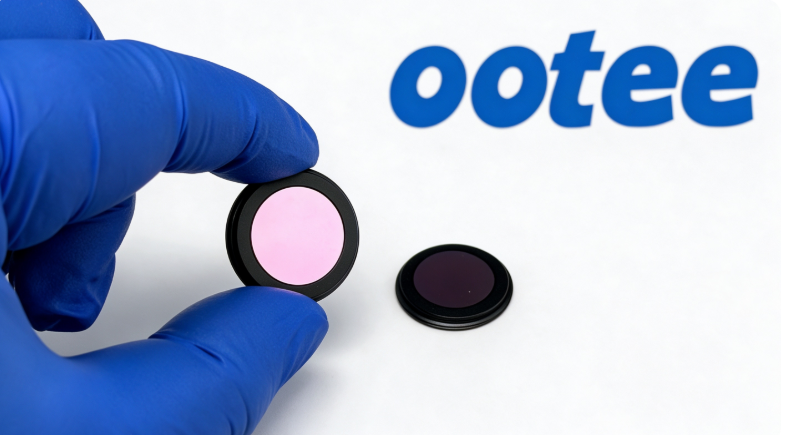
The defining strength of a flow cytometer is measuring several markers at once from a single sample. It excites multiple fluorophores with one laser, then splits the mixed fluorescence by wavelength and routes each band to its own detector. The splitting is done by a multichannel filter set.
Fluorescence leaves the interrogation point and passes through a chain of optics:
A four-colour cytometer typically needs 3–4 dichroics plus 4 bandpass filters for a complete splitting chain. Our dichroic mirror series offers standard edges and can be supplied as a matched set.
The closer two emission peaks are, the narrower the bandpass must be. FITC (520 nm) and PE (578 nm) are far enough apart for 30–40 nm bandwidth; PE and PE-Texas Red (615 nm) need 20–25 nm.
Spillover comes from two places: insufficient out-of-band blocking in a bandpass filter, and imperfect splitting ratios in a dichroic. Pushing bandpass blocking to OD5–OD6 and verifying dichroic reflection/transmission in adjacent bands are the main controls. Compensation algorithms can correct remaining spillover, but the less hardware spillover there is, the lighter the algorithmic burden and the more reliable the data.
Scatter at the laser wavelength (e.g. 488 nm) is far more intense than fluorescence. Forward and side scatter channels need dedicated bandpass plus high-blocking neutral density combinations, or weak fluorescence will be swamped.
| Laser | Channel | Typical bandpass | Dichroic edge |
|---|---|---|---|
| 488 nm | FITC | 530/30 | — |
| 488 nm | PE | 585/42 | 505 LP |
| 488 nm | PE-Texas Red | 610/20 | 560 LP |
| 488 nm | PerCP / Cy5.5 | 695/40 | 640 LP |
| 640 nm | APC | 660/20 | — |
Consistent aperture and thickness: mixed thicknesses shift the focal point in a multichannel system, so all filters should be supplied to one specification. Batch consistency: when filters are replaced later, large batch-to-batch center-wavelength variation forces recalibration. Buy complete sets matched to the instrument model and keep batch records.
OOTEE Optics can propose a complete multichannel filter plus dichroic package based on your laser configuration and dye panel, with guaranteed batch consistency. Contact us to discuss your channel combination.
 365nm Narrow Bandpass Filter | Ø50mm | T>90%
OT-HBP3659050
365nm Narrow Bandpass Filter; FWHM 10nm; transmission >90%; blocking OD5; size Ø50mm; AOI 0°.
 450nm Narrow Bandpass Filter | Ø50mm
OT-HBP4509050
450nm Narrow Bandpass Filter; FWHM 10nm; transmission >90%; blocking OD5; size Ø50mm; AOI 0°.
 525nm Narrow Bandpass Filter | Ø50mm
OT-HBP5259050
525nm Narrow Bandpass Filter; FWHM 10nm; transmission >90%; blocking OD5; size Ø50mm; AOI 0°.
Send us your drawing and spectral targets — an engineer replies with a feasibility check and quotation within one business day.