Original content by the OOTEE Optics editorial team, drawn from first-hand production line and inspection data. Please credit the source when republishing.
Given limits in expertise and test conditions, the theories, parameters and conclusions here carry no guarantee of absolute accuracy. For technical learning and exchange only - never the sole basis for design, acceptance or selection. Corrections welcome.
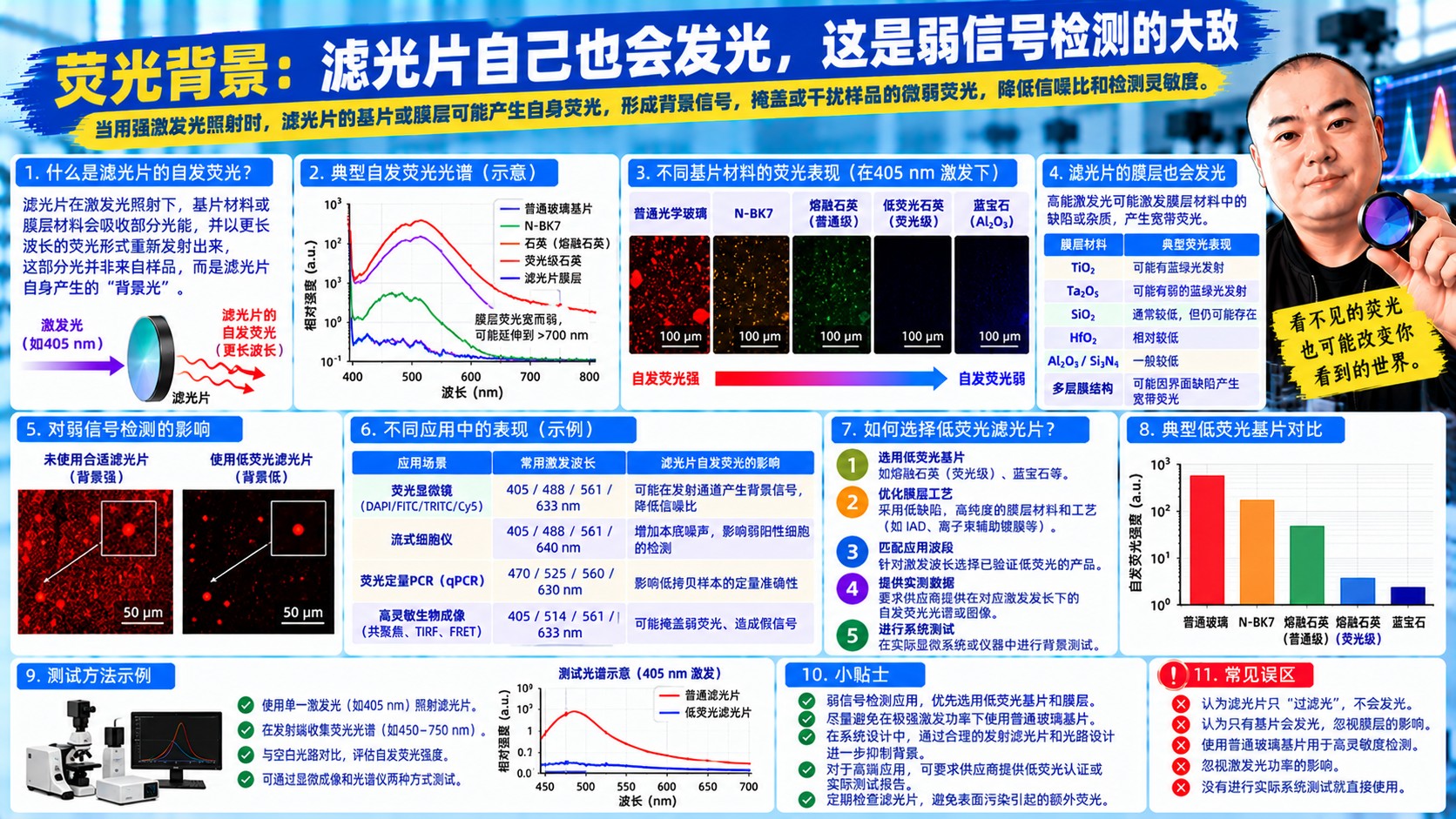
Fluorescence background is the light a filter itself emits under excitation. It sounds counterintuitive - a filter is supposed to filter light, not produce it.
Yet any material can emit longer-wavelength light after absorbing high-energy photons, especially ultraviolet or blue. Substrates, coatings and adhesives are no exception. In ordinary imaging this faint glow is irrelevant; in fluorescence imaging and Raman it can be the last straw that breaks your signal-to-noise ratio.
| Source | Explanation | Controllability |
|---|---|---|
| Substrate impurities | Trace transition metal or rare earth ions glow when excited | Much improved by high purity materials such as fused silica or UV-grade glass |
| Coating materials | Some films have defect levels that absorb and re-emit | Improved by material screening and process optimization |
| Adhesive layers | Optical cement in cemented assemblies is often a strong emitter | Keep cement out of the beam or use low-fluorescence adhesives |
| Edge blackening | Some black paints glow under excitation | Use inert absorbing materials |
The problem is where the background lands:
Result: the noise floor rises, weak signals disappear, and detection limits worsen. In single-molecule fluorescence or Raman, where the signal may be a few hundred photons, background decides whether the experiment works at all.
A simple, effective test:
Premium filter makers publish autofluorescence test data or mark parts "low autofluorescence". If a supplier has no data at all and your work involves weak signals, that itself is a red flag.
"Application: fluorescence imaging (excitation 488 nm, emission 520 nm); autofluorescence of the filter under 488 nm excitation must be below XX counts per second from 500 to 600 nm, or supply an autofluorescence test report; single-plate, uncemented, fused silica substrate."
State excitation wavelength, observation band, criterion and construction to actually get a suitable part.
Troubled by background? Send your configuration (excitation wavelength, emission channel, detector and current filter model) to sales@ootee.cn and we will trace the source and propose low-fluorescence replacements.
 365nm Narrow Bandpass Filter | Ø50mm | T>90%
OT-HBP3659050
365nm Narrow Bandpass Filter; FWHM 10nm; transmission >90%; blocking OD5; size Ø50mm; AOI 0°.
 450nm Narrow Bandpass Filter | Ø50mm
OT-HBP4509050
450nm Narrow Bandpass Filter; FWHM 10nm; transmission >90%; blocking OD5; size Ø50mm; AOI 0°.
 525nm Narrow Bandpass Filter | Ø50mm
OT-HBP5259050
525nm Narrow Bandpass Filter; FWHM 10nm; transmission >90%; blocking OD5; size Ø50mm; AOI 0°.
Send us your drawing and spectral targets — an engineer replies with a feasibility check and quotation within one business day.