Original content by the OOTEE Optics editorial team, drawn from first-hand production line and inspection data. Please credit the source when republishing.
Given limits in expertise and test conditions, the theories, parameters and conclusions here carry no guarantee of absolute accuracy. For technical learning and exchange only - never the sole basis for design, acceptance or selection. Corrections welcome.
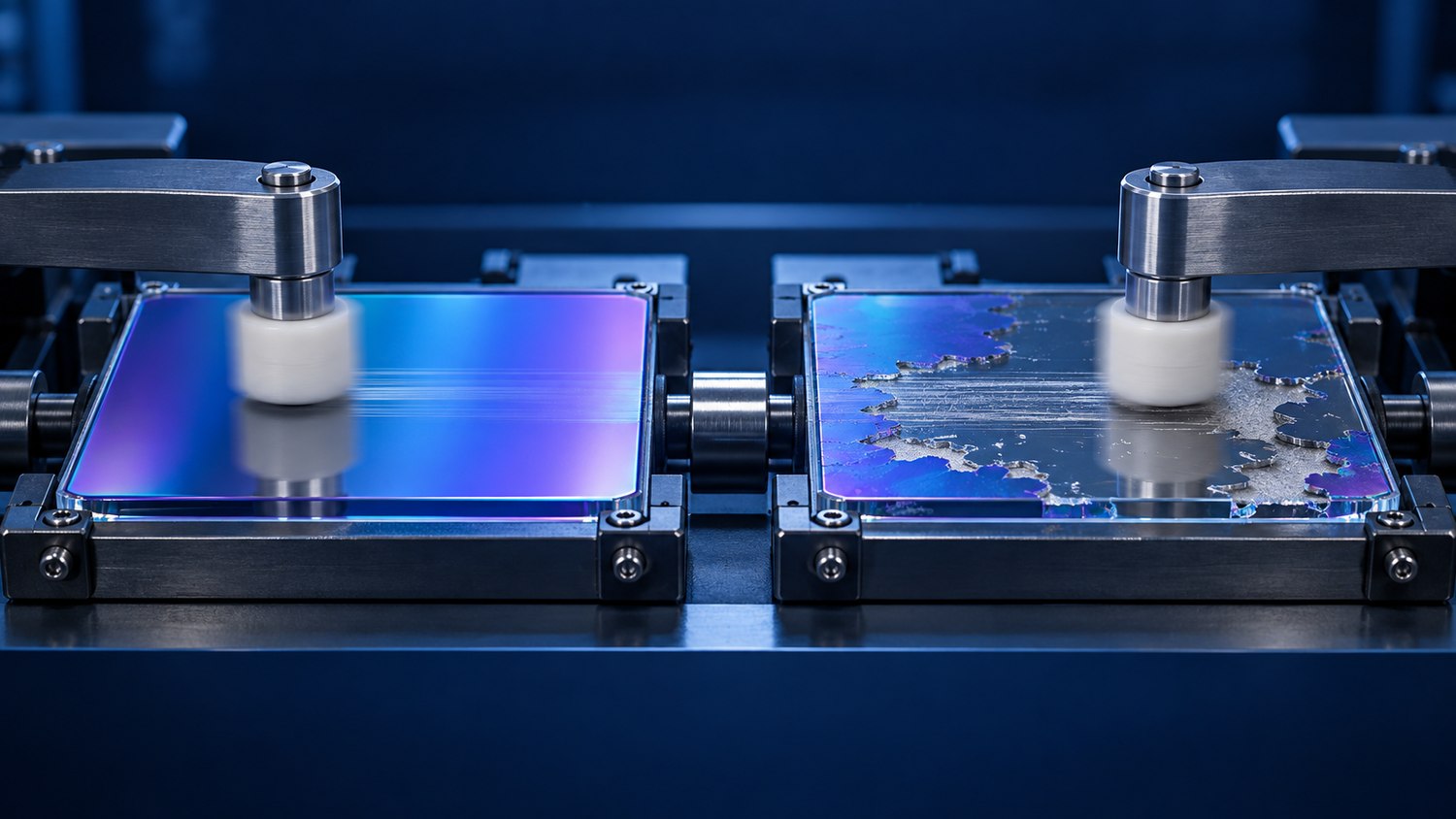
Hard and soft coatings are practical terms used for interference filters, rather than universal hardness grades. A hard coating generally describes a dense film stack suitable for exposed use. Traditional soft coatings often need a cover plate, bonding and edge sealing. Both select wavelengths through their optical design; their colour does not identify their durability.
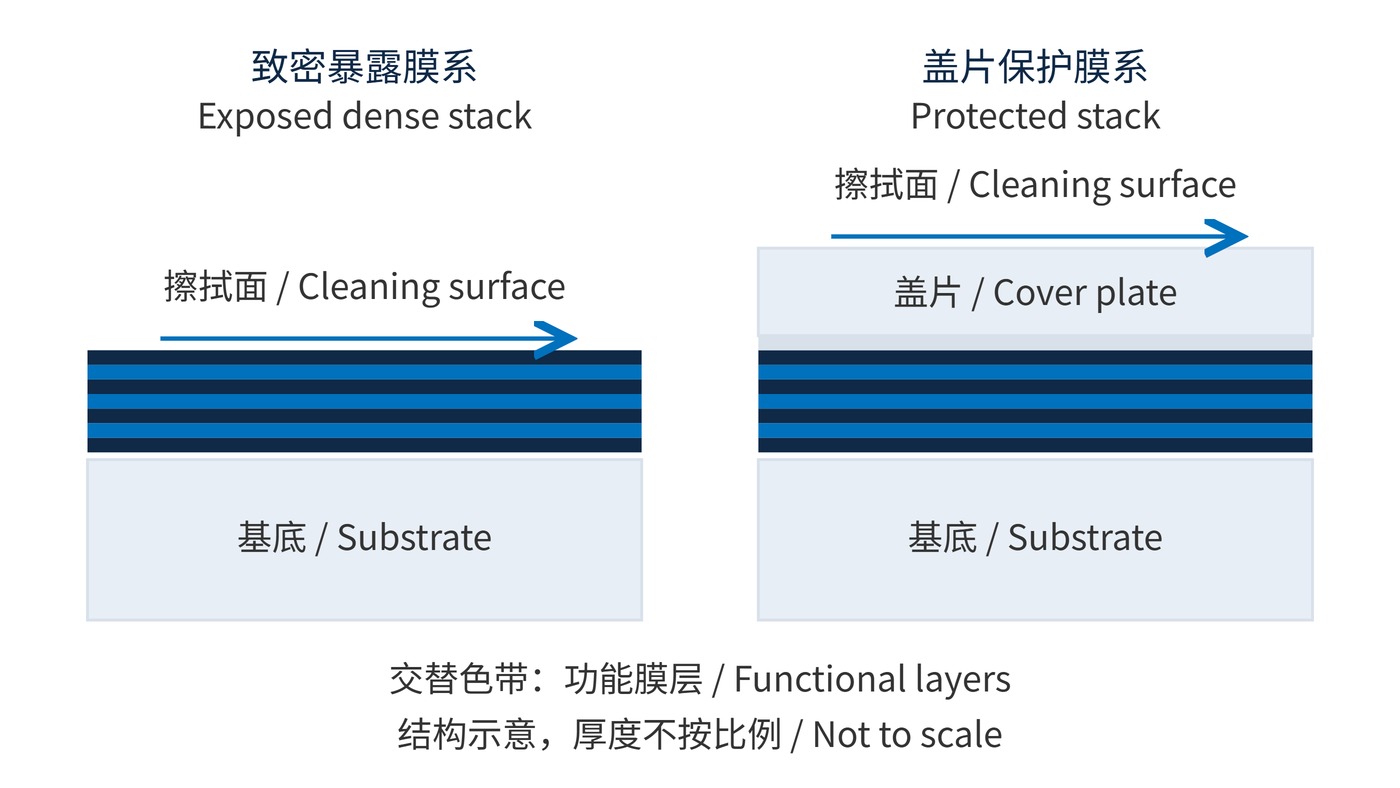
The useful purchasing question is which finished assembly maintains the required performance at the lowest cost over its intended service period. The abrasion contrast shown here is conceptual, not test data. On an encapsulated soft-coated filter, cleaning normally touches the cover plate rather than the protected functional layers.
Refractive index and layer thickness determine the optical response. Moisture entering pores can change the effective refractive index of a porous film. Dense films generally offer better stability, but adhesion, residual stress and substrate preparation still matter. Fig. 1 distinguishes the functional coating from the surface actually being cleaned.
Hold centre wavelength (CWL), full width at half maximum (FWHM), optical density (OD) and angle of incidence (AOI) constant before comparing quotations. An example specification is CWL 780 nm, FWHM 20 nm, peak transmission at least 90%, blocking of at least OD6 over 400–700 nm, and AOI 0°. These are illustrative purchasing requirements, not a product claim.
$$\mathrm{OD}(\lambda)=-\log_{10}T(\lambda)$$
Here $T$ is fractional transmission: OD6 means $10^{-6}$, or 0.0001%. After durability testing, remeasure the passband and blocking as well as inspecting for scratches and delamination. Small pinholes can increase leakage without conspicuous visual damage. Record the measurement aperture and instrument measurement floor.
Dense coatings can still fail through stress or poor adhesion. A protective assembly can introduce reflections, adhesive absorption or fluorescence. Neither architecture guarantees the best performance for every wavelength and detection background.
Keep the clear aperture and measurement geometry consistent when comparing before-and-after results. A defect outside the working beam may have little immediate effect, while a small damaged area inside it can matter greatly. A full-aperture average can also conceal local leakage relevant to the installed optical path.
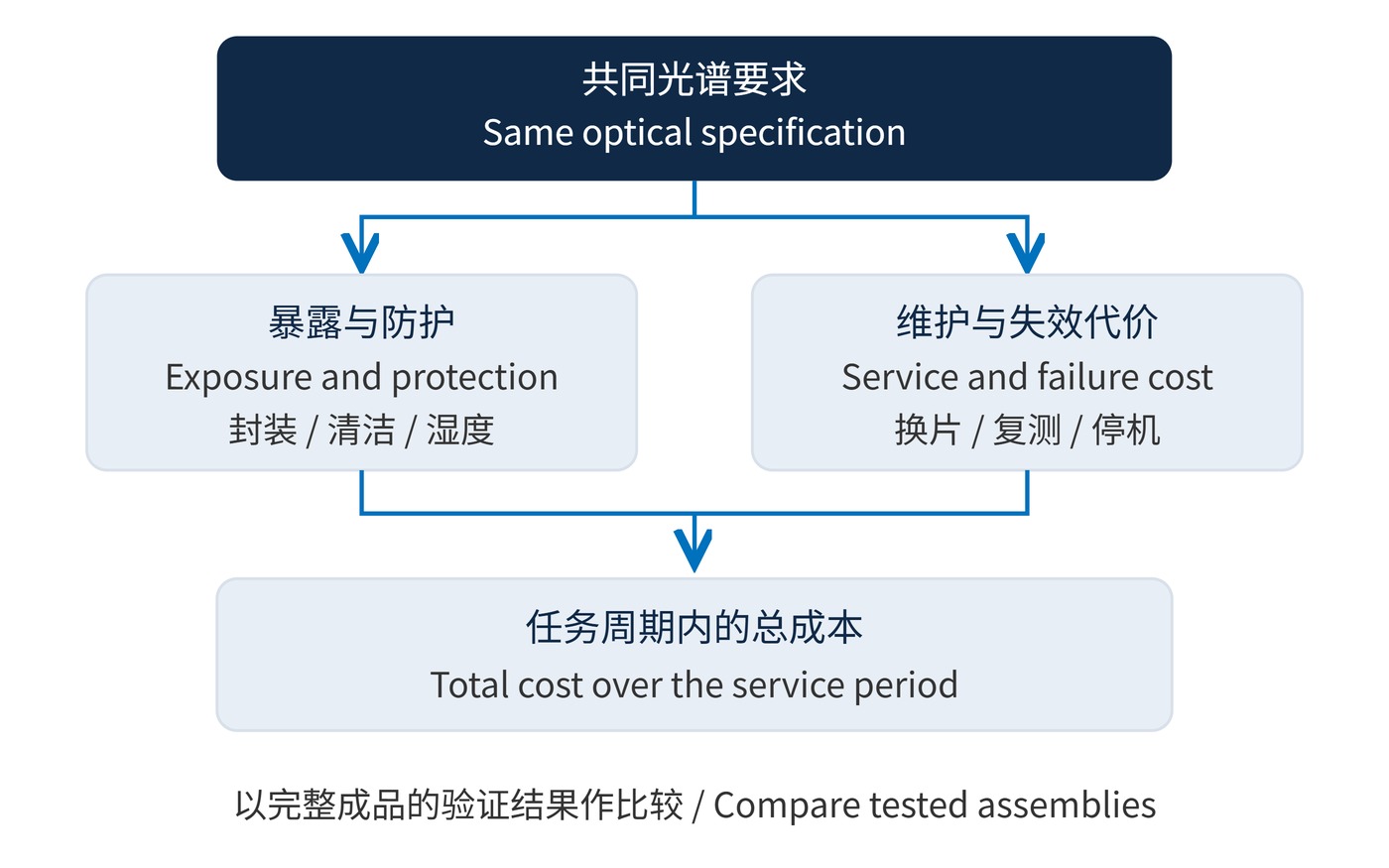
Start with cleaning frequency, humidity exposure, repair access and service duration. As Fig. 2 shows, both candidates must first meet the same optical specification. A dry sealed module and an open optical path cleaned daily can justify different choices.
$$C_{\mathrm{life}}=C_{\mathrm{buy}}+C_{\mathrm{protect}}+\mathbb{E}[N_{\mathrm{replace}}]C_{\mathrm{service}}$$
Service cost includes the replacement optic, labour, verification and downtime. Count protection costs only when they are additional to the purchase price. Suppose one hard-coated option costs 300 yuan more and each replacement event costs 600 yuan. With other costs equal and discounting ignored, avoiding more than 0.5 expected replacements offsets that premium. This is a budgeting example, not a failure-rate estimate.
| Operating situation | Cost priority | Evidence to request |
|---|---|---|
| Open path, frequent cleaning | Cleaning resistance and replacement | Appearance and spectra after specified cleaning |
| Dry sealed module | Packaging and module lifetime | Stability records for the complete assembly |
| Weak signals | Adhesive fluorescence and leakage | Background under actual excitation conditions |
Agree on cleaning medium, load, cycles, exposure sequence and acceptance limits. ISO 9211-4:2022 describes specific abrasion, adhesion and water-resistance methods. Citing it still requires an agreed method and severity; a standard number alone is not a complete acceptance specification.
Replacement estimates should come from relevant assembly records or a clearly stated budgeting assumption. If the evidence is incomplete, compare several replacement scenarios rather than presenting one assumed lifetime as a guaranteed saving. Include only costs that differ between the alternatives, and use the same service period for both.
Exposed machine-vision filters face dust and cleaning. A durable assembly may reduce removal and recalibration. If the system already has a replaceable protective window, include it in the comparison before paying for additional protection.
For sealed laboratory modules or short development programmes, an encapsulated soft-coated option can be worth evaluating. Check edge seals and adhesive compatibility. In continuously operated fluorescence instruments, verify spectral stability, background and downtime together rather than inferring performance from a coating label.
A protective window shifts maintenance to another component; it does not eliminate maintenance. Its replacement interval and optical losses belong in the system comparison, particularly when the available signal is limited.
Specify initial spectra, allowable changes after agreed exposure, and maintenance limits together. Ownership-cost comparisons become meaningful only when both options satisfy the same function and acceptance criteria.
 365nm Narrow Bandpass Filter | Ø50mm | T>90%
OT-HBP3659050
365nm Narrow Bandpass Filter; FWHM 10nm; transmission >90%; blocking OD5; size Ø50mm; AOI 0°.
 450nm Narrow Bandpass Filter | Ø50mm
OT-HBP4509050
450nm Narrow Bandpass Filter; FWHM 10nm; transmission >90%; blocking OD5; size Ø50mm; AOI 0°.
 525nm Narrow Bandpass Filter | Ø50mm
OT-HBP5259050
525nm Narrow Bandpass Filter; FWHM 10nm; transmission >90%; blocking OD5; size Ø50mm; AOI 0°.
Send us your drawing and spectral targets — an engineer replies with a feasibility check and quotation within one business day.