Original content by the OOTEE Optics editorial team, drawn from first-hand production line and inspection data. Please credit the source when republishing.
Given limits in expertise and test conditions, the theories, parameters and conclusions here carry no guarantee of absolute accuracy. For technical learning and exchange only - never the sole basis for design, acceptance or selection. Corrections welcome.
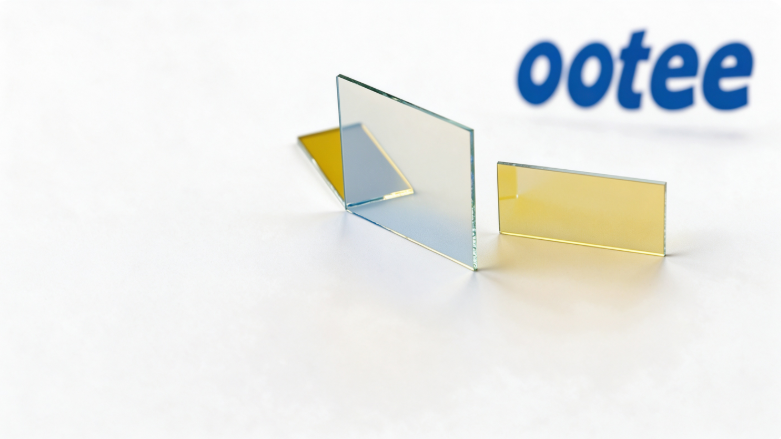
At the heart of an IPL (intense pulsed light) beauty device is a single filter. The flash lamp emits broadband light from 400–1200 nm; ultraviolet below 400 nm burns skin, and short-wave infrared above 1100 nm generates heat with almost no therapeutic benefit. The filter's job is to pass only the useful band.
| Filter | Passband | Typical indication |
|---|---|---|
| 515 nm | 515–1200 nm | Light skin, freckles, telangiectasia |
| 560 nm | 560–1200 nm | General hair removal (most common) |
| 590 nm | 590–1200 nm | Vascular lesions, darker skin types |
| 640 nm | 640–1200 nm | Darker-skin hair removal, deep vessels |
| 695 / 755 nm | 695–1200 nm | Dark skin, pigmented lesions |
Longer cut-off means less short-wave content and deeper penetration, but lower energy efficiency — hence the industry practice of swapping filters by skin type and indication.
IPL flash energy density is high and generates significant heat. Soft coatings delaminate, haze or drift spectrally under repeated pulsing, degrading efficacy and creating safety risk. Ion-assisted deposition (IAD) hard coatings withstand higher temperature and higher light flux while keeping the spectrum stable — the fundamental difference between an IPL filter and an ordinary decorative or imaging filter.
Beyond the spectral curve, ask the supplier for pulse-life data (e.g. spectral drift after 100,000 pulses), thermal shock test reports, and a statement of batch spectral consistency. If the filter mounts in a replaceable module, also confirm dimensional tolerance and sealing.
OOTEE Optics manufactures our longpass filter series in 515 / 560 / 590 / 640 / 695 / 755 nm options using hard coatings, with light-and-heat test reports available. Talk to our engineering team about your IPL project.
 365nm Narrow Bandpass Filter | Ø50mm | T>90%
OT-HBP3659050
365nm Narrow Bandpass Filter; FWHM 10nm; transmission >90%; blocking OD5; size Ø50mm; AOI 0°.
 450nm Narrow Bandpass Filter | Ø50mm
OT-HBP4509050
450nm Narrow Bandpass Filter; FWHM 10nm; transmission >90%; blocking OD5; size Ø50mm; AOI 0°.
 525nm Narrow Bandpass Filter | Ø50mm
OT-HBP5259050
525nm Narrow Bandpass Filter; FWHM 10nm; transmission >90%; blocking OD5; size Ø50mm; AOI 0°.
Send us your drawing and spectral targets — an engineer replies with a feasibility check and quotation within one business day.