Original content by the OOTEE Optics editorial team, drawn from first-hand production line and inspection data. Please credit the source when republishing.
Given limits in expertise and test conditions, the theories, parameters and conclusions here carry no guarantee of absolute accuracy. For technical learning and exchange only - never the sole basis for design, acceptance or selection. Corrections welcome.
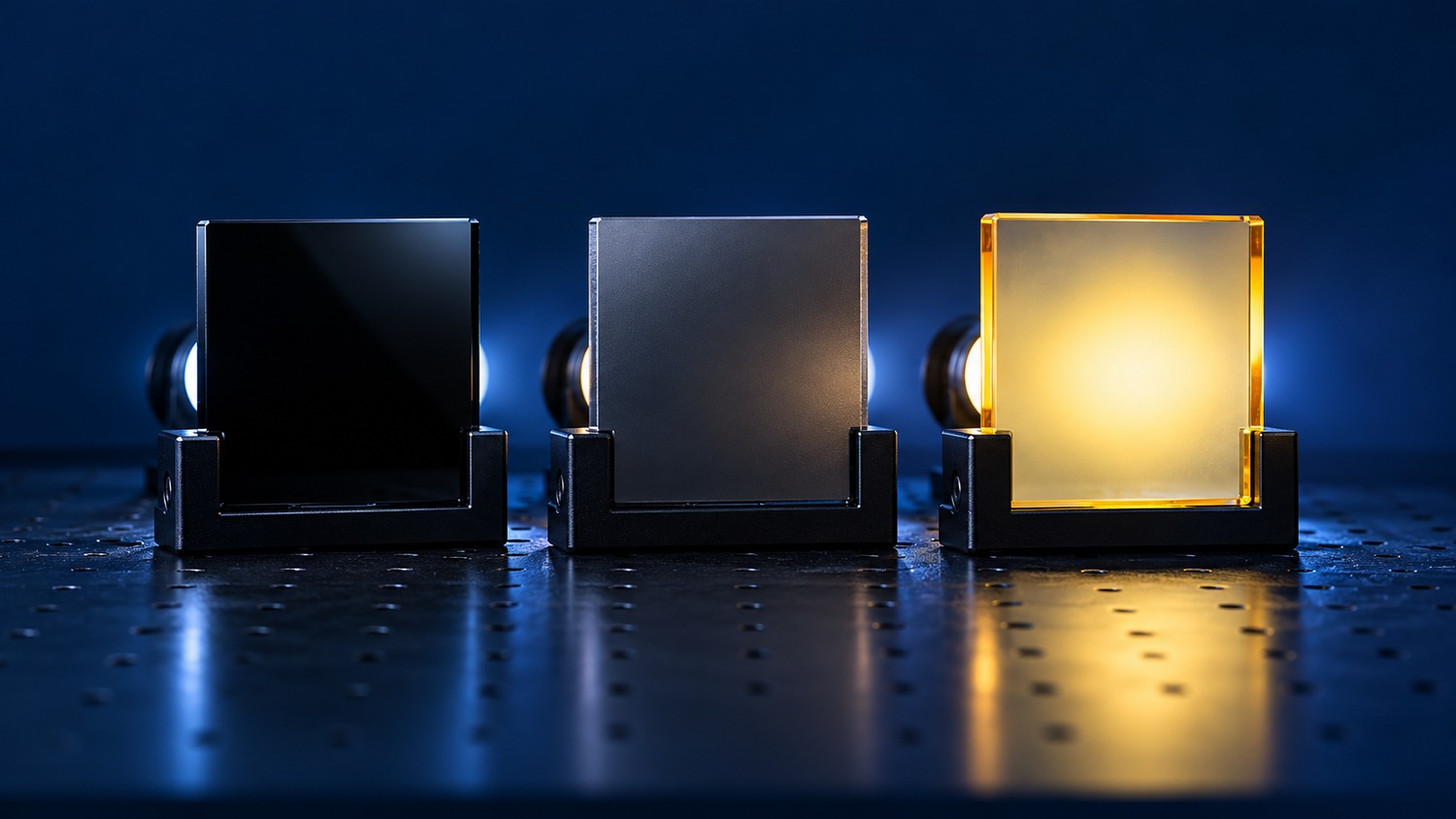
An infrared filter substrate carries the coating, but it also sets a limit on usable transmission. Silicon (Si), germanium (Ge) and zinc sulfide (ZnS) must therefore be assessed as optical materials before a coating is specified. An antireflection coating cannot recover light absorbed inside the substrate.
ZnS is zinc sulfide; ZnSe is zinc selenide. They are different materials. ZnS also comes in standard infrared and multispectral grades, with post-processing used to reduce scattering in the latter. ZnSe and ZnS are easily confused by name but are distinct materials: ZnSe is common in 10.6 um laser and thermal-imaging paths, ZnS in infrared windows, and they are not interchangeable.
Electronic absorption limits the short-wavelength side of a material's transmission window; lattice absorption constrains the long-wavelength side. Impurities and free carriers matter too. In silicon, oxygen can produce absorption near 9 μm in Czochralski-grown material. Float-zone processing reduces this concern. A broad handbook range is consequently insufficient to qualify Si for an entire 8–14 μm channel.
For absorption coefficient $\alpha$ in $\mathrm{cm^{-1}}$ and thickness $d$ in $\mathrm{cm}$, internal transmission is approximated by:
$$T_{\mathrm{int}}(\lambda)=\exp[-\alpha(\lambda)d]$$
This excludes reflection and scattering. As a hypothetical example, $\alpha=0.1\,\mathrm{cm^{-1}}$ gives approximately 99.0% internal transmission through 1 mm and 95.1% through 5 mm. These are illustrative calculations, not measured material specifications.
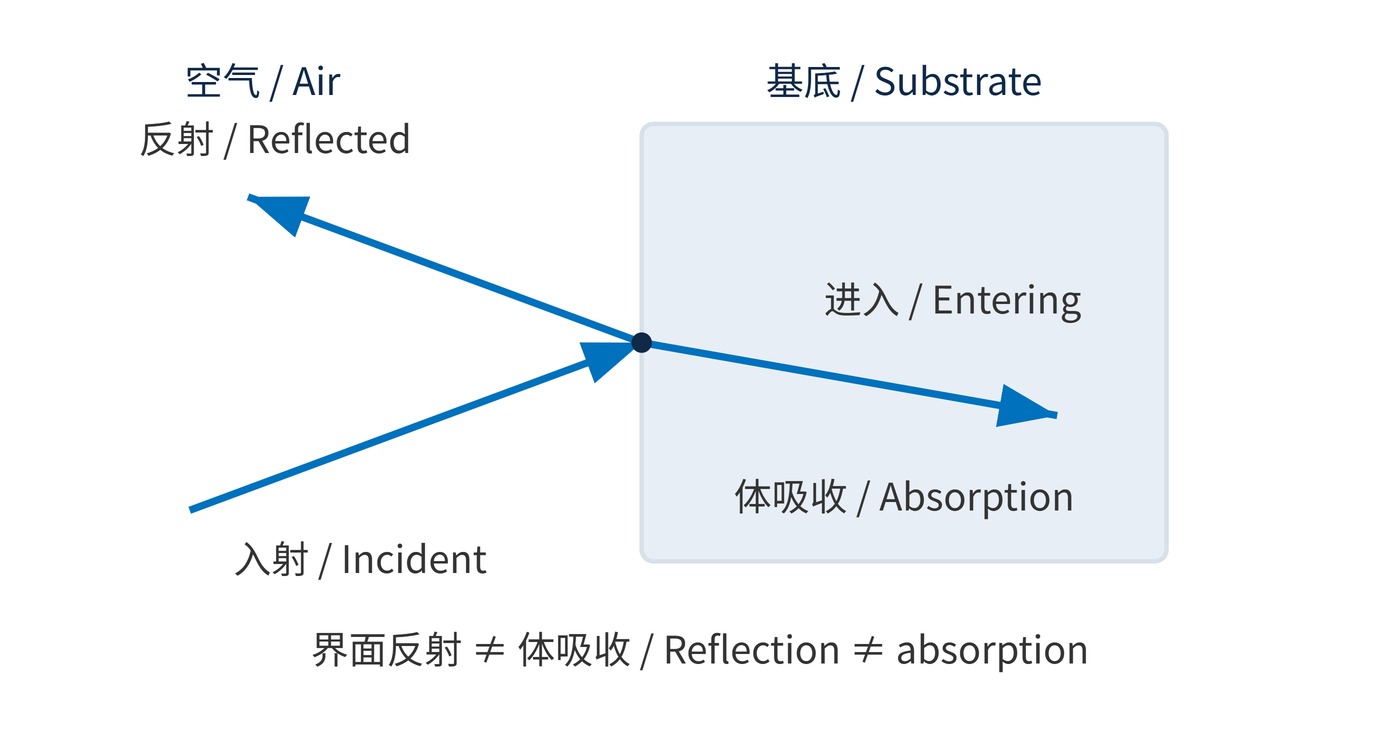
Fig. 1 separates the interface from the bulk. At normal incidence from air, with a real refractive index, the reflectance of one bare interface is:
$$R=\left(\frac{n-1}{n+1}\right)^2$$
Representative indices of 3.42 for Si and 4.00 for Ge give about 30.0% and 36.0% reflectance per interface. These indices are wavelength dependent. For a lossless parallel plate with incoherent multiple reflections collected, total transmission is $(1-R)/(1+R)$: about 53.9% and 47.1%, respectively.
Use the following as screening priorities, not guaranteed transmission limits. Final suitability depends on grade, thickness, temperature and coating.
| Material | Initial application fit | Conditions to verify |
|---|---|---|
| Si | 3–5 μm mid-wave infrared | Growth process, resistivity, oxygen absorption, thickness |
| Ge | 8–14 μm thermal imaging | Hot-state absorption, antireflection coating, mass, thermal design |
| ZnS | Infrared windows and multispectral apertures | Standard or multispectral grade, scattering, long-wave transmission |
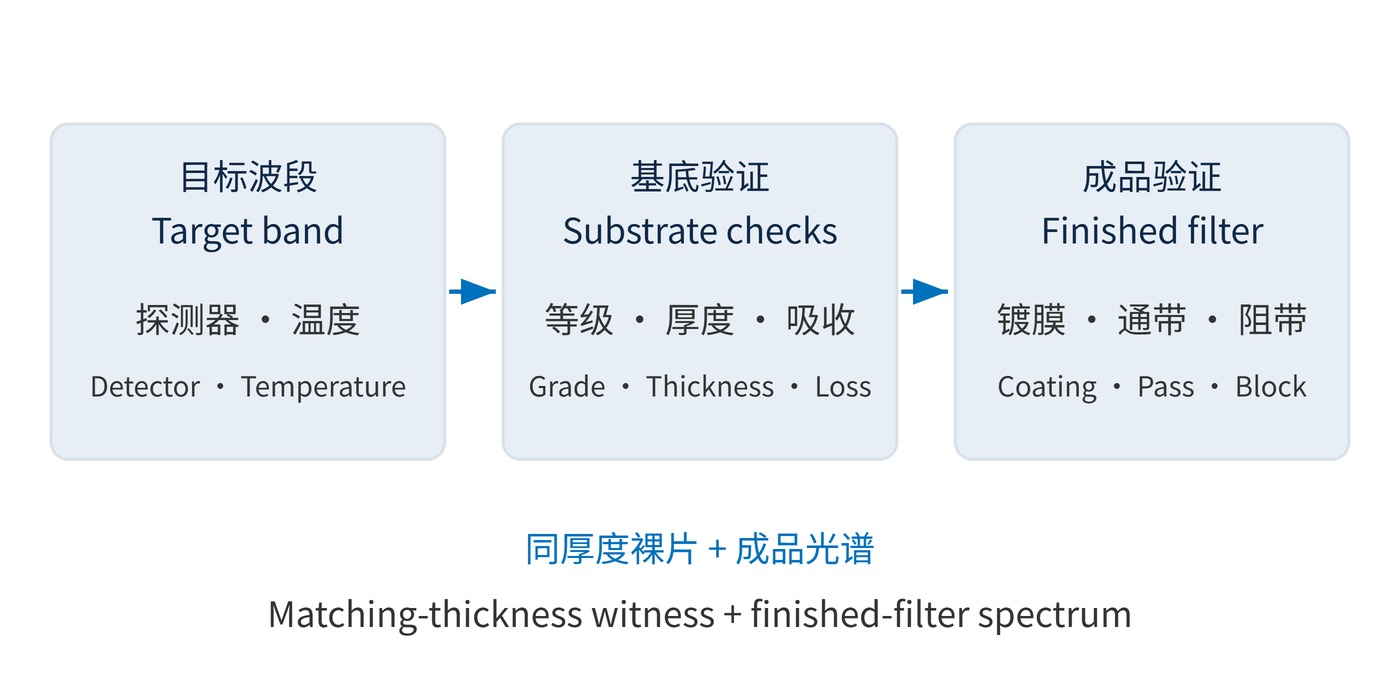
Follow the sequence in Fig. 2: detector and target band, substrate qualification, then coating and finished-part testing. An example gas-sensing requirement might specify center wavelength (CWL) 4260 nm, full width at half maximum (FWHM) 180 nm, angle of incidence (AOI) 0°, operation at 20–60 °C, and optical density (OD) 4 over an explicitly defined blocking interval. These are example requirements, not a product specification.
Request both an uncoated witness of matching thickness and the finished filter spectrum. Record angular conditions, spectral resolution and whether scattered light is collected. Visually clear multispectral ZnS still needs an imaging-scatter assessment. Ge requires transmission checks at operating temperature rather than room-temperature evidence alone.
A purchasing drawing should identify the material grade and control substitutions. The same chemical formula does not establish equivalent optical performance. When the growth process or source batch changes, repeat checks of minimum in-band transmission and relevant absorption features, retaining the witness data for comparison. Keep the measurement aperture consistent as well: a change in how scattered light is collected can make two transmission reports look different even when bulk absorption has not changed. Documenting these conditions makes a later throughput shortfall easier to trace.
For 3–5 μm gas sensing, Si is a starting candidate, subject to absorption around the measurement band and out-of-band leakage checks. For 8–14 μm imaging, Ge is widely applicable, but component temperature, ghost reflections and thermal background remain system-level constraints.
Multispectral ZnS can support visible alignment alongside infrared operation in a shared aperture. Verify infrared throughput and image degradation from scatter separately. A 10.6 μm laser system may instead involve ZnSe, which requires its own absorption, thermal-load and damage assessment; similarity of the chemical abbreviations does not establish interchangeability.
Acceptance should establish finished-filter performance under operating conditions, while retaining separate records of bulk absorption, interface reflection and coating selectivity.
 365nm Narrow Bandpass Filter | Ø50mm | T>90%
OT-HBP3659050
365nm Narrow Bandpass Filter; FWHM 10nm; transmission >90%; blocking OD5; size Ø50mm; AOI 0°.
 450nm Narrow Bandpass Filter | Ø50mm
OT-HBP4509050
450nm Narrow Bandpass Filter; FWHM 10nm; transmission >90%; blocking OD5; size Ø50mm; AOI 0°.
 525nm Narrow Bandpass Filter | Ø50mm
OT-HBP5259050
525nm Narrow Bandpass Filter; FWHM 10nm; transmission >90%; blocking OD5; size Ø50mm; AOI 0°.
Send us your drawing and spectral targets — an engineer replies with a feasibility check and quotation within one business day.