Original content by the OOTEE Optics editorial team, drawn from first-hand production line and inspection data. Please credit the source when republishing.
Given limits in expertise and test conditions, the theories, parameters and conclusions here carry no guarantee of absolute accuracy. For technical learning and exchange only - never the sole basis for design, acceptance or selection. Corrections welcome.
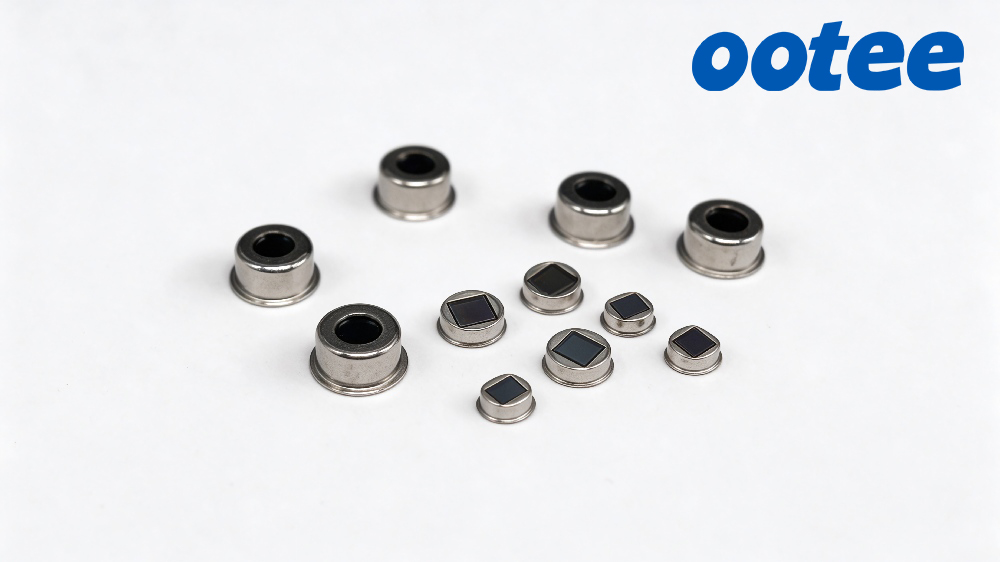
Every infrared thermometer contains an IR filter. Its job is simple: let the target's infrared radiation in, keep sunlight, lamps and nearby heat sources out. Choose the wrong wavelength and your readings drift.
A human body at 37 °C peaks around 9.4 μm, so 8–14 μm covers the radiation peak of room-temperature objects. Characteristics:
Around 5.5 μm is a good window for industrial high-temperature targets such as steel mills and glass furnaces, and solar interference there is far lower than in the 8–14 μm broadband. Characteristics:
Typical requirements: in-band average transmission ≥ 85%, blocking in the visible (0.4–1.1 μm) ≥ OD2, and small wavelength drift over the operating temperature range. Medical forehead thermometers also need a flat passband edge in 8–14 μm to avoid reading fluctuation from edge drift.
OOTEE Optics supplies both 8–14 μm broadband and 5.5 μm narrowband options through our longpass filter series, with customization of passband, blocking depth and substrate size. Tell us your temperature range and mounting dimensions and we will recommend the right band.
 365nm Narrow Bandpass Filter | Ø50mm | T>90%
OT-HBP3659050
365nm Narrow Bandpass Filter; FWHM 10nm; transmission >90%; blocking OD5; size Ø50mm; AOI 0°.
 450nm Narrow Bandpass Filter | Ø50mm
OT-HBP4509050
450nm Narrow Bandpass Filter; FWHM 10nm; transmission >90%; blocking OD5; size Ø50mm; AOI 0°.
 525nm Narrow Bandpass Filter | Ø50mm
OT-HBP5259050
525nm Narrow Bandpass Filter; FWHM 10nm; transmission >90%; blocking OD5; size Ø50mm; AOI 0°.
Send us your drawing and spectral targets — an engineer replies with a feasibility check and quotation within one business day.