Original content by the OOTEE Optics editorial team, drawn from first-hand production line and inspection data. Please credit the source when republishing.
Given limits in expertise and test conditions, the theories, parameters and conclusions here carry no guarantee of absolute accuracy. For technical learning and exchange only - never the sole basis for design, acceptance or selection. Corrections welcome.

A useful supplier questionnaire establishes whether a filter can be delivered repeatedly under agreed conditions, with traceable evidence. Price, lead time and peak transmission alone do not make quotations comparable. Ask for a requirement, its test conditions, supporting records and a response when it fails.
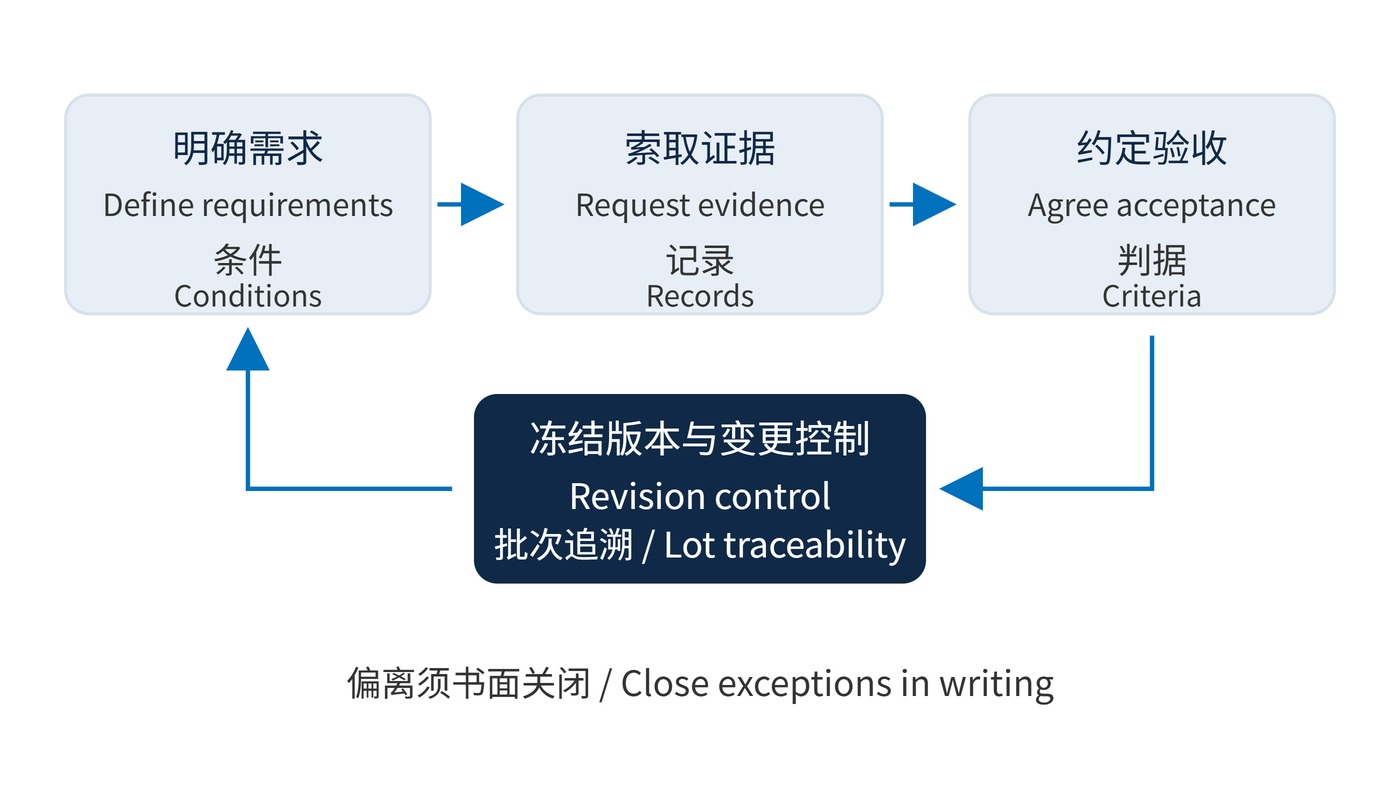
Issue one revision of the specification to every candidate. Request a response of compliant, exception or validation pending for each item. Fig. 1 connects those answers to controlled drawings and acceptance records. A successful prototype establishes the performance of that sample; production capability needs separate evidence.
Define center wavelength (CWL), full width at half maximum (FWHM), optical density (OD) and angle of incidence (AOI). For an asymmetric passband, specify how CWL is calculated rather than assuming every supplier uses the same method.
$$\mathrm{OD}(\lambda)=-\log_{10}T(\lambda)$$
Here, transmittance $T$ is a dimensionless fraction between 0 and 1. OD6 means $T=10^{-6}$, or 0.0001%. A blocking claim needs a wavelength interval; one deep measurement cannot establish performance throughout the stopband.
$$T(\lambda_1)=T(\lambda_2)=\frac{T_{\mathrm{peak}}}{2},\qquad \mathrm{FWHM}=\lambda_2-\lambda_1$$
An example inquiry could specify CWL 780 ± 1 nm, FWHM 20 ± 2 nm, peak transmission ≥90%, and OD6 at every wavelength within 400–740 nm and 820–1100 nm. State AOI 0°, unpolarized light and 23 ± 2 °C, then define beam divergence and clear aperture separately. These are example requirements, not universal acceptance limits.
| Question | Evidence or agreement to request |
|---|---|
| 1. How are CWL and FWHM defined? | Algorithms, tolerances and treatment of asymmetric or multiple peaks. |
| 2. Is transmission specified as peak or average? | Averaging interval, minimum value and guaranteed aperture. |
| 3. Where does the OD guarantee apply? | Complete blocking intervals, transition regions and pointwise versus average limits. |
| 4. What angles and polarizations are verified? | Data for the operating AOI, cone angle and polarization. |
| 5. How much does performance vary? | Temperature range, spatial sampling and permitted shifts. |
When evaluating narrow bandpass filters, resolve unsupported critical claims before comparing cost. A supplier need not disclose its coating recipe to document materials, change control and validation responsibilities. Use the actual beam geometry when assessing angle-dependent performance.
| Question | Evidence or agreement to request |
|---|---|
| 1. Can the substrate grade be fixed? | Material, thickness, tolerances and approval of substitutions. |
| 2. What coating and bonding structure is supplied? | Coated faces, adhesive layers, cleaning compatibility and orientation. |
| 3. Which operations are outsourced? | Critical process sources, inspection ownership and change notification. |
| 4. How are geometry and aperture controlled? | Drawing limits for bevels, edge exclusion, flatness and parallelism. |
| 5. What establishes environmental durability? | Exposure conditions, sample count and before/after acceptance criteria. |
| Question | Evidence or agreement to request |
|---|---|
| 1. Can the instrument verify the target OD? | Stray light, dynamic range, detection limit and validation method. |
| 2. How are spectra acquired? | Spectral bandwidth, sampling interval, spot size and calibration status. |
| 3. Is inspection complete or sampled? | Separate sampling and rejection rules for spectra, appearance and dimensions. |
| 4. Are underlying data supplied? | Readable data with units, lot identity and drawing revision. |
| 5. How are borderline results decided? | Measurement uncertainty, decision rule and dispute retest procedure. |
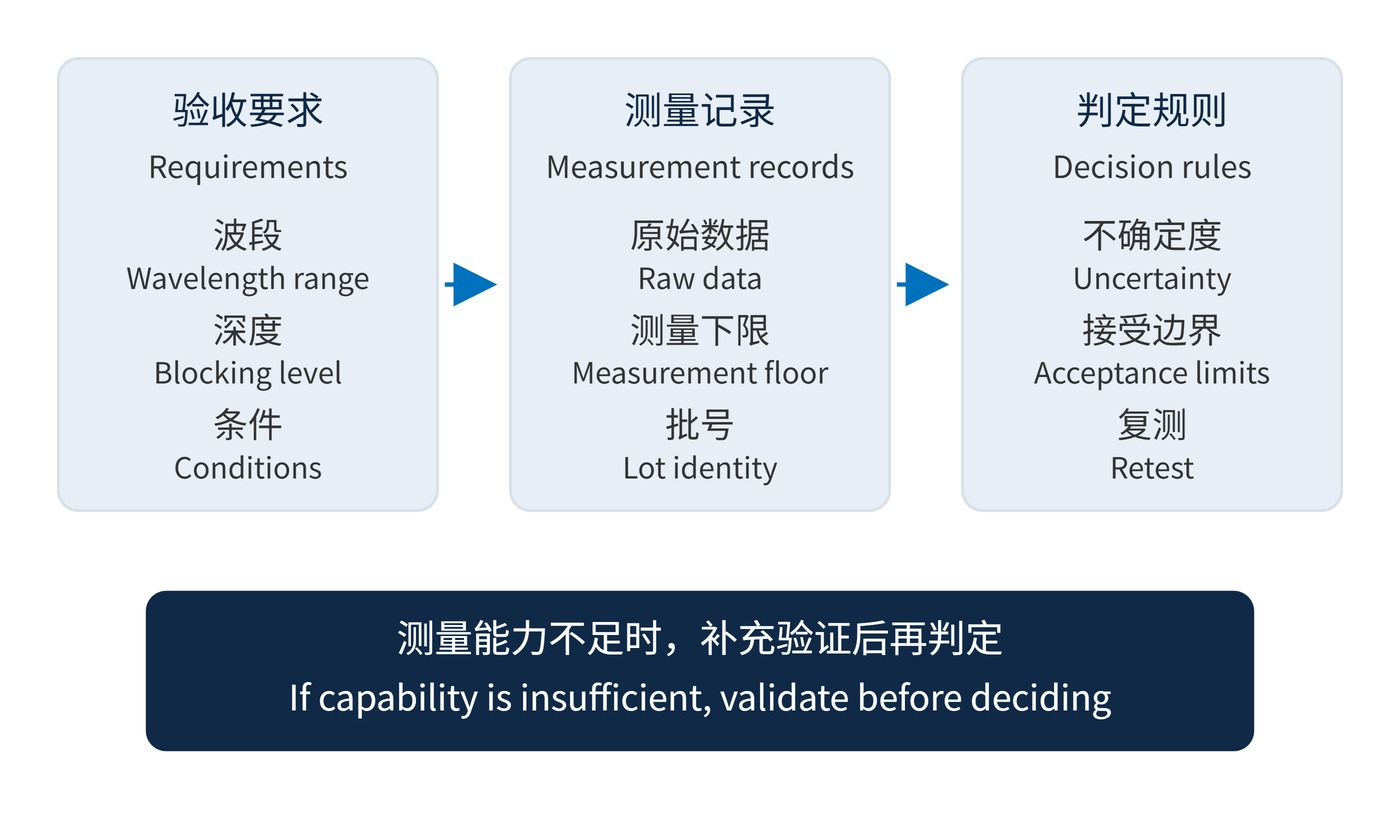
Fig. 2 links each requirement to a record and a decision. Stray light limits low-transmittance measurements: a flat trace near the instrument floor does not establish OD6. NIST's infrared filter characterization study illustrates why out-of-band measurements may require an extended dynamic range.
| Question | Evidence or agreement to request |
|---|---|
| 1. When does the lead-time clock start? | Drawing freeze, first-article and production delivery milestones. |
| 2. Do prototypes use the production process? | Differences, scale-up validation and lot traceability. |
| 3. How are parts packed and stored? | Surface protection, identification, storage conditions and transit-damage responsibility. |
| 4. How are nonconformities resolved? | Containment, retesting, root-cause analysis and replacement deadlines. |
| 5. How are changes or discontinuation announced? | Notice periods, requalification and record-retention terms. |
Fluorescence detection puts excitation leakage and the operating light cone first. Machine vision calls for illumination wavelengths, field angles and mounting aperture. Laser systems also require wavelength, pulse duration, repetition rate and damage-test conditions; thresholds from different test conditions are not directly comparable.
Early prototypes can address the largest risks. Before production, freeze the revision, retain reference samples and confirm inspection capacity at the planned output rate. Contractual guarantees should match the engineering acceptance sheet. If a prototype uses a different substrate source or coating route, request a documented comparison and an agreed production qualification plan. Retained samples are useful for investigating later differences, but they do not replace current lot records or a defined acceptance procedure.
A typical curve is not a guaranteed minimum. A conformity statement does not establish individual testing, and a process name does not establish durability. Document exceptions with their impact, additional tests and acceptance conditions.
Close the review only when critical requirements have defined test conditions, records identify the relevant parts or lots, and decisions follow agreed limits. Without those connections, supplier comparison still depends on promises.
 365nm Narrow Bandpass Filter | Ø50mm | T>90%
OT-HBP3659050
365nm Narrow Bandpass Filter; FWHM 10nm; transmission >90%; blocking OD5; size Ø50mm; AOI 0°.
 450nm Narrow Bandpass Filter | Ø50mm
OT-HBP4509050
450nm Narrow Bandpass Filter; FWHM 10nm; transmission >90%; blocking OD5; size Ø50mm; AOI 0°.
 525nm Narrow Bandpass Filter | Ø50mm
OT-HBP5259050
525nm Narrow Bandpass Filter; FWHM 10nm; transmission >90%; blocking OD5; size Ø50mm; AOI 0°.
Send us your drawing and spectral targets — an engineer replies with a feasibility check and quotation within one business day.