Original content by the OOTEE Optics editorial team, drawn from first-hand production line and inspection data. Please credit the source when republishing.
Given limits in expertise and test conditions, the theories, parameters and conclusions here carry no guarantee of absolute accuracy. For technical learning and exchange only - never the sole basis for design, acceptance or selection. Corrections welcome.

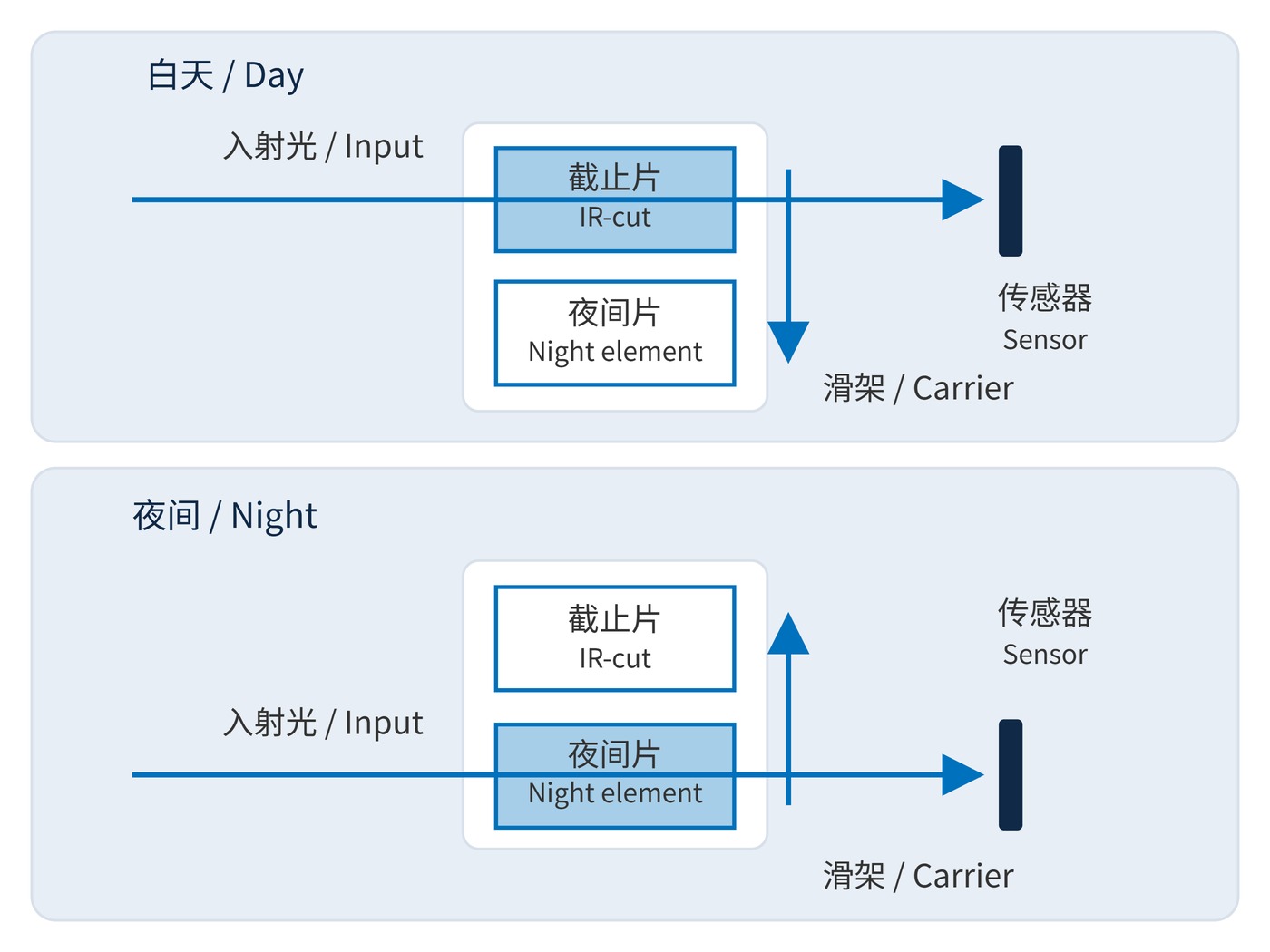
A day/night surveillance camera typically moves an infrared-cut filter into the imaging path for daytime operation and exchanges it for a night element after dark. The night element may be clear compensation glass or an infrared-transmitting filter. This is reflected-light imaging, distinct from detecting thermal emission.
Fig. 1 shows two positions of one shared sliding carrier. A pivoting mechanism can perform the same exchange. Clear glass admits both visible and near-infrared light; a narrow bandpass element selects the illuminator band. Removing the IR-cut filter therefore does not automatically create a narrowband camera.
An LED emits a spectrum rather than a single wavelength. Center wavelength (CWL), full width at half maximum (FWHM), optical density (OD), and angle of incidence (AOI) determine how much useful light reaches the sensor. OD uses fractional transmittance: OD4 means 0.01%, over a specified blocking range.
$$\mathrm{OD}(\lambda)=-\log_{10}T(\lambda)$$
Peak transmission alone does not predict the night signal. With photon spectral flux $\Phi_{\lambda}$ incident on the filter, quantum efficiency $\eta$, and exposure time $t$, the signal electron count is:
$$N_{\mathrm{s}}=t\int\Phi_{\lambda}(\lambda)T(\lambda)\eta(\lambda)\,\mathrm{d}\lambda$$
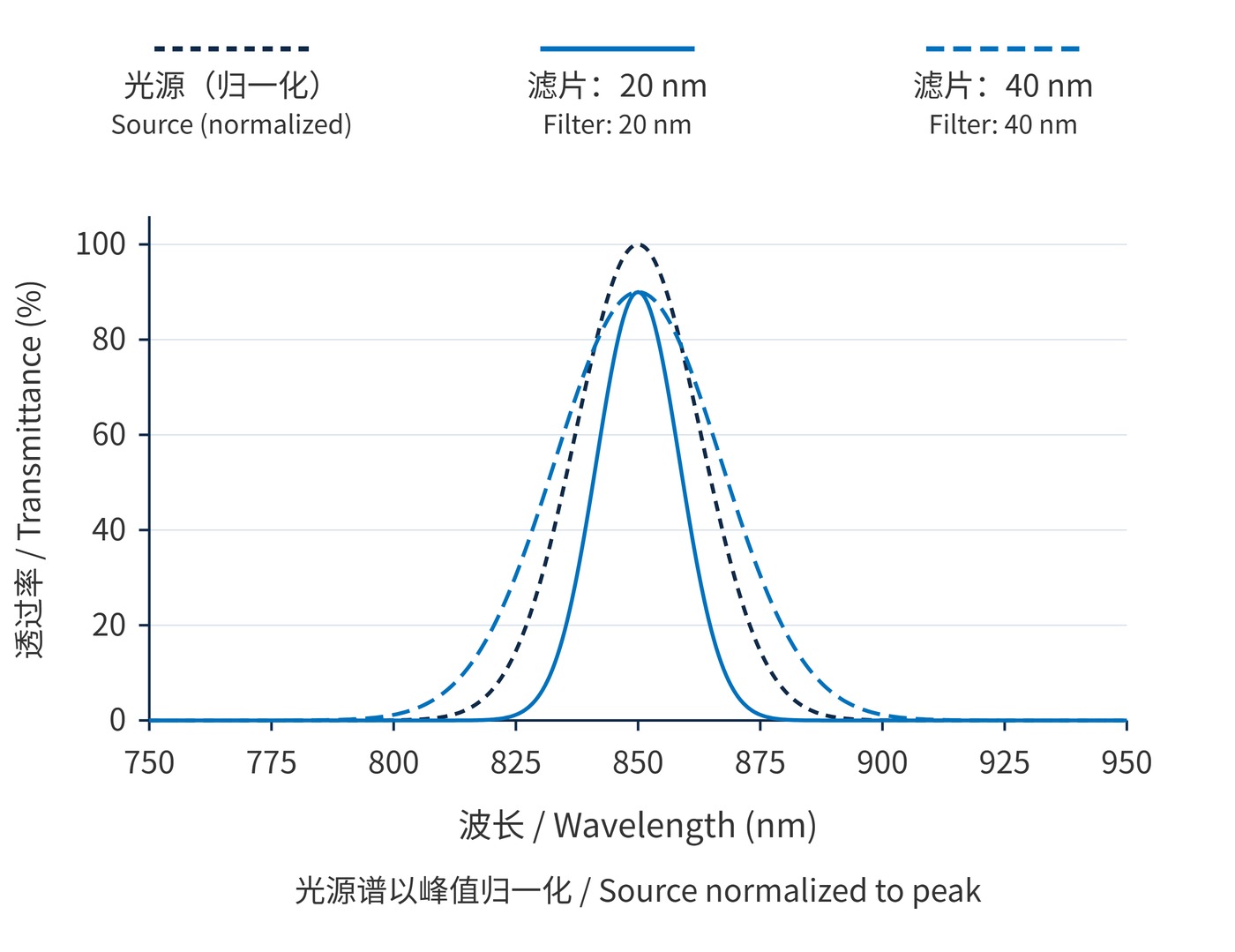
Fig. 2 uses Gaussian profiles centered at 850 nm. The LED has a 30 nm FWHM; both filters peak at 90%. Changing only filter FWHM from 20 nm to 40 nm increases the integrated fraction of LED light transmitted from about 50% to 72%. Target reflectance and detector response are excluded, so these are model results rather than measured camera sensitivity.
The two positions must also preserve focus. A plane-parallel plate introduces a paraxial focus shift of approximately $\Delta z\approx d(1-1/n)$, where $d$ is thickness and $n$ is refractive index. Equal thickness does not guarantee equal shift. Check wedge, seating tilt, mounting height, and the lens's visible-to-infrared focus difference.
850 nm commonly favors useful range, although an LED may show a faint red glow. Moving to 940 nm reduces that visibility risk but often encounters lower silicon-sensor response. Compare actual radiant output, quantum efficiency, and required distance rather than assuming equal reach.
| Night element | Operating need | Acceptance focus |
|---|---|---|
| Clear compensation glass | Retain ambient and near-infrared light | Matched focus shift, ghosts, sharpness in both states |
| 850 nm narrow bandpass | Active illumination with out-of-band rejection | LED overlap, angular shift, background saturation |
| 940 nm narrow bandpass | Installations sensitive to visible red glow | Response margin, hot LED output, moving-target exposure |
A discussion specification might use CWL 850 nm, FWHM 40 nm, peak transmission ≥90%, and OD4 blocking from 400–780 nm. Specify the opposite blocking region, transition intervals, and test AOI separately. These are illustrative requirements, not an offered product specification. When evaluating narrow bandpass filters, compare full curves with the LED spectrum at operating temperature. A 940 nm design requires a new throughput budget.
Translate service life into movements and failure criteria. At 20 one-way transitions per day, five years represents approximately 36500 movements, not a demonstrated lifetime rating. Define whether a supplier's cycle means one movement or a round trip. Test for sticking, positioning repeatability, aperture obstruction, and focus after switching at the specified temperature, supply voltage, orientation, and vibration conditions.
Use separate day-to-night and night-to-day thresholds, a persistence timer, and minimum dwell time. Otherwise headlights or feedback from the illuminator can repeatedly trigger the mechanism. Coordinate the LED, exposure, and carrier state; suppress transition frames and establish the carrier position after power loss.
A perimeter installation can begin by evaluating 850 nm illumination with clear night glass. A fixed traffic lane troubled by visible headlights may benefit from a bandpass night element. However, sunlight and headlights can also contribute in-band radiation. Exposure control, illumination level, viewing direction, and wide dynamic range imaging may still be needed.
Do not assume a longer wavelength will see through fog. Droplet scattering and backscatter from illumination close to the viewing axis can wash out the foreground. Backscatter occupies the same band as the target return and cannot be removed by spectral filtering. Test separated illuminators, reduced near-field illumination, and shorter working distances against identification performance.
For final acceptance, fix target, distance, illumination, temperature, and target speed. Compare sharpness, signal-to-noise ratio, saturated-pixel fraction, and switching settling time in both states. Repeatable night performance requires the filter, illuminator, and mechanism to pass under the same operating conditions.
 365nm Narrow Bandpass Filter | Ø50mm | T>90%
OT-HBP3659050
365nm Narrow Bandpass Filter; FWHM 10nm; transmission >90%; blocking OD5; size Ø50mm; AOI 0°.
 450nm Narrow Bandpass Filter | Ø50mm
OT-HBP4509050
450nm Narrow Bandpass Filter; FWHM 10nm; transmission >90%; blocking OD5; size Ø50mm; AOI 0°.
 525nm Narrow Bandpass Filter | Ø50mm
OT-HBP5259050
525nm Narrow Bandpass Filter; FWHM 10nm; transmission >90%; blocking OD5; size Ø50mm; AOI 0°.
Send us your drawing and spectral targets — an engineer replies with a feasibility check and quotation within one business day.