Original content by the OOTEE Optics editorial team, drawn from first-hand production line and inspection data. Please credit the source when republishing.
Given limits in expertise and test conditions, the theories, parameters and conclusions here carry no guarantee of absolute accuracy. For technical learning and exchange only - never the sole basis for design, acceptance or selection. Corrections welcome.
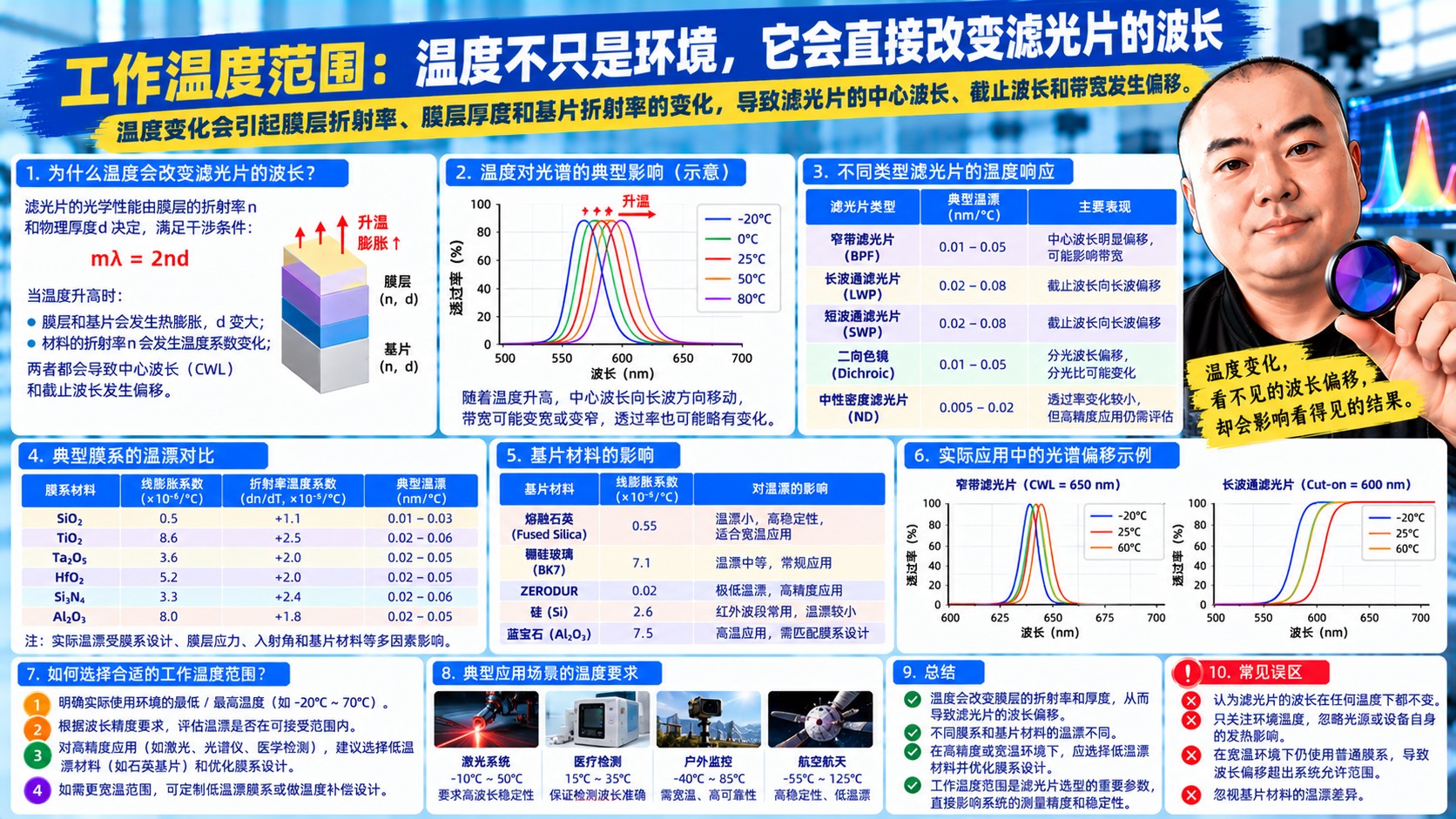
The operating temperature range is the ambient range over which a filter performs normally, in degrees C. It is often dismissed as a line like "-20 to +70 C", but temperature directly changes the optical behavior of the part.
Two mechanisms act together:
Together they shift the center wavelength. Most interference filters red-shift when heated. Typical magnitudes:
| Type | Typical thermal drift |
|---|---|
| Visible narrowband filter | about 0.01-0.03 nm per degree C |
| Near infrared narrowband | about 0.02-0.05 nm per degree C |
| Absorbing colored glass | Much smaller, though the edge still moves |
| Germanium based IR filter | Wavelength drift plus transmission falling as it heats |
Do the arithmetic: a 532 nm narrowband filter warming from 20 C to 60 C (40 degrees) drifts about 0.8 nm at 0.02 nm per degree. Irrelevant at 10 nm bandwidth, catastrophic at 2 nm.
Two-part form:
"Operating temperature range -20 C to +70 C; over that range center wavelength drift no more than 1 nm and peak transmission change no more than 2%."
For wavelength-critical systems, ask for a temperature compensated design that minimizes drift, or calibrate it out at system level.
Want the drift estimated? Send wavelength, bandwidth, temperature range and mounting method to sales@ootee.cn.
 365nm Narrow Bandpass Filter | Ø50mm | T>90%
OT-HBP3659050
365nm Narrow Bandpass Filter; FWHM 10nm; transmission >90%; blocking OD5; size Ø50mm; AOI 0°.
 450nm Narrow Bandpass Filter | Ø50mm
OT-HBP4509050
450nm Narrow Bandpass Filter; FWHM 10nm; transmission >90%; blocking OD5; size Ø50mm; AOI 0°.
 525nm Narrow Bandpass Filter | Ø50mm
OT-HBP5259050
525nm Narrow Bandpass Filter; FWHM 10nm; transmission >90%; blocking OD5; size Ø50mm; AOI 0°.
Send us your drawing and spectral targets — an engineer replies with a feasibility check and quotation within one business day.