Original content by the OOTEE Optics editorial team, drawn from first-hand production line and inspection data. Please credit the source when republishing.
Given limits in expertise and test conditions, the theories, parameters and conclusions here carry no guarantee of absolute accuracy. For technical learning and exchange only - never the sole basis for design, acceptance or selection. Corrections welcome.
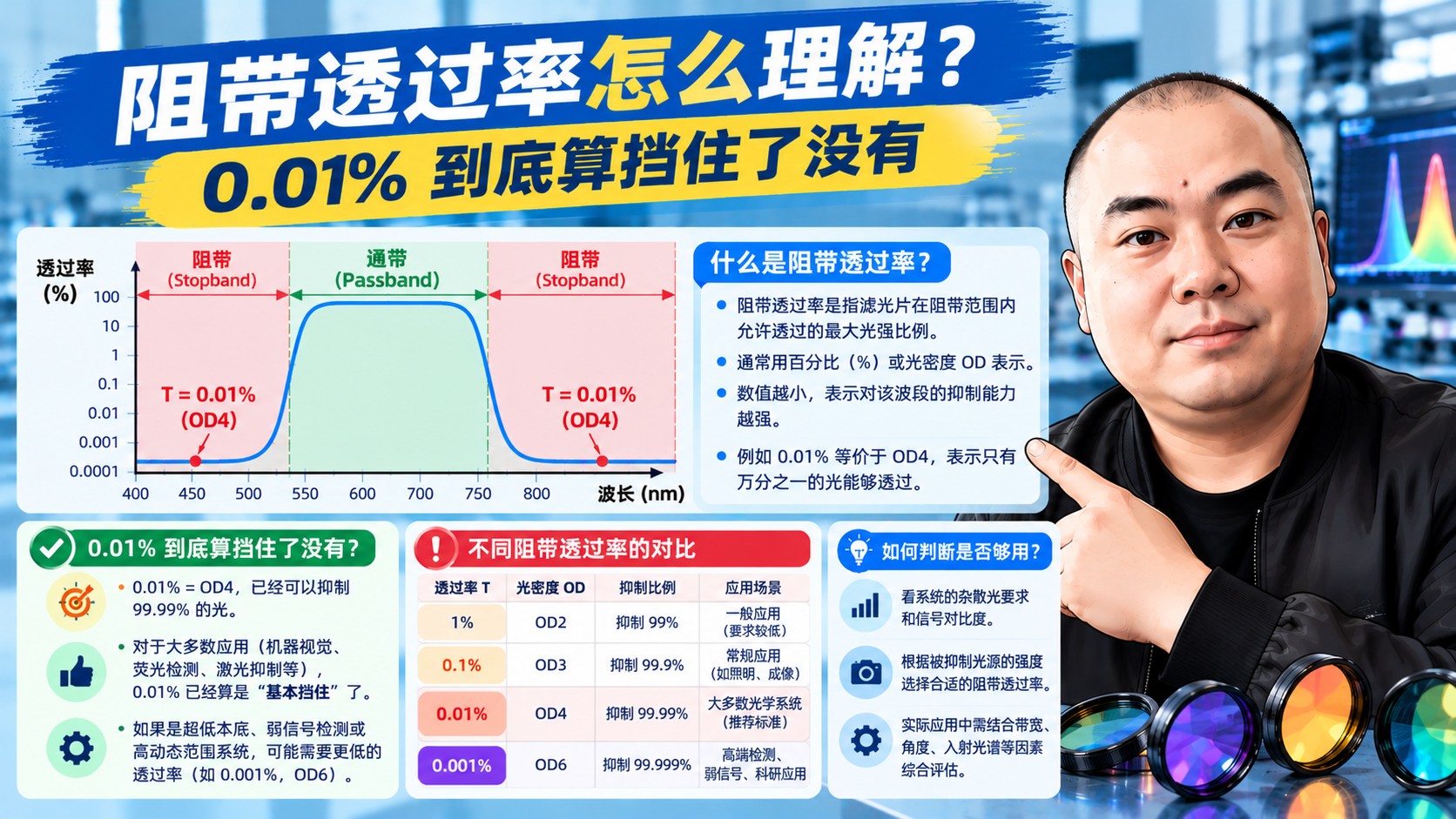
Stopband transmission answers: what is the largest fraction of light the filter lets through its stopband? It is the same quantity as OD, written differently:
T = 10^(-OD) so OD4 means T = 0.01%.
If they are equivalent, why do datasheets use both? Because the viewpoints differ: OD expresses how deep the blocking is; percent transmission expresses how much stray light survives. Percentages are more intuitive when you are building a system budget.
This is the single most important point of the article. Two forms exist:
| Wording | Meaning | Risk |
|---|---|---|
| Typical stopband transmission below 0.01% | Most parts achieve it; some may exceed | High risk - a part at 0.05% still complies |
| Maximum stopband transmission no more than 0.01% | Every part, every wavelength in the stopband | Safe, directly usable as acceptance criterion |
In volume purchasing the difference multiplies: if 20 out of 500 parts leak more, you have 20 instruments with washed-out images and 20 service cases. Changing "typical" to "maximum" costs one word and saves a great deal of trouble.
The criterion is not the number but whether the leaked light or your signal is stronger. A simple method:
Example: in a fluorescence system the excitation light reaching the detector can be 10 to the power of 5 times the signal. To keep leakage below one tenth of the signal you need stopband transmission of 10 to the minus 6 - that is OD6. This is exactly why fluorescence filters commonly specify OD5 to OD6.
Conversely, in machine vision the ambient light may exceed the signal by only 10 to 100 times, so OD3-OD4 (0.1% to 0.01%) is ample and OD6 would be wasted money.
The same 0.01% matters a lot where the detector is sensitive and not at all where it is blind. The right approach is weighting by detector response:
For that reason, "OD4" written over 400-700 nm and over 400-1000 nm are very different products. Specify first for the bands where the detector responds and background exists, rather than asking for everything.
Want help with a leakage budget? Send the source spectrum, detector model and an order-of-magnitude signal level to sales@ootee.cn and we will back out the OD required in each band.
 365nm Narrow Bandpass Filter | Ø50mm | T>90%
OT-HBP3659050
365nm Narrow Bandpass Filter; FWHM 10nm; transmission >90%; blocking OD5; size Ø50mm; AOI 0°.
 450nm Narrow Bandpass Filter | Ø50mm
OT-HBP4509050
450nm Narrow Bandpass Filter; FWHM 10nm; transmission >90%; blocking OD5; size Ø50mm; AOI 0°.
 525nm Narrow Bandpass Filter | Ø50mm
OT-HBP5259050
525nm Narrow Bandpass Filter; FWHM 10nm; transmission >90%; blocking OD5; size Ø50mm; AOI 0°.
Send us your drawing and spectral targets — an engineer replies with a feasibility check and quotation within one business day.