Original content by the OOTEE Optics editorial team, drawn from first-hand production line and inspection data. Please credit the source when republishing.
Given limits in expertise and test conditions, the theories, parameters and conclusions here carry no guarantee of absolute accuracy. For technical learning and exchange only - never the sole basis for design, acceptance or selection. Corrections welcome.
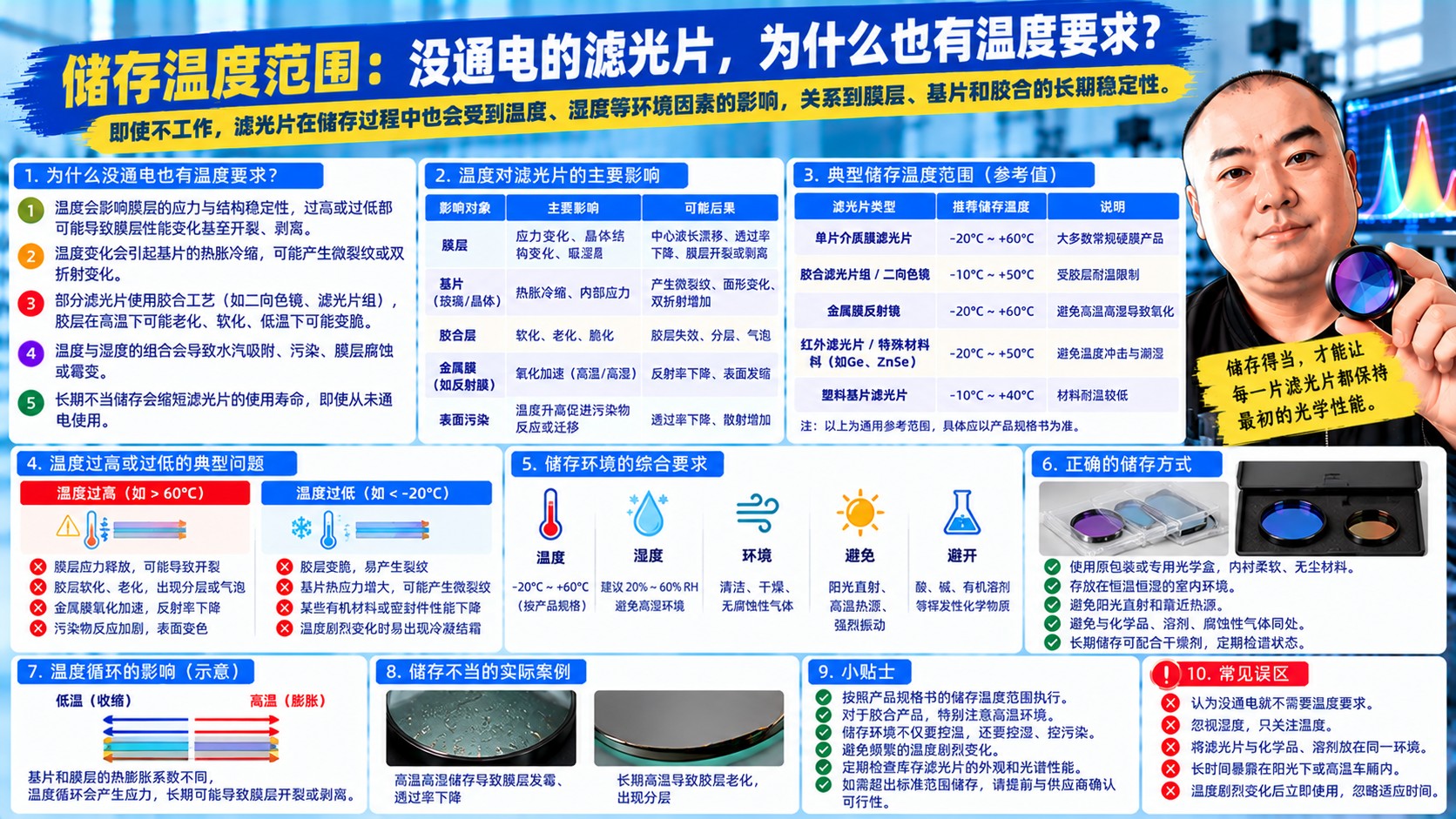
The storage temperature range is the interval in which a filter may be kept while not in use, in degrees C. Often treated as a footnote, it decides whether the parts are still conforming when they arrive from the warehouse or a long shipment.
| Item | Operating range | Storage range |
|---|---|---|
| Definition | In use, performance must meet spec | Not in use, no permanent damage allowed |
| Criterion | Optical figures met in service | Figures still met after returning to room temperature |
| Width | Narrower | Usually wider |
| Typical values | -20 to +70 C | -40 to +85 C |
The key difference is the criterion: performance need not hold at the storage extreme, but it must recover once back at room temperature. Exceeding the upper limit can cause permanent change - yellowed adhesive, oxidized film - that no amount of cooling back will undo.
In storage and shipping incidents the culprit is rarely the temperature itself but condensation:
The correct handling: let the package return to room temperature for several hours before opening. Tell your warehouse staff - this step is skipped constantly.
If your supply chain includes these, say so and require packaging with cushioning and thermal buffering.
"Storage temperature range -40 C to +85 C; packaging to include desiccant and cushioning; avoid severe temperature swings in transit."
For export or long-haul shipments, also agree on drop testing and temperature-humidity logging so any dispute has evidence behind it.
Need packaging assessed for your logistics route? Send the transport mode, destination and seasonal conditions to sales@ootee.cn.
 365nm Narrow Bandpass Filter | Ø50mm | T>90%
OT-HBP3659050
365nm Narrow Bandpass Filter; FWHM 10nm; transmission >90%; blocking OD5; size Ø50mm; AOI 0°.
 450nm Narrow Bandpass Filter | Ø50mm
OT-HBP4509050
450nm Narrow Bandpass Filter; FWHM 10nm; transmission >90%; blocking OD5; size Ø50mm; AOI 0°.
 525nm Narrow Bandpass Filter | Ø50mm
OT-HBP5259050
525nm Narrow Bandpass Filter; FWHM 10nm; transmission >90%; blocking OD5; size Ø50mm; AOI 0°.
Send us your drawing and spectral targets — an engineer replies with a feasibility check and quotation within one business day.