Original content by the OOTEE Optics editorial team, drawn from first-hand production line and inspection data. Please credit the source when republishing.
Given limits in expertise and test conditions, the theories, parameters and conclusions here carry no guarantee of absolute accuracy. For technical learning and exchange only - never the sole basis for design, acceptance or selection. Corrections welcome.
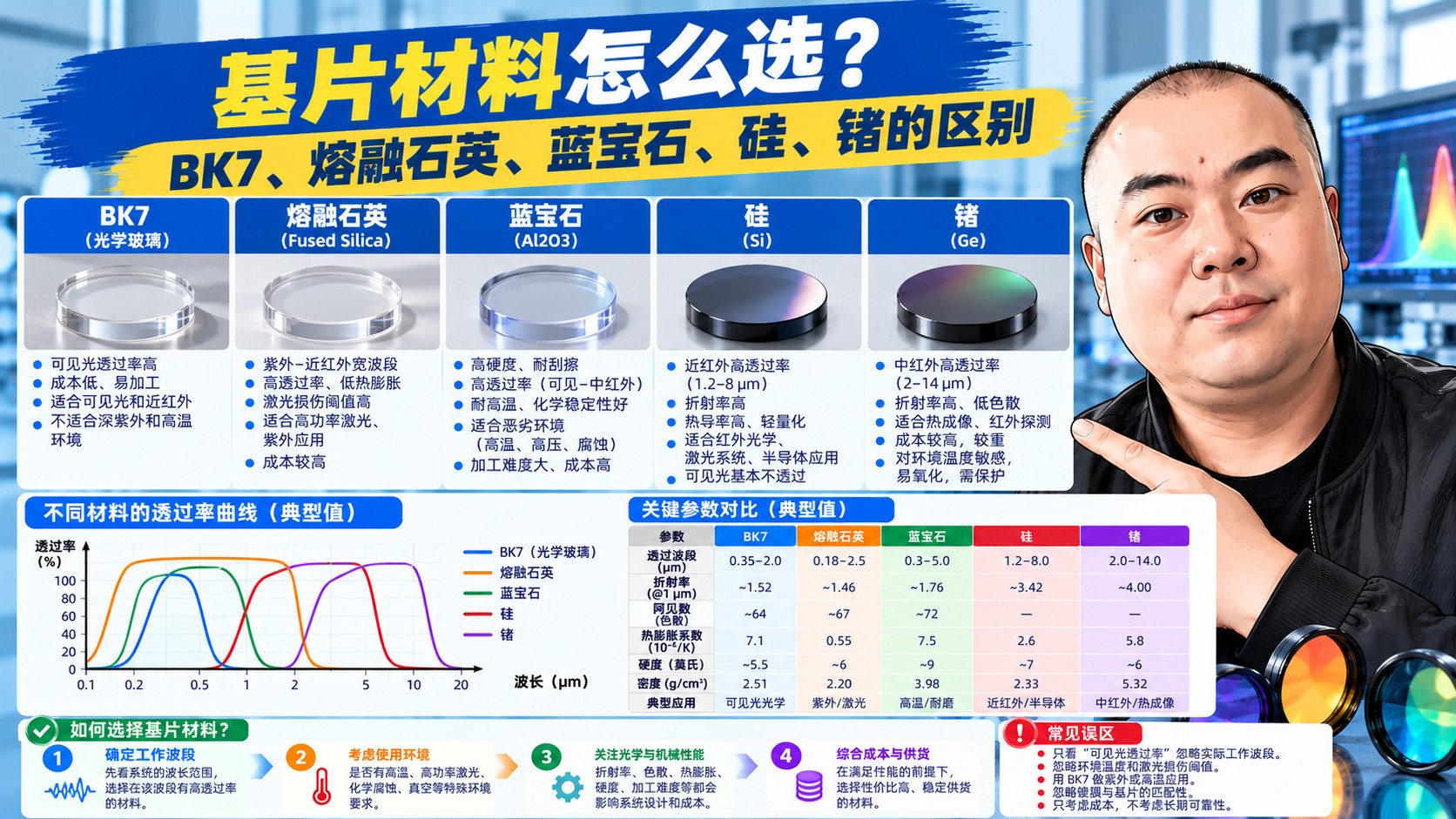
The substrate is the base that carries the coating. It does not select wavelengths - that is the coating's job - but it decides three things: which band you can use, how much temperature you can survive, and how much mechanical and environmental abuse the part takes.
Picking the wrong substrate is one of the hardest mistakes to fix, because once the coating is deposited the base cannot be swapped.
| Material | Transmission window | Character | Typical use |
|---|---|---|---|
| BK7 / K9 optical glass | about 350-2000 nm | Cheap, easy to polish, good homogeneity | Visible filters, machine vision |
| Fused silica | about 180-2500 nm | Excellent UV transmission, very low expansion | UV filters, laser optics |
| Sapphire | about 200-5000 nm | Extremely hard (Mohs 9), scratch and corrosion resistant | Harsh environment windows, medical, defense |
| Silicon | about 1200 nm to 7 micrometers | IR workhorse, good thermal conductivity, opaque in visible | NIR and mid-IR filters |
| Germanium | about 2-14 micrometers | LWIR workhorse; transmission drops as temperature rises | Thermal imaging, IR thermometry |
| Calcium fluoride | about 180 nm to 8 micrometers | Very wide window, low dispersion, but soft and moisture sensitive | Deep UV, broadband systems |
| Colored glass (Schott family and similar) | by glass type | Intrinsic absorption that supplements interference blocking | Machine vision, blocking reinforcement |
This is a hard gate: outside its window the material is simply a wall. Ordinary glass absorbs almost everything at 254 nm and no coating can rescue it; silicon is opaque grey in the visible and cannot host a visible filter.
Substrate and coating cannot be combined arbitrarily. Two issues dominate:
This is why "change the substrate" usually means "redevelop the coating process", not simply coating a different blank.
Not sure which one fits? Send the band, operating temperature, environment and budget to sales@ootee.cn for two or three viable options with cost comparison.
 365nm Narrow Bandpass Filter | Ø50mm | T>90%
OT-HBP3659050
365nm Narrow Bandpass Filter; FWHM 10nm; transmission >90%; blocking OD5; size Ø50mm; AOI 0°.
 450nm Narrow Bandpass Filter | Ø50mm
OT-HBP4509050
450nm Narrow Bandpass Filter; FWHM 10nm; transmission >90%; blocking OD5; size Ø50mm; AOI 0°.
 525nm Narrow Bandpass Filter | Ø50mm
OT-HBP5259050
525nm Narrow Bandpass Filter; FWHM 10nm; transmission >90%; blocking OD5; size Ø50mm; AOI 0°.
Send us your drawing and spectral targets — an engineer replies with a feasibility check and quotation within one business day.