Original content by the OOTEE Optics editorial team, drawn from first-hand production line and inspection data. Please credit the source when republishing.
Given limits in expertise and test conditions, the theories, parameters and conclusions here carry no guarantee of absolute accuracy. For technical learning and exchange only - never the sole basis for design, acceptance or selection. Corrections welcome.
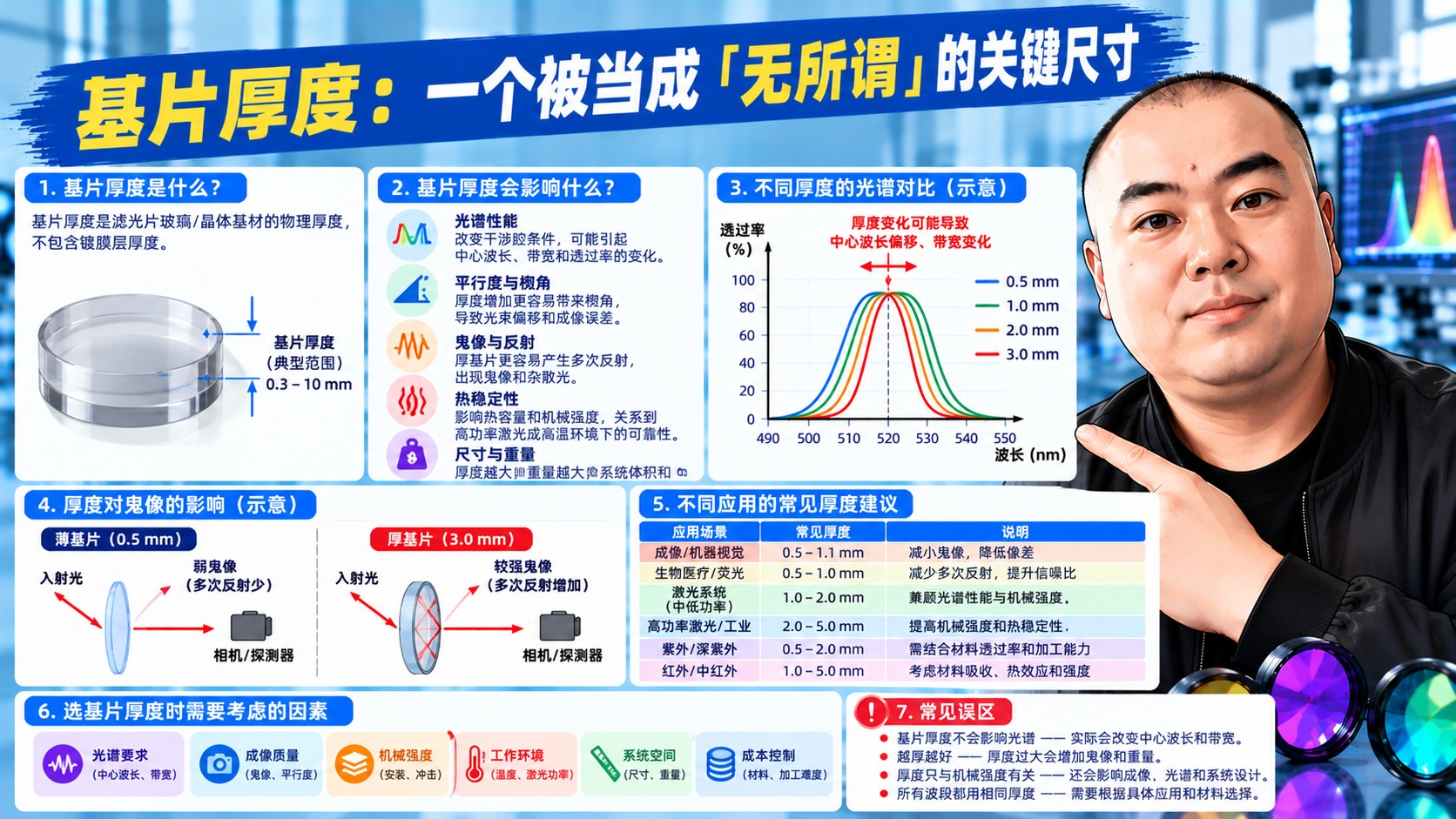
Substrate thickness, in millimeters, is often left blank on a purchase order or marked "standard" - until assembly or focusing goes wrong and it turns out to be a real parameter.
Inserting a filter into a beam adds a higher-index medium where there was air, moving the focus. The shift is approximately:
delta approx t x (1 - 1/n) (t = thickness, n = substrate index)
For 1 mm of BK7 (n about 1.52) the focus moves back roughly 0.34 mm. In a high-magnification microscope whose depth of focus is tens of micrometers, that alone softens the image. Collimated paths are forgiving; converging paths are not.
Rule of thumb: keep the diameter-to-thickness ratio between 10:1 and 20:1. A 25 mm diameter part typically lands at 1.0-2.0 mm.
Longer path means more absorption. Negligible for visible glass, but not in these cases:
Thick parts have more thermal mass and develop larger gradients under thermal shock; thin parts respond fast but deform more easily. Large aperture infrared optics (germanium at 5.33 g/cm3) impose real weight on the mechanical design.
| Thickness | Suitable for | Caveat |
|---|---|---|
| 0.1-0.3 mm | Ultra-thin windows, sensor covers | Warps and cracks easily; needs special process |
| 0.5-1.0 mm | Small filters, filter wheels | Common, good value |
| 1.0-2.0 mm | Standard filters (12.5-25 mm diameter) | The most versatile balance of strength and weight |
| 3.0-5.0 mm | Large apertures, tight figure requirements | Stable figure, higher absorption and cost |
Plus or minus 0.1 mm is normally fine; precision assemblies want 0.05 mm; focus-critical or stacked designs can tighten to 0.02 mm at higher cost. Tighter tolerance means higher scrap - ask for what you need, no more.
Unsure about thickness? Send the mounting method, aperture and band to sales@ootee.cn for a recommended thickness and tolerance.
 365nm Narrow Bandpass Filter | Ø50mm | T>90%
OT-HBP3659050
365nm Narrow Bandpass Filter; FWHM 10nm; transmission >90%; blocking OD5; size Ø50mm; AOI 0°.
 450nm Narrow Bandpass Filter | Ø50mm
OT-HBP4509050
450nm Narrow Bandpass Filter; FWHM 10nm; transmission >90%; blocking OD5; size Ø50mm; AOI 0°.
 525nm Narrow Bandpass Filter | Ø50mm
OT-HBP5259050
525nm Narrow Bandpass Filter; FWHM 10nm; transmission >90%; blocking OD5; size Ø50mm; AOI 0°.
Send us your drawing and spectral targets — an engineer replies with a feasibility check and quotation within one business day.