Original content by the OOTEE Optics editorial team, drawn from first-hand production line and inspection data. Please credit the source when republishing.
Given limits in expertise and test conditions, the theories, parameters and conclusions here carry no guarantee of absolute accuracy. For technical learning and exchange only - never the sole basis for design, acceptance or selection. Corrections welcome.
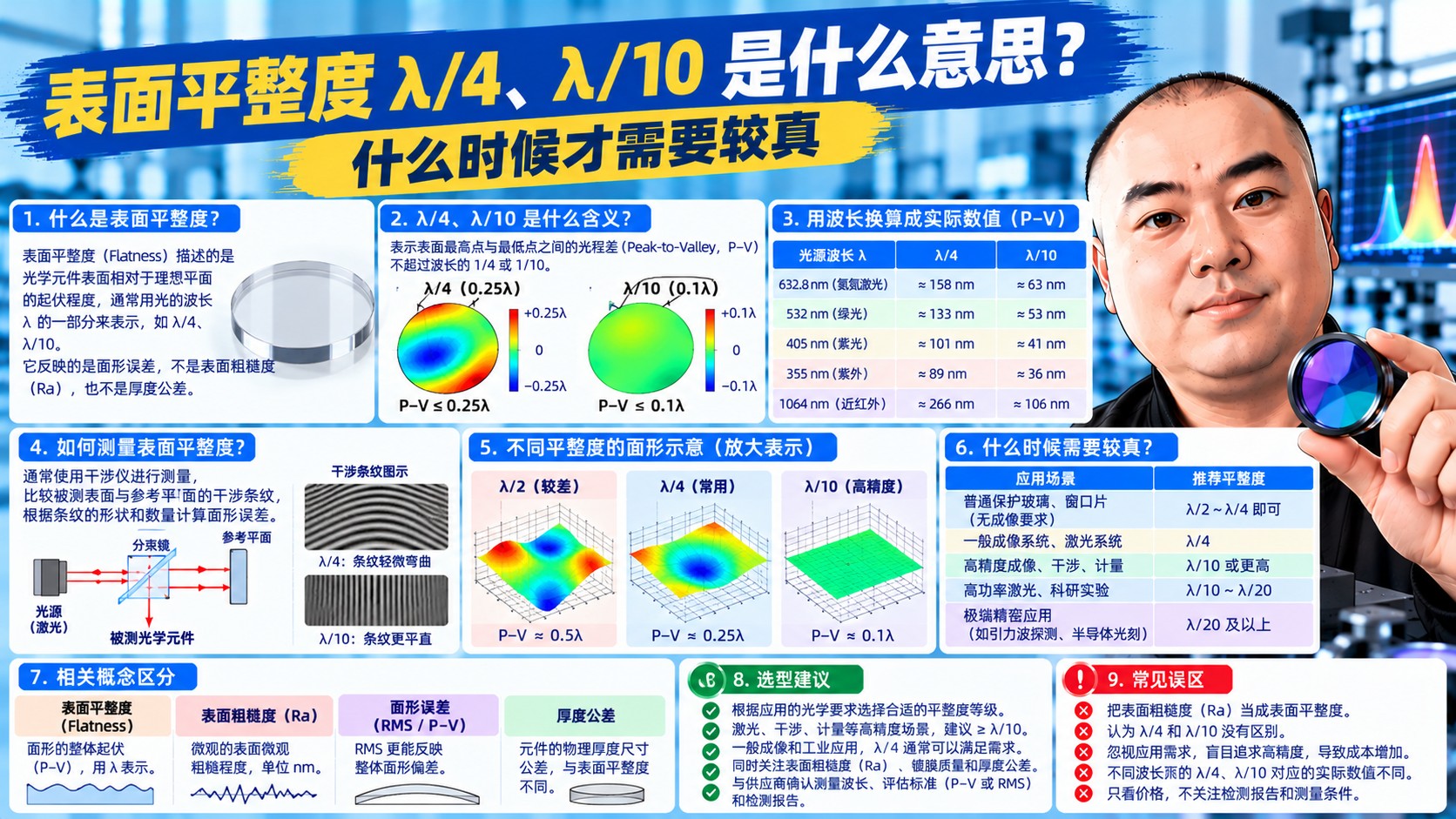
Surface flatness describes the deviation of an optical surface from an ideal plane, conventionally written as a fraction of the wavelength: lambda/2, lambda/4, lambda/10, lambda/20. The larger the denominator, the flatter the surface.
The usual reference is the helium-neon wavelength, lambda = 632.8 nm:
| Notation | Peak-to-valley deviation | Equivalent |
|---|---|---|
| lambda/2 | about 316 nm | roughly 0.3 micrometers, routine industrial grade |
| lambda/4 | about 158 nm | the most common commercial precision grade |
| lambda/10 | about 63 nm | precision imaging and laser work |
| lambda/20 | about 32 nm | high precision interferometry, lithography related |
For scale, a human hair is about 50-70 micrometers across. Lambda over four is roughly one four-hundredth of that - optical manufacturing tolerances are far finer than everyday intuition suggests.
Place the surface against a reference flat (or in an interferometer) and illuminate it with monochromatic light to produce equal-thickness fringes:
This is also why the specification is written "lambda/4 at 632.8 nm" - without the reference wavelength the number is meaningless.
A filter is a transmissive component, so errors on both faces accumulate into transmitted wavefront error (TWE):
Many applications are surprisingly insensitive, and tightening the figure only adds cost:
Every step up in flatness raises polishing time, inspection cost and scrap. Typical tiers:
Special warning: thin and large parts are hard to keep flat. A 50 mm diameter, 0.5 mm thick part distorts easily during polishing and coating, so lambda/10 is often unrealistic. Increase thickness or relax the figure instead.
"Surface flatness: coated face lambda/4 at 632.8 nm, other face lambda/2."
Requiring it only on the critical face is the most direct way to control cost. If your system is wavefront sensitive, add a TWE requirement as well.
Want a sanity check on your flatness requirement? Send dimensions, thickness and application to sales@ootee.cn for manufacturability and cost feedback.
 365nm Narrow Bandpass Filter | Ø50mm | T>90%
OT-HBP3659050
365nm Narrow Bandpass Filter; FWHM 10nm; transmission >90%; blocking OD5; size Ø50mm; AOI 0°.
 450nm Narrow Bandpass Filter | Ø50mm
OT-HBP4509050
450nm Narrow Bandpass Filter; FWHM 10nm; transmission >90%; blocking OD5; size Ø50mm; AOI 0°.
 525nm Narrow Bandpass Filter | Ø50mm
OT-HBP5259050
525nm Narrow Bandpass Filter; FWHM 10nm; transmission >90%; blocking OD5; size Ø50mm; AOI 0°.
Send us your drawing and spectral targets — an engineer replies with a feasibility check and quotation within one business day.