Original content by the OOTEE Optics editorial team, drawn from first-hand production line and inspection data. Please credit the source when republishing.
Given limits in expertise and test conditions, the theories, parameters and conclusions here carry no guarantee of absolute accuracy. For technical learning and exchange only - never the sole basis for design, acceptance or selection. Corrections welcome.
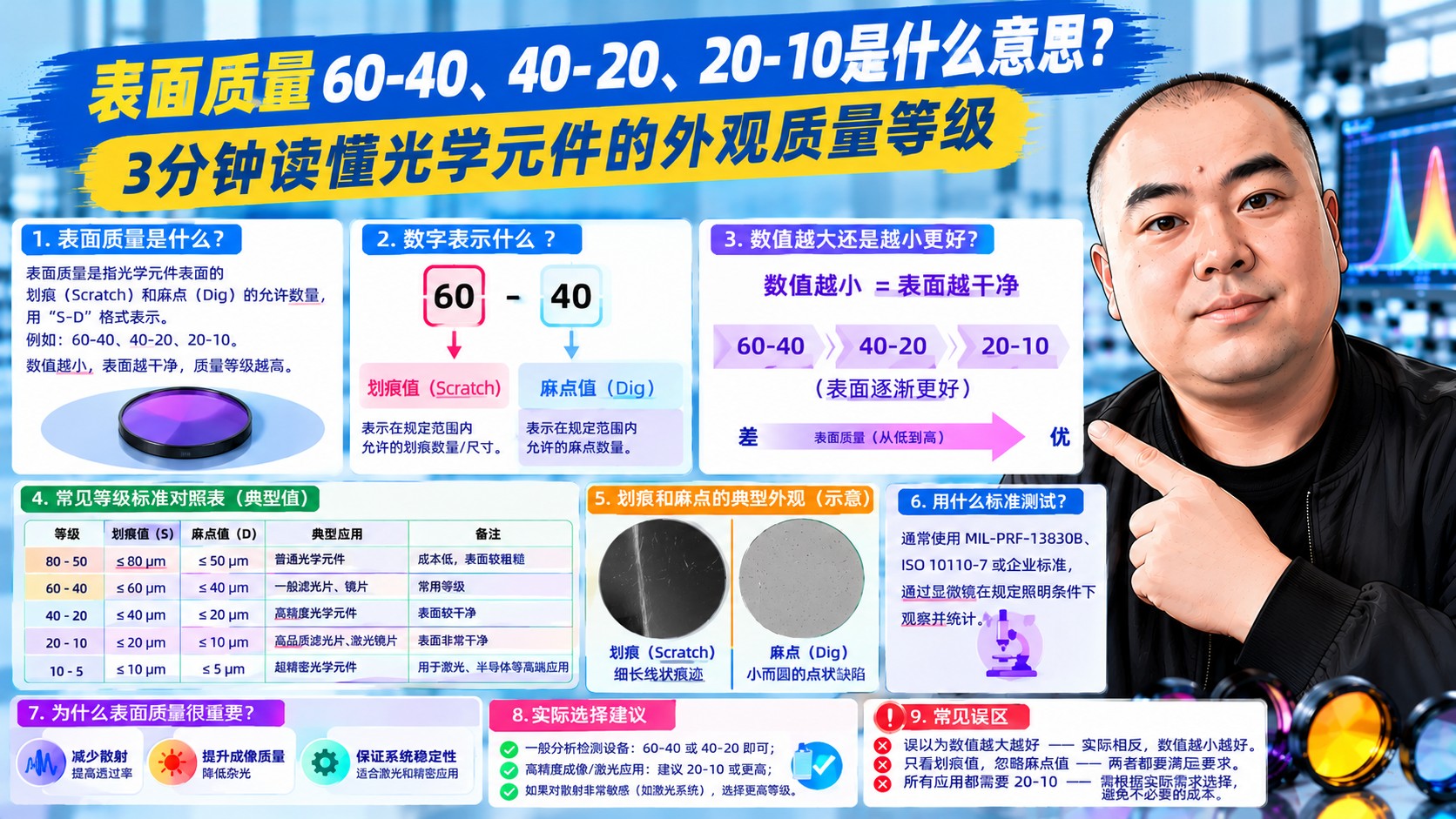
Surface quality grades the scratches and digs on an optical surface. The universal notation is "scratch number - dig number", for example 60-40, 40-20 or 20-10.
One line to remember: smaller numbers mean stricter requirements and higher prices.
| Item | Meaning | How it is judged |
|---|---|---|
| Scratch number (60, 40, 20 ...) | Visibility grade of scratches | Visual comparison against reference standards under defined lighting - not a length or width |
| Dig number (40, 20, 10 ...) | Largest allowed pit | Pit diameter is roughly the dig number times 0.01 mm (dig 20 is about 0.2 mm) |
The scratch number is constantly misunderstood. A 60 scratch is not 60 micrometers wide or 60 millimeters long; it is the number of the reference standard it matches. An inspector compares the surface with standard samples under specified illumination in a darkroom. It is subjective but universally accepted across the industry (originating from MIL-PRF-13830B).
| Grade | Application | Cost impact |
|---|---|---|
| 80-50 | Lighting, non-imaging use, protective windows | Lowest |
| 60-40 | The mainstream grade for imaging and industrial filters | Baseline |
| 40-20 | Precision imaging, medical, laboratory instruments | Slightly higher |
| 20-10 | Laser systems, high power, ultraviolet work | Clearly higher |
| 10-5 and better | Ultrafast lasers, extreme ultraviolet | High; dedicated polishing and inspection |
Scratches and digs are not merely cosmetic:
That is why laser work routinely demands 20-10 - not over-specification, but a necessary threshold against damage.
Surface quality is a visual criterion, so different inspectors can read it differently. Recommended:
Unsure which grade fits? Send the application type (imaging, laser, lighting) and power level to sales@ootee.cn for a sufficient and economical recommendation.
 365nm Narrow Bandpass Filter | Ø50mm | T>90%
OT-HBP3659050
365nm Narrow Bandpass Filter; FWHM 10nm; transmission >90%; blocking OD5; size Ø50mm; AOI 0°.
 450nm Narrow Bandpass Filter | Ø50mm
OT-HBP4509050
450nm Narrow Bandpass Filter; FWHM 10nm; transmission >90%; blocking OD5; size Ø50mm; AOI 0°.
 525nm Narrow Bandpass Filter | Ø50mm
OT-HBP5259050
525nm Narrow Bandpass Filter; FWHM 10nm; transmission >90%; blocking OD5; size Ø50mm; AOI 0°.
Send us your drawing and spectral targets — an engineer replies with a feasibility check and quotation within one business day.