Original content by the OOTEE Optics editorial team, drawn from first-hand production line and inspection data. Please credit the source when republishing.
Given limits in expertise and test conditions, the theories, parameters and conclusions here carry no guarantee of absolute accuracy. For technical learning and exchange only - never the sole basis for design, acceptance or selection. Corrections welcome.
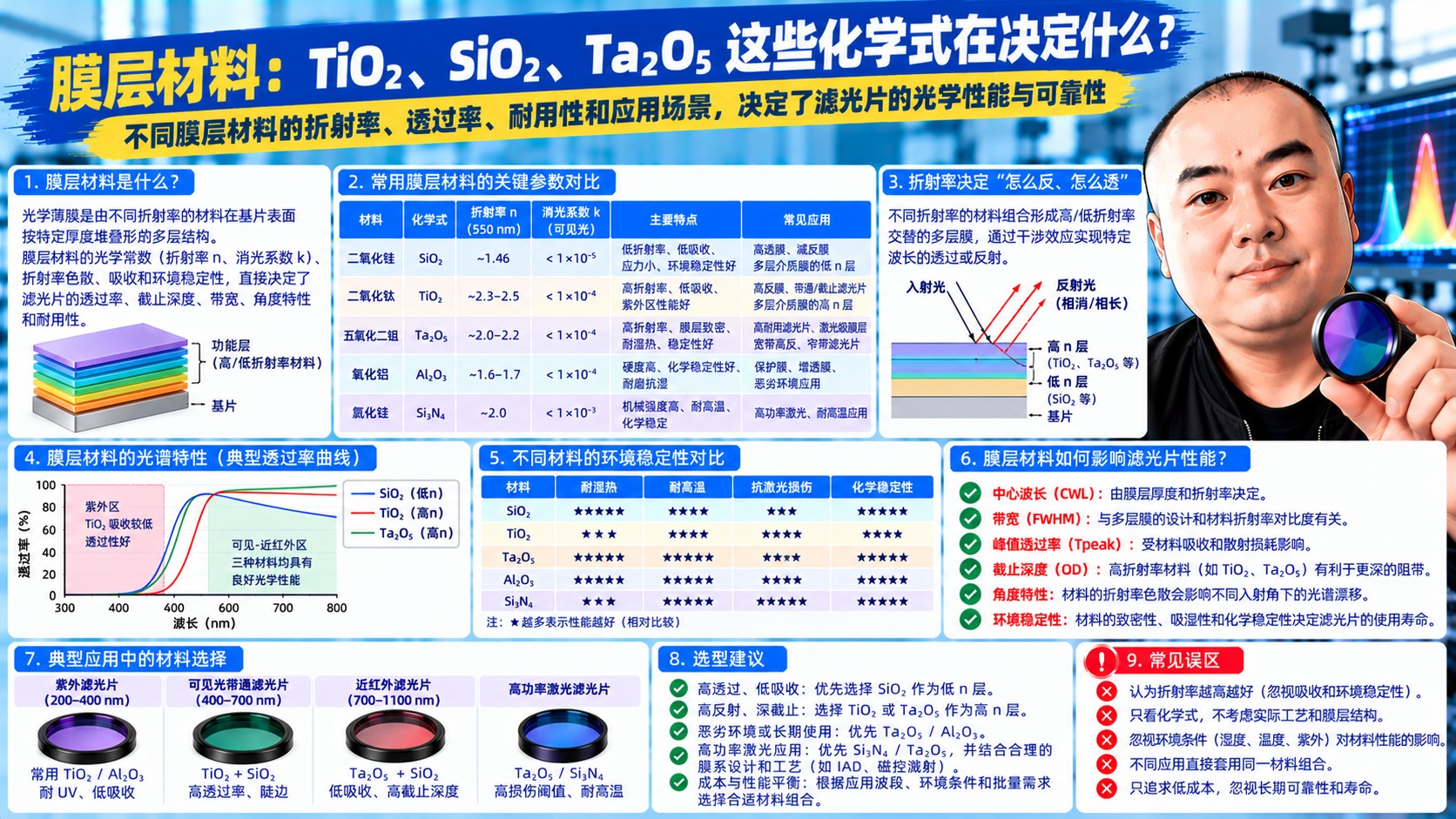
An interference filter is dozens to hundreds of alternating thin layers, and the choice of material for each layer determines how narrow, how deep and how stable the finished part can be.
The building block is a high-index layer paired with a low-index one. The larger the index contrast, the stronger the reflection at each interface, which means:
That is why TiO2 (n about 2.3-2.4 in the visible) with SiO2 (n about 1.46) is such a classic pair: the contrast approaches 1, making it extremely efficient.
| Material | Index (visible) | Character | Usable band |
|---|---|---|---|
| SiO2 (silica) | about 1.46 | The standard low-index material: stable, low absorption, hard | Deep UV to near IR |
| TiO2 (titania) | about 2.3-2.4 | One of the highest indices, but absorbs noticeably in the UV | Visible to near IR |
| Ta2O5 (tantala) | about 2.1 | Low UV absorption and excellent stability; dearer than TiO2 | UV to near IR |
| Nb2O5 (niobia) | about 2.3 | Close to TiO2 with slightly lower absorption | Visible to near IR |
| MgF2 (magnesium fluoride) | about 1.38 | One of the lowest indices; good UV transmission | Deep UV to visible |
| Al2O3 (alumina) | about 1.65 | Dense and hard; used as an intermediate or protective layer | Deep UV to IR |
| Si (silicon) | about 3.5 (IR) | High index, the infrared workhorse | Near IR to mid IR |
| Ge (germanium) | about 4.0 (IR) | Very high index, the long wave IR workhorse | Mid IR to long wave IR |
Every material has an absorption edge beyond which it absorbs strongly and stops being transparent:
This is also why UV filters generally show lower peak transmission: few materials are available and all carry some residual absorption.
The extinction coefficient eats transmission directly, and with many layers the loss accumulates - one reason ultra-narrow filters rarely exceed 70% peak.
LIDT varies hugely between materials. High power laser coatings usually avoid the more absorbing options (TiO2 in certain bands) in favour of Ta2O5, HfO2 or Al2O3.
Most buyers need not specify materials, but should confirm:
Replacing an imported part? Send the measured curve to sales@ootee.cn and we will work back to the material system and quote an equivalent.
 365nm Narrow Bandpass Filter | Ø50mm | T>90%
OT-HBP3659050
365nm Narrow Bandpass Filter; FWHM 10nm; transmission >90%; blocking OD5; size Ø50mm; AOI 0°.
 450nm Narrow Bandpass Filter | Ø50mm
OT-HBP4509050
450nm Narrow Bandpass Filter; FWHM 10nm; transmission >90%; blocking OD5; size Ø50mm; AOI 0°.
 525nm Narrow Bandpass Filter | Ø50mm
OT-HBP5259050
525nm Narrow Bandpass Filter; FWHM 10nm; transmission >90%; blocking OD5; size Ø50mm; AOI 0°.
Send us your drawing and spectral targets — an engineer replies with a feasibility check and quotation within one business day.