Original content by the OOTEE Optics editorial team, drawn from first-hand production line and inspection data. Please credit the source when republishing.
Given limits in expertise and test conditions, the theories, parameters and conclusions here carry no guarantee of absolute accuracy. For technical learning and exchange only - never the sole basis for design, acceptance or selection. Corrections welcome.
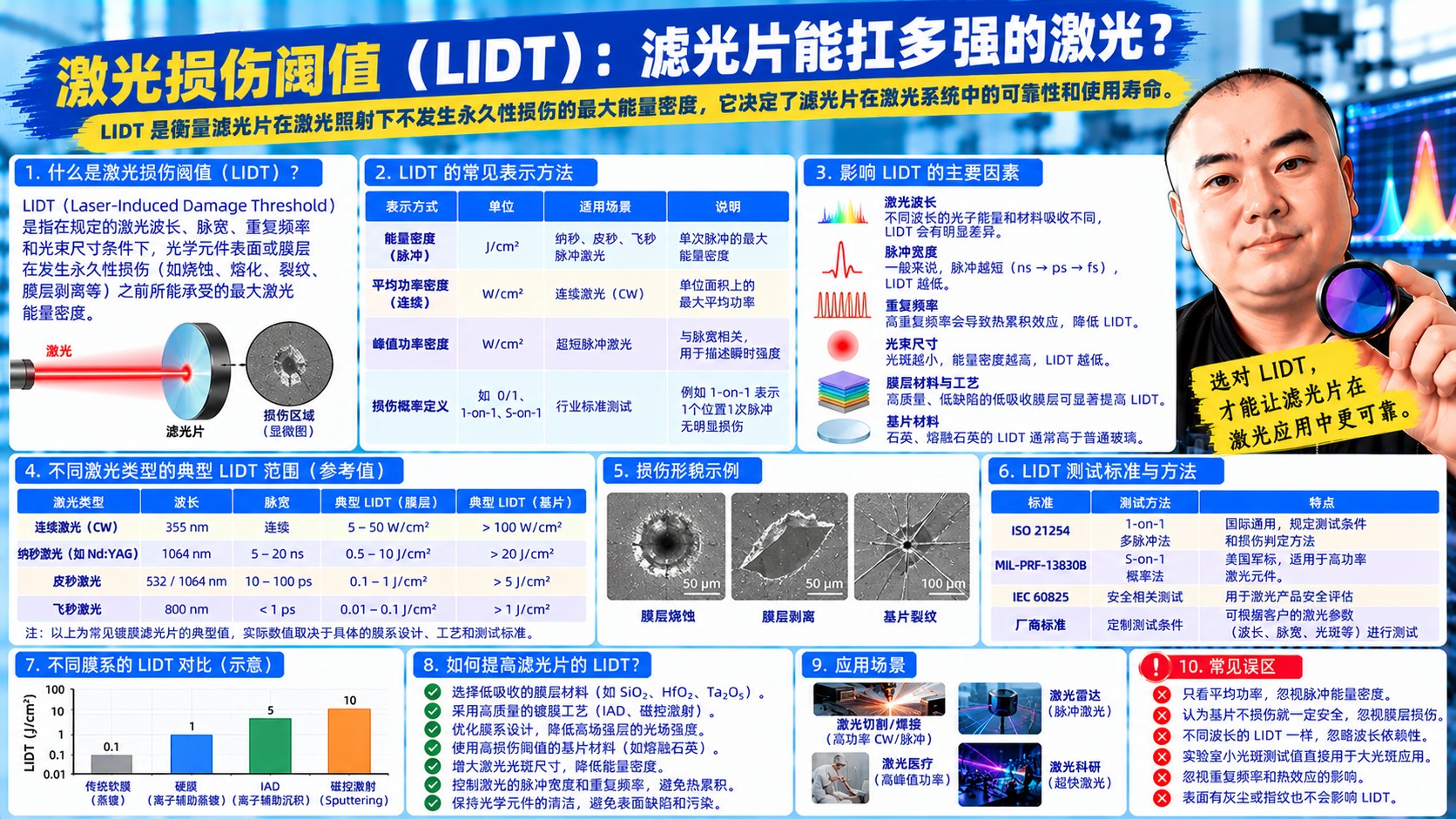
Laser induced damage threshold (LIDT) is the maximum laser fluence or power density a filter can withstand. Beyond it, the coating suffers irreversible damage - pits at best, a destroyed part at worst.
In laser systems this is the only hard figure with no room for negotiation: exceed it and the part dies.
| Type | Unit | Applies to |
|---|---|---|
| Pulsed laser | J/cm2 (energy density) | Nanosecond, picosecond, femtosecond pulses |
| Continuous laser | W/cm2 (power density) | Continuous wave (CW) lasers |
They do not convert directly (pulse duration and repetition rate also matter). If a vendor quotes one number without saying pulsed or CW, ask.
Useful conversion: average power density equals pulse fluence times repetition rate. 1 J/cm2 at 10 Hz is 10 W/cm2 average, while peak power density depends on pulse width (1 J/cm2 in 10 ns corresponds to 100 MW/cm2 peak).
Damage almost always starts at a defect, never in perfect film:
That is why high power laser filters routinely demand 20-10 surface quality and extreme cleanliness - not fussiness, necessity. See surface quality.
"Operating conditions: 1064 nm, 10 ns pulse, 20 Hz, 3 mm spot, S-on-1 test; LIDT at least 5 J/cm2. Surface quality 20-10, hard coating process."
With full conditions the supplier can design the stack and process route accordingly.
Need a damage risk assessment? Send laser parameters (wavelength, pulse width, repetition rate, energy, spot size) to sales@ootee.cn.
 365nm Narrow Bandpass Filter | Ø50mm | T>90%
OT-HBP3659050
365nm Narrow Bandpass Filter; FWHM 10nm; transmission >90%; blocking OD5; size Ø50mm; AOI 0°.
 450nm Narrow Bandpass Filter | Ø50mm
OT-HBP4509050
450nm Narrow Bandpass Filter; FWHM 10nm; transmission >90%; blocking OD5; size Ø50mm; AOI 0°.
 525nm Narrow Bandpass Filter | Ø50mm
OT-HBP5259050
525nm Narrow Bandpass Filter; FWHM 10nm; transmission >90%; blocking OD5; size Ø50mm; AOI 0°.
Send us your drawing and spectral targets — an engineer replies with a feasibility check and quotation within one business day.