Original content by the OOTEE Optics editorial team, drawn from first-hand production line and inspection data. Please credit the source when republishing.
Given limits in expertise and test conditions, the theories, parameters and conclusions here carry no guarantee of absolute accuracy. For technical learning and exchange only - never the sole basis for design, acceptance or selection. Corrections welcome.
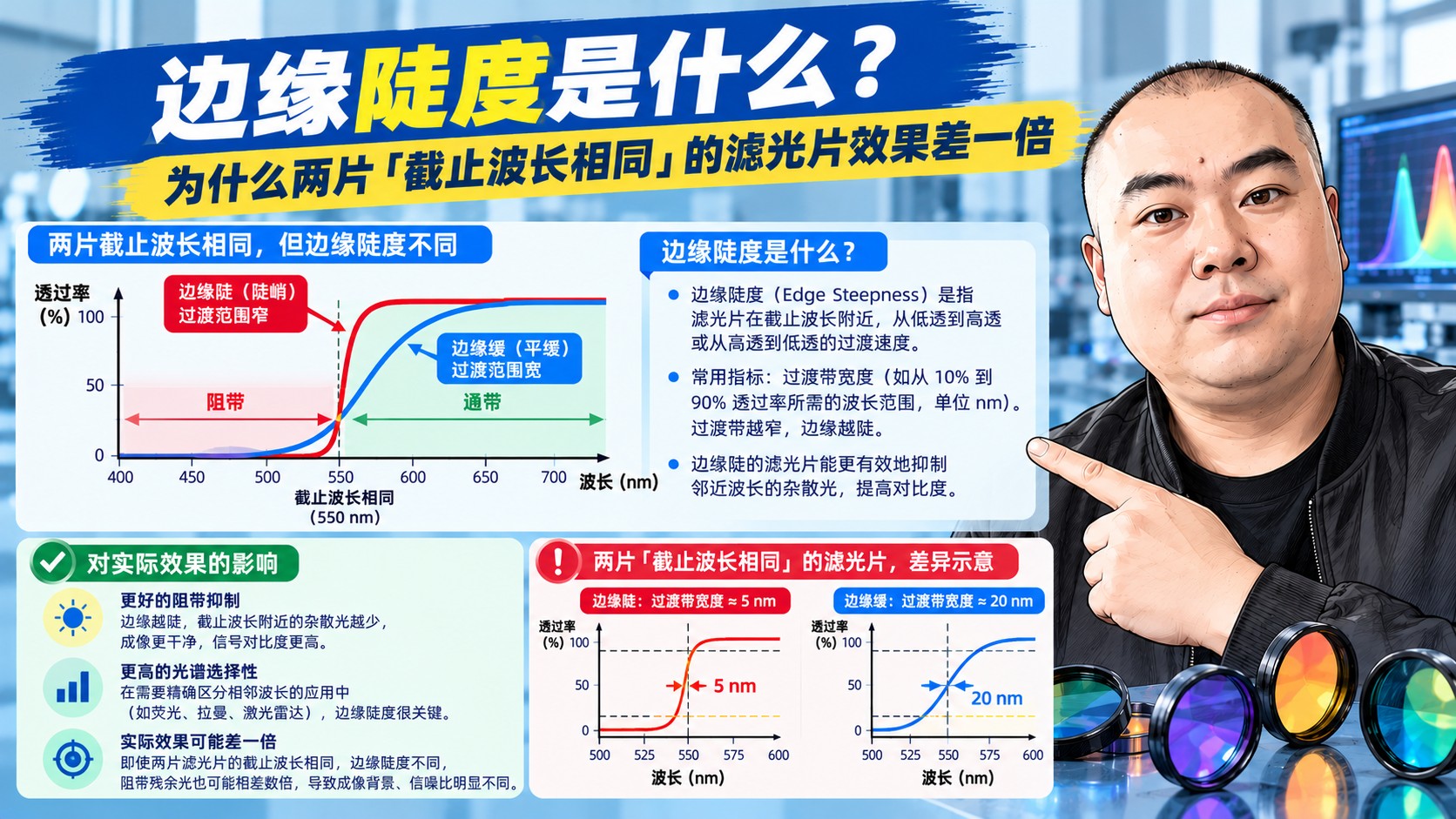
Edge steepness, or transition width, describes how fast a filter switches from passband to stopband. Two longpass filters may share a 500 nm cut-on, yet one climbs from 5% to 90% in 8 nm while the other needs 40 nm. In a fluorescence system the first cleanly removes the excitation light; the second lets it leak straight over the signal.
| Notation | Meaning | Used for |
|---|---|---|
| 5% to 90% span | Most universal; directly shows transition speed | Edge filters, dichroics |
| T50 to OD3 span | From half-maximum to the OD3 point | Where blocking depth is critical |
| Slope at a point (%/nm) | Local steepness | Research-grade descriptions |
Whichever you use, state the start and end points. "Steepness no more than 10 nm" without reference points is not a specification.
From a coating design standpoint, two factors dominate:
Two practical limits also apply:
For bandpass filters, steepness also explains a frequently overlooked effect: the gap between nominal and usable bandwidth. The softer the shoulders, the longer the tail below half maximum - a filter nominally 10 nm wide may still transmit meaningfully over 20 nm. When suppressing broadband background, examine FWHM and the edge shape together rather than a single number.
Recommended: "Cut-on at 50% = 500 +/- 5 nm, 5% to 90% transition no more than 15 nm, AOI 0 degrees."
If your beam is converging or the filter works at 45 degrees, say so - the maker will re-evaluate for the real angle and may change the coating design. Otherwise a beautiful 0 degree curve turns blunt once installed.
Wondering whether a steepness target is achievable? Send the edge wavelength, working angle and spacing to adjacent signals to sales@ootee.cn for a realistic range and process option.
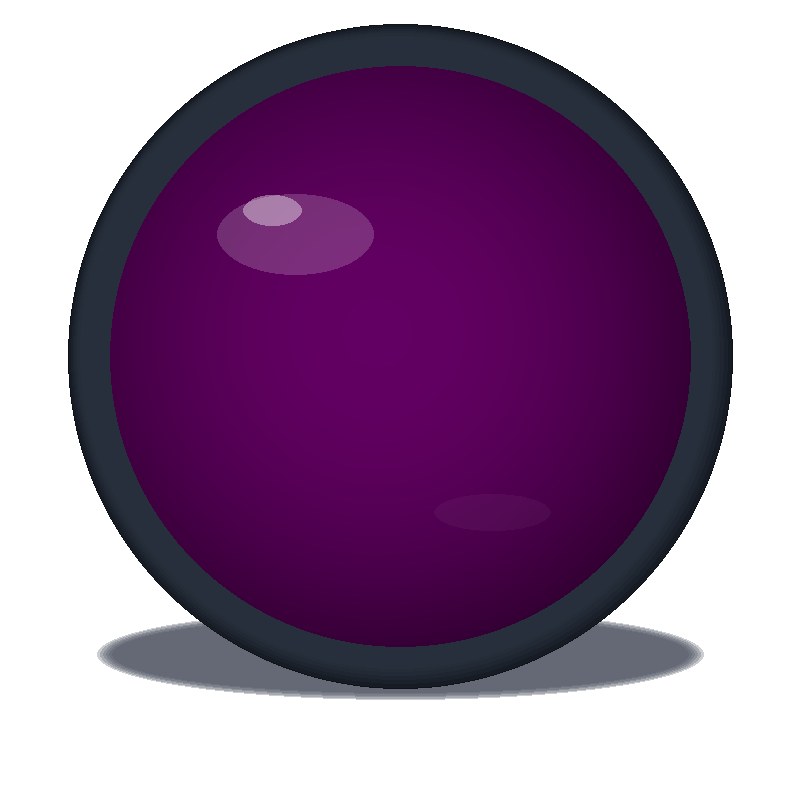 365nm Narrow Bandpass Filter | Ø50mm | T>90%
OT-HBP3659050
365nm Narrow Bandpass Filter; FWHM 10nm; transmission >90%; blocking OD5; size Ø50mm; AOI 0°.
 450nm Narrow Bandpass Filter | Ø50mm
OT-HBP4509050
450nm Narrow Bandpass Filter; FWHM 10nm; transmission >90%; blocking OD5; size Ø50mm; AOI 0°.
 525nm Narrow Bandpass Filter | Ø50mm
OT-HBP5259050
525nm Narrow Bandpass Filter; FWHM 10nm; transmission >90%; blocking OD5; size Ø50mm; AOI 0°.
Send us your drawing and spectral targets — an engineer replies with a feasibility check and quotation within one business day.