Original content by the OOTEE Optics editorial team, drawn from first-hand production line and inspection data. Please credit the source when republishing.
Given limits in expertise and test conditions, the theories, parameters and conclusions here carry no guarantee of absolute accuracy. For technical learning and exchange only - never the sole basis for design, acceptance or selection. Corrections welcome.
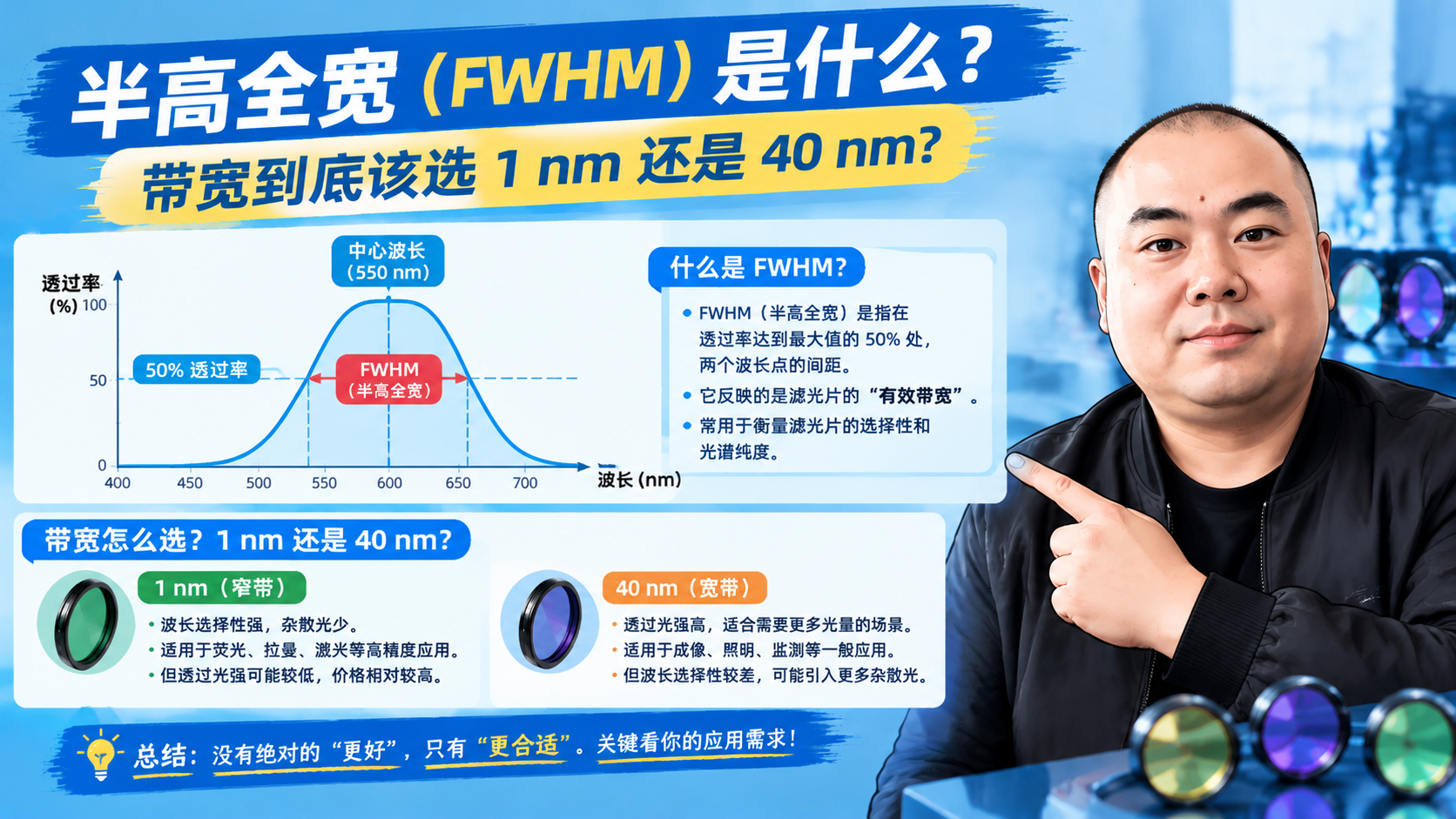
Full Width at Half Maximum (FWHM) is the width metric quoted most often for bandpass filters: the distance between the two wavelengths where transmission falls to 50% of the peak, in nanometers. A filter with CWL 532 nm and FWHM 10 nm transmits half its peak at 527 and 537 nm.
Because it is stable. Peak height drifts with process, batch and ageing, while the half-height points reflect only the shape of the curve, unaffected by overall scaling. That makes FWHM a common language across vendors.
That same virtue causes the classic misuse: FWHM says nothing about how much light you actually get. Two filters with identical 10 nm FWHM but peaks of 90% and 50% differ almost twofold in delivered flux. For a power budget, go back to passband range and peak transmission.
| FWHM | Typical application | Characteristics |
|---|---|---|
| 0.5-2 nm | Raman, laser line cleanup, atomic lines | Ultra narrow, 40-70% transmission, very angle sensitive |
| 3-10 nm | Fluorescence imaging, flow cytometry, multiplex assays | The mainstream narrowband zone; balances SNR and throughput |
| 10-40 nm | Machine vision, LED sorting, color measurement | High throughput, lower cost, forgiving on angle |
| 40-80 nm and above | Lighting, projection, broadband splitting | Closer to colored glass bandpass; softer edges |
Going from 40 nm to 2 nm is not a matter of "a few less layers". Four things happen:
These four effects create the price steps: from 10 nm to 3 nm the price typically doubles; from 3 nm to 1 nm it can double again. On a tight budget ask how wide your signal really is - relaxing 3 nm to 5 nm often saves a great deal while costing almost nothing in signal-to-noise.
With those answers plus your CWL, the bandwidth range basically locks itself in. For a full workflow see the five-step narrowband selection guide.
Bandwidth, transmission and cost always pull against each other. Send your source and detector parameters to sales@ootee.cn and we will return two or three candidate designs with measured curves.
 365nm Narrow Bandpass Filter | Ø50mm | T>90%
OT-HBP3659050
365nm Narrow Bandpass Filter; FWHM 10nm; transmission >90%; blocking OD5; size Ø50mm; AOI 0°.
 450nm Narrow Bandpass Filter | Ø50mm
OT-HBP4509050
450nm Narrow Bandpass Filter; FWHM 10nm; transmission >90%; blocking OD5; size Ø50mm; AOI 0°.
 525nm Narrow Bandpass Filter | Ø50mm
OT-HBP5259050
525nm Narrow Bandpass Filter; FWHM 10nm; transmission >90%; blocking OD5; size Ø50mm; AOI 0°.
Send us your drawing and spectral targets — an engineer replies with a feasibility check and quotation within one business day.