Original content by the OOTEE Optics editorial team, drawn from first-hand production line and inspection data. Please credit the source when republishing.
Given limits in expertise and test conditions, the theories, parameters and conclusions here carry no guarantee of absolute accuracy. For technical learning and exchange only - never the sole basis for design, acceptance or selection. Corrections welcome.
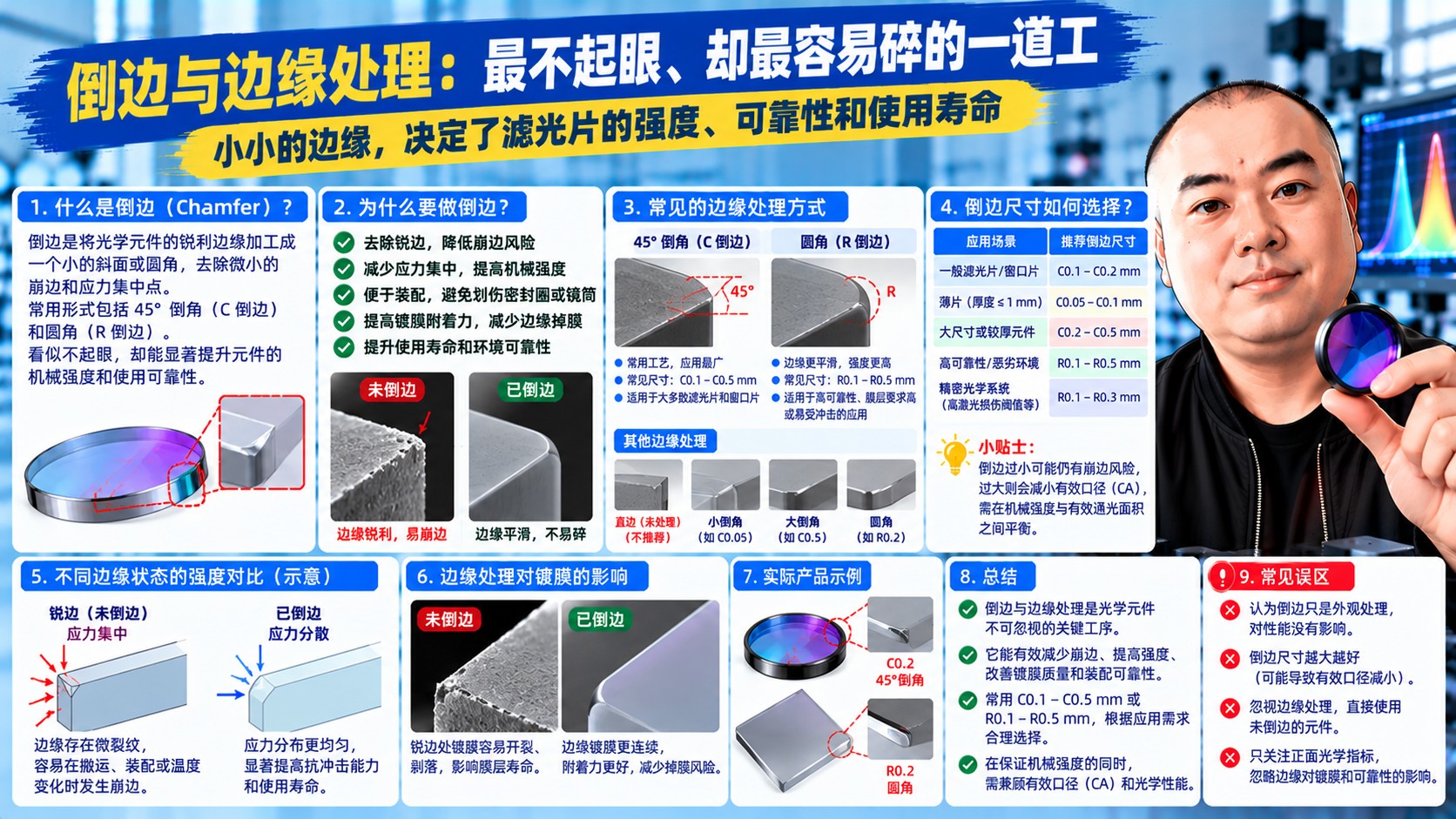
Edge treatment covers how the rim of a filter is finished: whether it is chamfered, how wide, ground or polished, and whether it is blackened.
It is the line most often left out of a specification, and one of the most common sources of trouble: the rim is where stress concentrates, and a single chip can scrap the part - or cut someone's finger.
After cutting or grinding, the edge has a sharp 90 degree corner full of micro-cracks. Those cracks are dangerous:
Removing that sharp angle removes most of the risk.
| Finish | Method | Used for |
|---|---|---|
| Chamfer / bevel | A 45 degree facet, 0.2-0.5 mm wide | Standard on virtually every filter |
| Ground edge | Dull matt finish | Better adhesion when bonded with adhesive |
| Polished edge | Bright polished rim | Total internal reflection parts, edge-lit designs |
| Blackened edge | Black absorbing paint on the rim | Suppressing edge reflections and stray light |
The glass rim reflects and scatters light in unexpected directions. Blackening clearly helps when:
Two caveats: the blackening material must survive your operating temperature and humidity, and for high power lasers or high temperatures confirm it will not outgas or char.
Typical values:
Chamfer width eats into the clear aperture: chamfer plus retainer coverage typically consumes 1-2 mm of rim, so check what CA is left.
"Chamfer 0.2-0.3 mm at 45 degrees all round, ground edge; blacken the rim if stray light control is needed (rated to 80 C)."
When space is tight, put the chamfer width on the drawing too - it is small but consumes outer diameter.
Have an assembly drawing or special environment? Send it to sales@ootee.cn and we will evaluate the edge treatment as part of the proposal.
 365nm Narrow Bandpass Filter | Ø50mm | T>90%
OT-HBP3659050
365nm Narrow Bandpass Filter; FWHM 10nm; transmission >90%; blocking OD5; size Ø50mm; AOI 0°.
 450nm Narrow Bandpass Filter | Ø50mm
OT-HBP4509050
450nm Narrow Bandpass Filter; FWHM 10nm; transmission >90%; blocking OD5; size Ø50mm; AOI 0°.
 525nm Narrow Bandpass Filter | Ø50mm
OT-HBP5259050
525nm Narrow Bandpass Filter; FWHM 10nm; transmission >90%; blocking OD5; size Ø50mm; AOI 0°.
Send us your drawing and spectral targets — an engineer replies with a feasibility check and quotation within one business day.