Original content by the OOTEE Optics editorial team, drawn from first-hand production line and inspection data. Please credit the source when republishing.
Given limits in expertise and test conditions, the theories, parameters and conclusions here carry no guarantee of absolute accuracy. For technical learning and exchange only - never the sole basis for design, acceptance or selection. Corrections welcome.
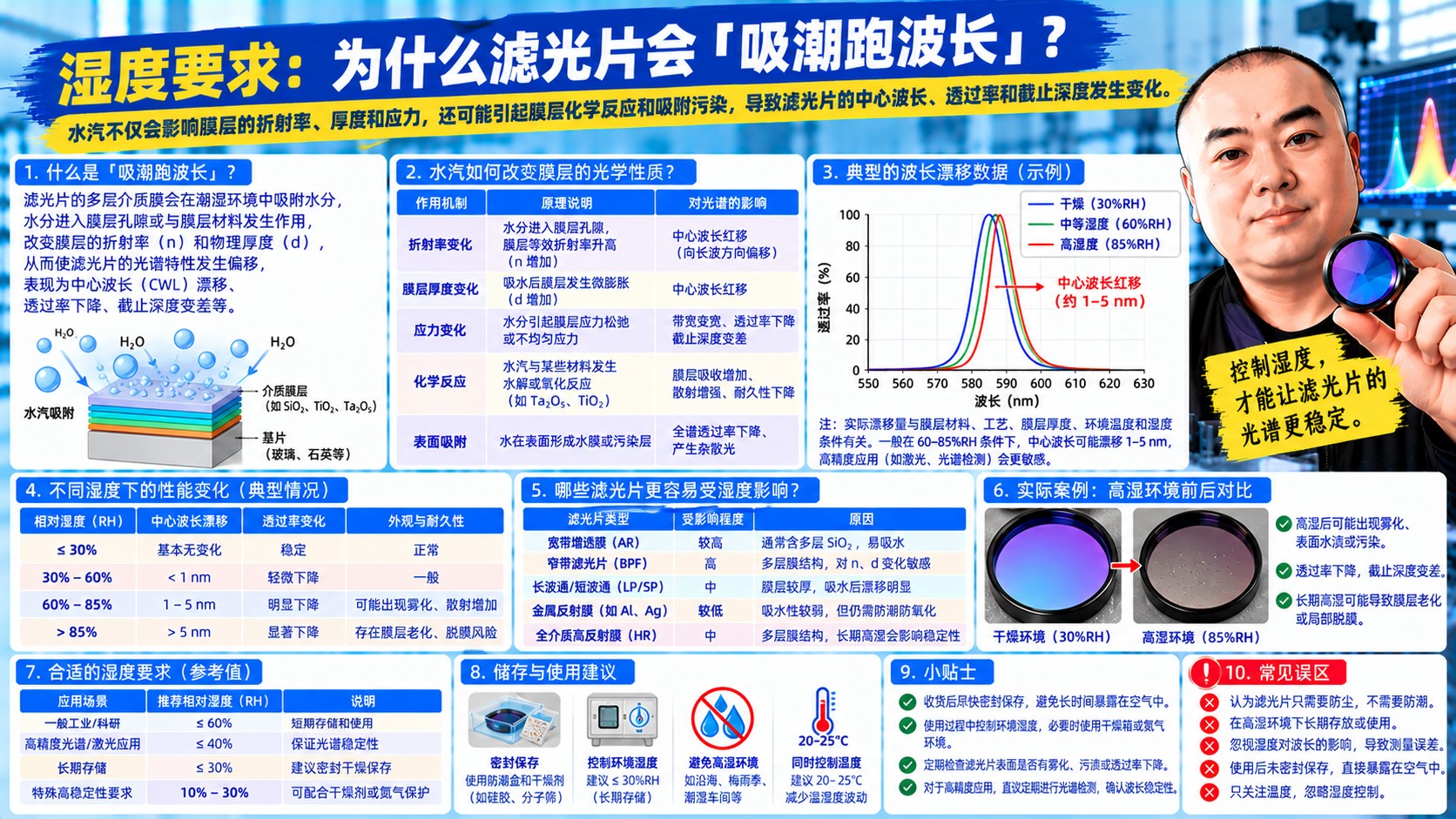
The humidity requirement states the allowable relative humidity (%RH) or damp-heat rating. It looks like a storage footnote, but for interference filters humidity is a variable that changes the optical figures directly.
It comes down to the microstructure of the film:
Typical magnitude: from dry air to 90% RH, a soft coating can drift 0.1-0.3%. For a 532 nm filter that is 0.5-1.6 nm - enough to push the signal out of a 1-3 nm window.
IAD and magnetron sputtering compact the arriving atoms to near theoretical density, leaving no voids for water to fill. Humidity drift in hard-coated filters is usually too small to measure (below 0.01%).
That is why every narrowband, fluorescence and outdoor application must use a hard coating - not marketing, but a physical necessity. See coating types.
| Test | Typical condition | Criteria |
|---|---|---|
| Damp heat, steady | 40 C / 90% RH, 48-96 h | Wavelength drift, transmission change, appearance |
| Humidity cycling | 25-55 C cycling with high humidity | Adhesion, cracking |
| Salt fog | 5% NaCl, 24-96 h | Corrosion, discoloration |
Common standards are MIL-C-48497, the ISO 9211 series and GB/T 26332. Automotive and outdoor equipment also reference the IEC 60068 environmental test series.
Three elements: humidity range + test condition + drift threshold.
"Operating relative humidity 10-85% RH, non-condensing; per ISO 9211, 96 hours damp heat at 40 C and 90% RH, after which CWL drift no more than 0.3 nm, peak transmission loss no more than 2%, no mould or corrosion."
For humid or outdoor duty, also fix the coating process (hard) and require a damp heat test report - belt and braces.
Want the humidity risk assessed? Send the environment, whether it is outdoors, and the bandwidth requirement to sales@ootee.cn.
 365nm Narrow Bandpass Filter | Ø50mm | T>90%
OT-HBP3659050
365nm Narrow Bandpass Filter; FWHM 10nm; transmission >90%; blocking OD5; size Ø50mm; AOI 0°.
 450nm Narrow Bandpass Filter | Ø50mm
OT-HBP4509050
450nm Narrow Bandpass Filter; FWHM 10nm; transmission >90%; blocking OD5; size Ø50mm; AOI 0°.
 525nm Narrow Bandpass Filter | Ø50mm
OT-HBP5259050
525nm Narrow Bandpass Filter; FWHM 10nm; transmission >90%; blocking OD5; size Ø50mm; AOI 0°.
Send us your drawing and spectral targets — an engineer replies with a feasibility check and quotation within one business day.