Original content by the OOTEE Optics editorial team, drawn from first-hand production line and inspection data. Please credit the source when republishing.
Given limits in expertise and test conditions, the theories, parameters and conclusions here carry no guarantee of absolute accuracy. For technical learning and exchange only - never the sole basis for design, acceptance or selection. Corrections welcome.
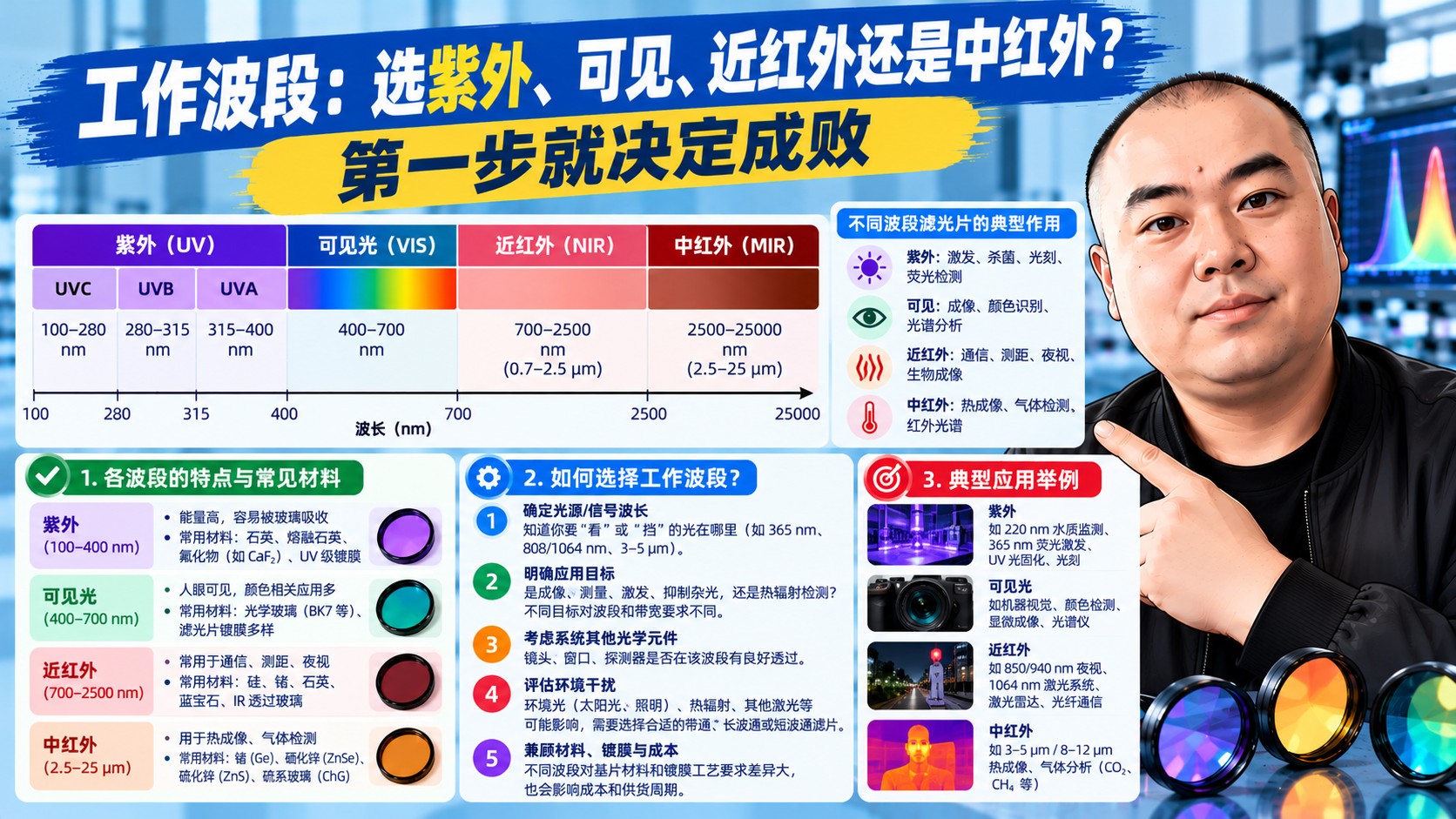
The operating spectral band is the region of the spectrum the filter is built for. It must be settled first, because changing it changes everything downstream: substrate, coating materials, process route and test equipment.
| Band | Range | Common substrates | Typical applications |
|---|---|---|---|
| Deep ultraviolet (DUV) | 180-280 nm | Fused silica, calcium fluoride | Semiconductor inspection, lithography, sterilization |
| Ultraviolet (UV) | 280-400 nm | Fused silica, UV-grade glass | Fluorescence excitation, curing, forensics |
| Visible (VIS) | 400-700 nm | BK7, K9, B270 | Machine vision, displays, lighting |
| Near infrared (NIR) | 700-2500 nm | Silicon, fused silica, BK7 | Fiber communications, night vision, sorting |
| Short to mid wave infrared | 1.4-6 micrometers | Silicon, sapphire, calcium fluoride | Gas sensing, thermal imaging |
| Long wave infrared (LWIR) | 8-14 micrometers | Germanium, silicon, ZnSe | IR thermometry, thermal imaging |
Every optical material has its own transmission window; beyond it, the material becomes opaque. Facts worth memorizing:
See substrate material for the full comparison table.
Coating materials are equally band-specific:
"Operating band: visible 400-700 nm; passband 520-545 nm; blocking OD4 or better from 350-500 nm and 560-1100 nm."
One sentence defines the passband, the stopband and the band edges, so a material and process proposal can follow immediately.
Still unsure which band applies? Send the application, light source and detector model to sales@ootee.cn for material and process recommendations.
 365nm Narrow Bandpass Filter | Ø50mm | T>90%
OT-HBP3659050
365nm Narrow Bandpass Filter; FWHM 10nm; transmission >90%; blocking OD5; size Ø50mm; AOI 0°.
 450nm Narrow Bandpass Filter | Ø50mm
OT-HBP4509050
450nm Narrow Bandpass Filter; FWHM 10nm; transmission >90%; blocking OD5; size Ø50mm; AOI 0°.
 525nm Narrow Bandpass Filter | Ø50mm
OT-HBP5259050
525nm Narrow Bandpass Filter; FWHM 10nm; transmission >90%; blocking OD5; size Ø50mm; AOI 0°.
Send us your drawing and spectral targets — an engineer replies with a feasibility check and quotation within one business day.