Original content by the OOTEE Optics editorial team, drawn from first-hand production line and inspection data. Please credit the source when republishing.
Given limits in expertise and test conditions, the theories, parameters and conclusions here carry no guarantee of absolute accuracy. For technical learning and exchange only - never the sole basis for design, acceptance or selection. Corrections welcome.
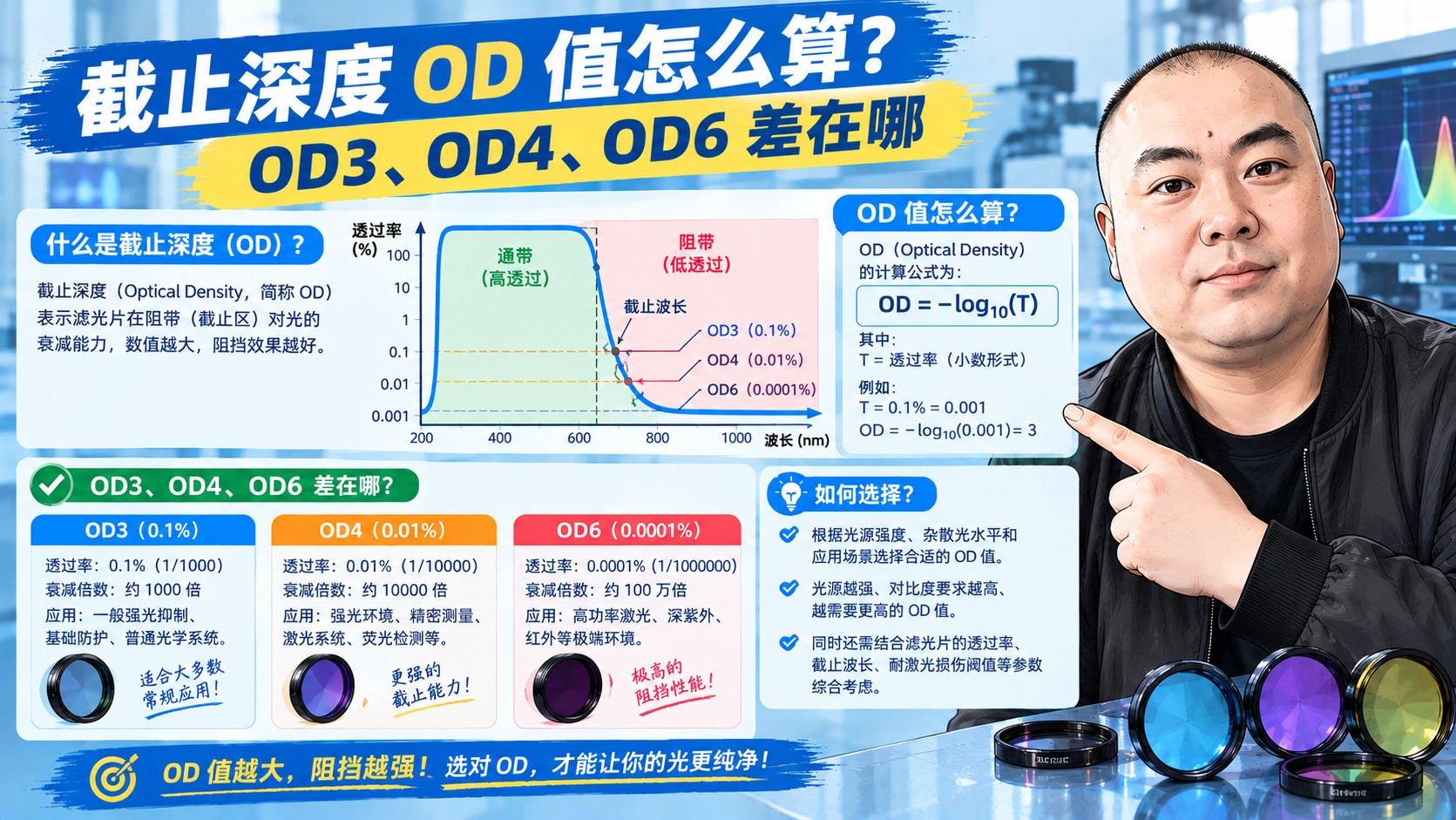
Optical density (OD) describes how strongly a filter suppresses light in its stopband. One formula links it to transmission T:
OD = -log10(T) (T as a decimal, not a percentage)
Each additional unit of OD cuts transmission by a factor of ten:
| OD | Transmission T | Light rejected |
|---|---|---|
| OD1 | 10% | 90% |
| OD2 | 1% | 99% |
| OD3 | 0.1% | 99.9% |
| OD4 | 0.01% | 99.99% |
| OD5 | 0.001% | 99.999% |
| OD6 | 0.0001% | 99.9999% |
Two elements must appear together: how deep (OD) and how wide (stopband range).
A filter marked "OD6 at 532 nm" probably reaches OD6 only within a few nanometers of that line and falls to OD2 by 600 nm. With broadband background - room lighting, daylight, sample autofluorescence - the real rejection is far worse than the headline number suggests.
Write it as: "OD5 or better from 350 to 700 nm, OD6 or better at 532 nm" - a floor across the range, then reinforcement at the critical point.
OD3 to OD4 is easy (a few more reflector pairs). OD5 to OD6 is not:
Typical quotation steps: OD4 as the baseline, OD5 plus 20-40%, OD6 possibly double or more. If your background is a thousand times the signal, OD5 is enough - OD6 is money wasted.
For more on pairing OD with blocking range, read What Does OD Mean? Filter Blocking Depth Explained.
Unsure which OD level you need? Send signal strength, background level (even an order-of-magnitude estimate) and detector model to sales@ootee.cn for a recommendation that is sufficient without being wasteful.
 365nm Narrow Bandpass Filter | Ø50mm | T>90%
OT-HBP3659050
365nm Narrow Bandpass Filter; FWHM 10nm; transmission >90%; blocking OD5; size Ø50mm; AOI 0°.
 450nm Narrow Bandpass Filter | Ø50mm
OT-HBP4509050
450nm Narrow Bandpass Filter; FWHM 10nm; transmission >90%; blocking OD5; size Ø50mm; AOI 0°.
 525nm Narrow Bandpass Filter | Ø50mm
OT-HBP5259050
525nm Narrow Bandpass Filter; FWHM 10nm; transmission >90%; blocking OD5; size Ø50mm; AOI 0°.
Send us your drawing and spectral targets — an engineer replies with a feasibility check and quotation within one business day.