Original content by the OOTEE Optics editorial team, drawn from first-hand production line and inspection data. Please credit the source when republishing.
Given limits in expertise and test conditions, the theories, parameters and conclusions here carry no guarantee of absolute accuracy. For technical learning and exchange only - never the sole basis for design, acceptance or selection. Corrections welcome.
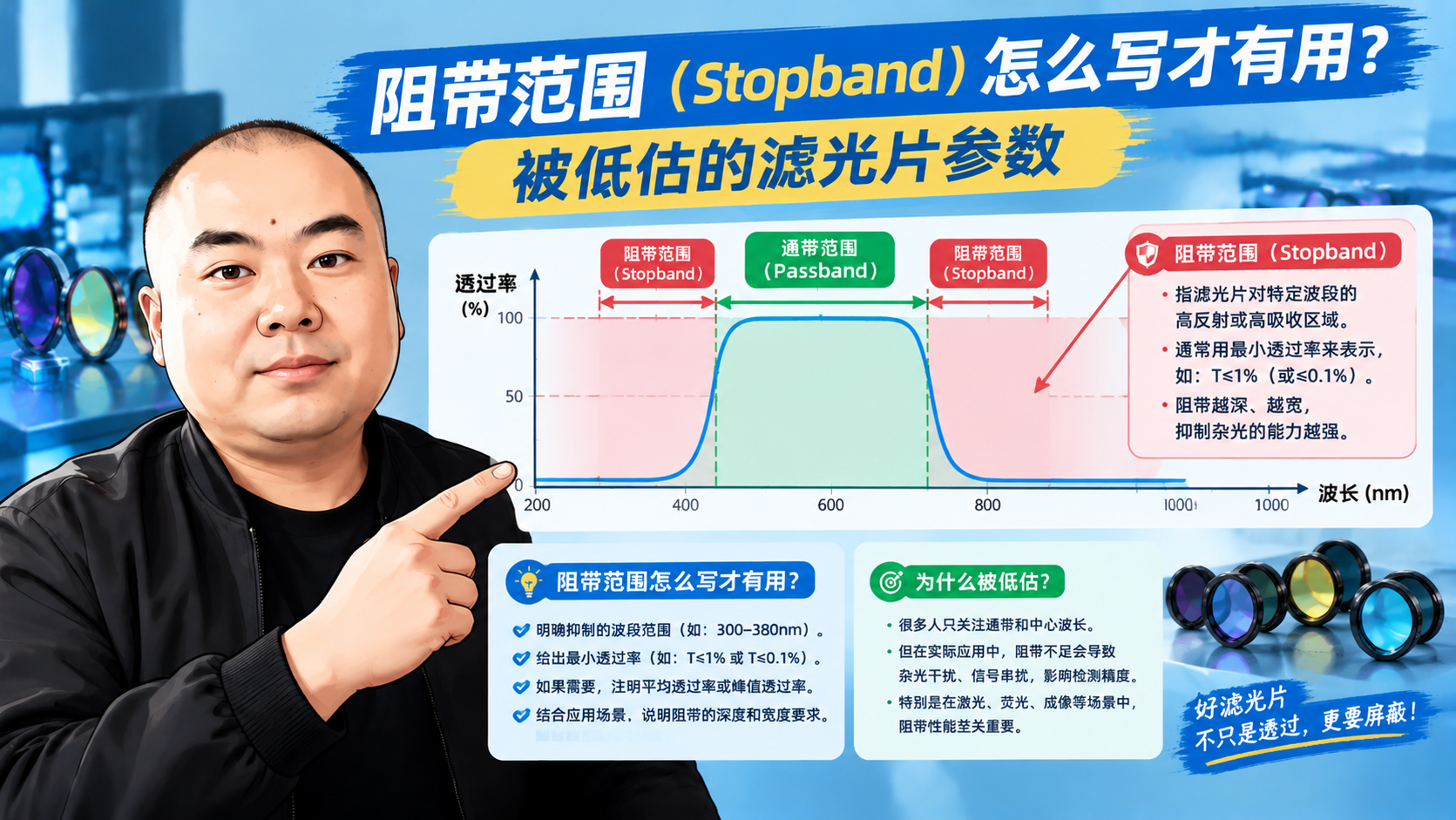
Stopband, or blocking range, is the wavelength interval a filter suppresses or rejects. It is the other half of the OD value: OD answers how deep, stopband answers how wide. Deep without wide is no specification at all.
Many "great on paper, useless on the bench" cases come from here. The datasheet proudly prints OD6 - but only across 530-560 nm. At 850 nm transmission quietly climbs back to 20%.
A complete statement reads: "OD4 average from 200 to 1100 nm, with OD6 at 532 nm". It fixes three things at once: the range, the minimum depth inside it, and any reinforced point.
| Notation | Verdict |
|---|---|
| OD4 | Incomplete: no range, and no indication whether it is minimum or typical |
| OD6 at 532 nm | Covers the laser line only; ambient light and secondary peaks pass |
| 200-1100 nm, OD4 | Acceptable: full range, defined depth |
| OD5 from 350-700 nm, OD3 from 700-1100 nm | Better: tailored to detector response, better value |
Interference filters reject light through destructive reflection across dozens or hundreds of layers, and cancellation only works near specific wavelengths - the origin of sidebands: block 500-600 nm and the natural periodicity of the stack opens transmission windows again near 900 nm, or in the ultraviolet.
There are three standard fixes, each with a cost:
So "OD6 plus full-range blocking" is usually a hybrid of interference coating and absorbing glass. When a quote looks expensive, check whether the blocking range is over-specified: narrowing 200-1100 nm to 350-1000 nm can cut cost substantially with no practical loss.
Trap 1: the infrared tail of silicon sensors. CMOS and CCD still respond strongly from 900 to 1100 nm. In daylight or with IR-rich sources, a stopband that stops at 800 nm leaves the image washed out.
Trap 2: secondary emission peaks in fluorescence. Dyes often have shoulders, and excitation sources have stray lines. Blocking only the main peak lets the rest through.
Trap 3: polarization splitting in dichroics. At 45 degrees, S and P blocking edges differ considerably; a single unpolarized measurement badly misrepresents performance. See polarization sensitivity.
Unsure how wide or deep your blocking needs to be? Send the source spectrum, detector model and any measured curve of your current filter to sales@ootee.cn for a segmented blocking recommendation - and stop paying for wavelengths you do not use.
 365nm Narrow Bandpass Filter | Ø50mm | T>90%
OT-HBP3659050
365nm Narrow Bandpass Filter; FWHM 10nm; transmission >90%; blocking OD5; size Ø50mm; AOI 0°.
 450nm Narrow Bandpass Filter | Ø50mm
OT-HBP4509050
450nm Narrow Bandpass Filter; FWHM 10nm; transmission >90%; blocking OD5; size Ø50mm; AOI 0°.
 525nm Narrow Bandpass Filter | Ø50mm
OT-HBP5259050
525nm Narrow Bandpass Filter; FWHM 10nm; transmission >90%; blocking OD5; size Ø50mm; AOI 0°.
Send us your drawing and spectral targets — an engineer replies with a feasibility check and quotation within one business day.