Original content by the OOTEE Optics editorial team, drawn from first-hand production line and inspection data. Please credit the source when republishing.
Given limits in expertise and test conditions, the theories, parameters and conclusions here carry no guarantee of absolute accuracy. For technical learning and exchange only - never the sole basis for design, acceptance or selection. Corrections welcome.
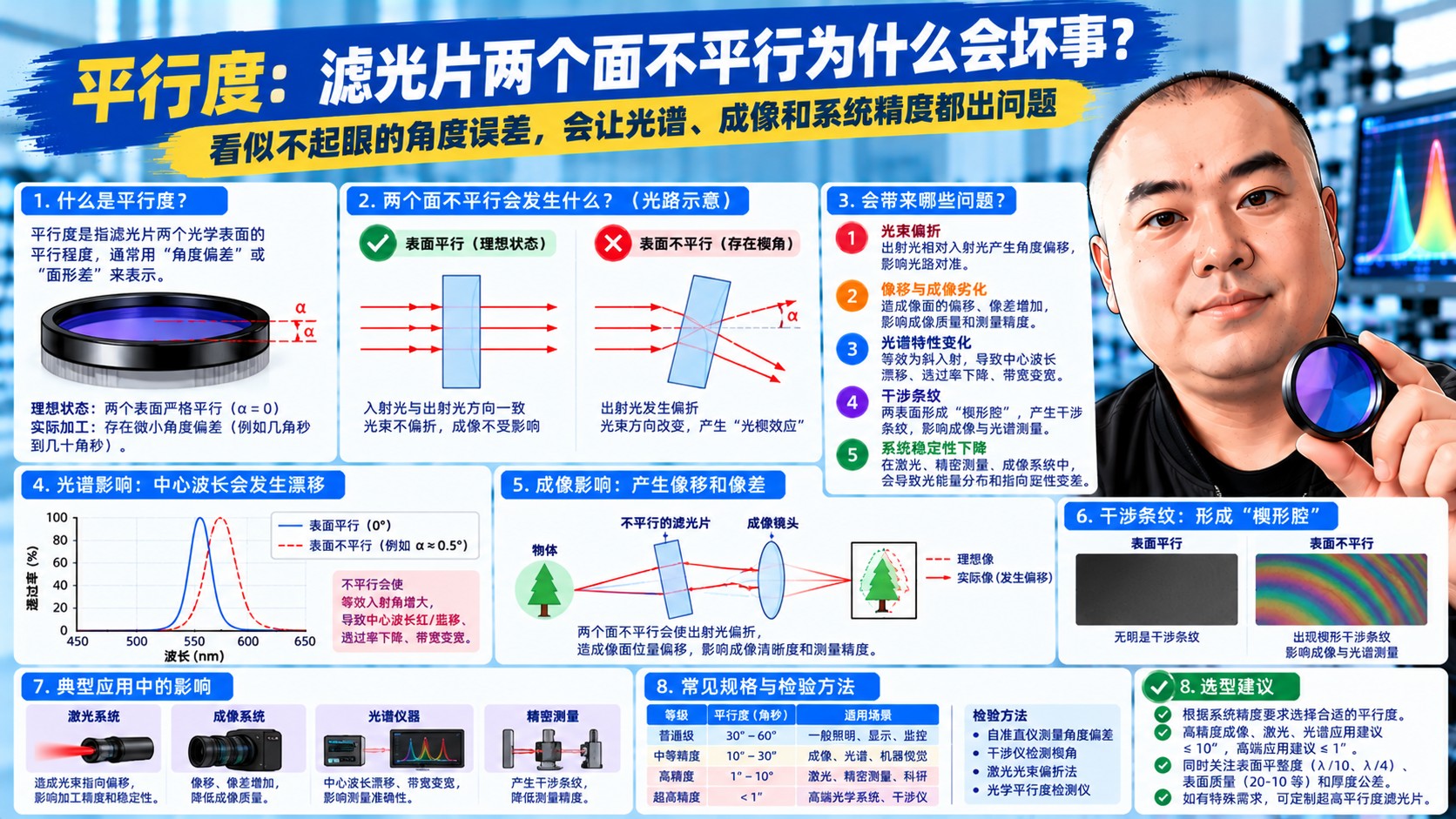
Parallelism describes how parallel the two faces of a filter are. Ideally they are exactly parallel; in practice a small wedge remains, expressed in arcminutes, arcseconds or as thickness difference per unit length.
Conversions: 1 arcminute = 60 arcseconds; 30 arcseconds is about 0.0083 degrees, equivalent to roughly 3.6 micrometers of thickness difference across a 25 mm part.
| Grade | Typical value | Application |
|---|---|---|
| Standard | 3-5 arcminutes | Lighting, detection, general imaging |
| Precision | 30-60 arcseconds | Imaging systems, machine vision |
| High precision | 10-30 arcseconds | Lasers, interferometry, precision metrology |
| Ultra precision | better than 5 arcseconds | Interferometers, wavefront sensitive systems |
If non-parallelism causes all those problems, why do wedged filters exist? Because of the last two effects:
Typical wedge angles are 0.5 to 3 degrees - far larger than parallelism errors. In laser systems and at strongly reflecting interfaces, a wedge is standard practice. The price is beam deviation, which the optical layout must absorb. See wedge angle.
"Parallelism no worse than 30 arcseconds." If you need a wedge to kill ghosts, write "wedge angle 1 degree +/- 0.2 degree, thick edge marked" - and specify the marking so assembly can orient the part.
Not sure whether to tighten parallelism or switch to a wedge? Send source type (laser or LED), the optical layout and whether ghosts appear, to sales@ootee.cn.
 365nm Narrow Bandpass Filter | Ø50mm | T>90%
OT-HBP3659050
365nm Narrow Bandpass Filter; FWHM 10nm; transmission >90%; blocking OD5; size Ø50mm; AOI 0°.
 450nm Narrow Bandpass Filter | Ø50mm
OT-HBP4509050
450nm Narrow Bandpass Filter; FWHM 10nm; transmission >90%; blocking OD5; size Ø50mm; AOI 0°.
 525nm Narrow Bandpass Filter | Ø50mm
OT-HBP5259050
525nm Narrow Bandpass Filter; FWHM 10nm; transmission >90%; blocking OD5; size Ø50mm; AOI 0°.
Send us your drawing and spectral targets — an engineer replies with a feasibility check and quotation within one business day.