Original content by the OOTEE Optics editorial team, drawn from first-hand production line and inspection data. Please credit the source when republishing.
Given limits in expertise and test conditions, the theories, parameters and conclusions here carry no guarantee of absolute accuracy. For technical learning and exchange only - never the sole basis for design, acceptance or selection. Corrections welcome.
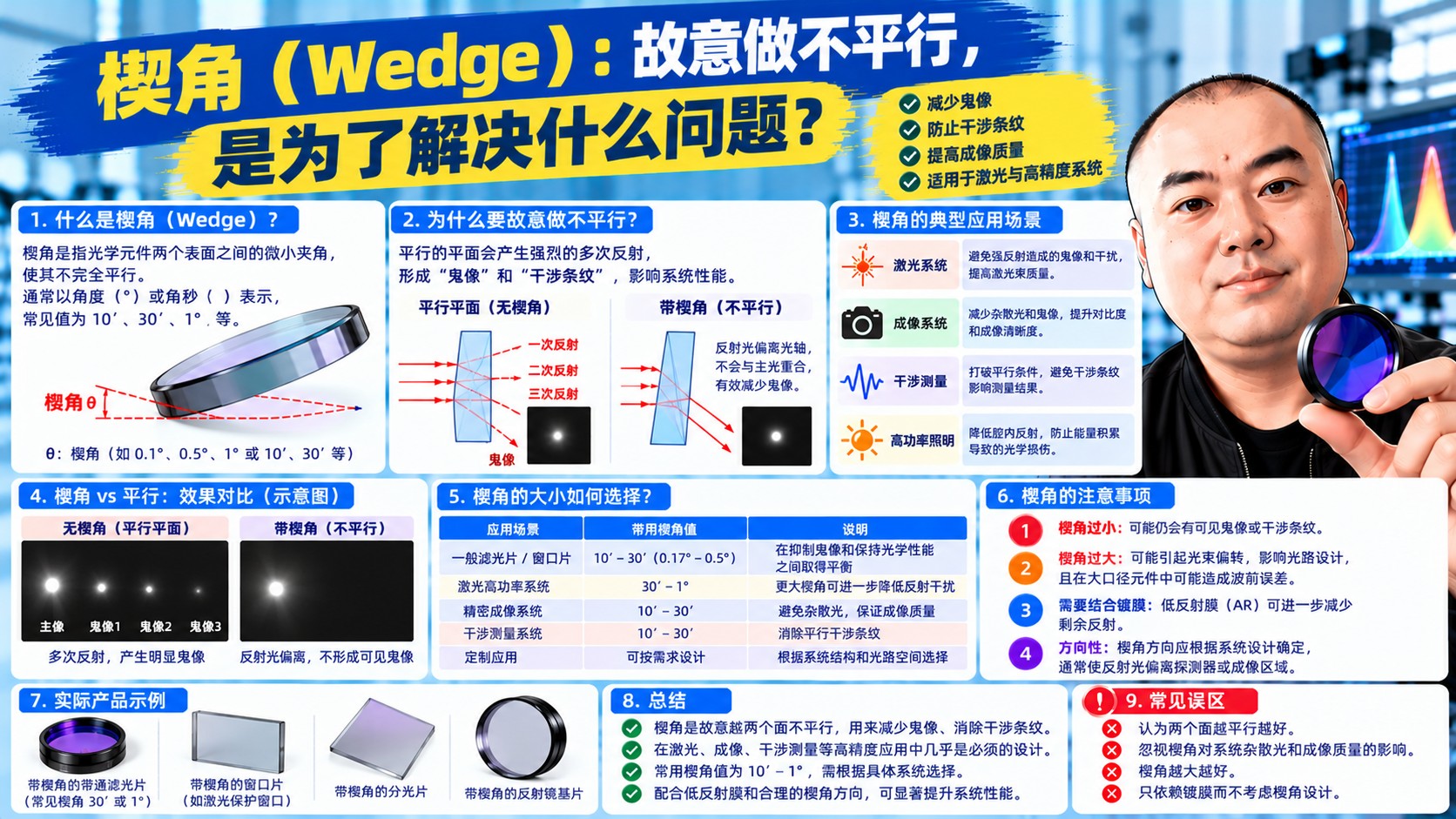
A wedge is a deliberate angle between the two faces of a filter. It is not the same thing as a parallelism error: the latter is a manufacturing defect (smaller is better), the former is a design tool (sometimes essential).
A filter with parallel faces reflects a small fraction of light at each surface (about 4% each uncoated). The two reflected beams travel in exactly the same direction, so:
With a wedge, the two reflections no longer share a direction: the ghost leaves the field and the fringe cannot form. The problem disappears at its root.
| Wedge angle | Typical use | Deviation (n about 1.5) |
|---|---|---|
| 3-10 arcminutes | Mild fringe suppression where beam deviation is critical | Very small |
| 30 arcseconds to 3 arcminutes | Standard wedged windows | Negligible |
| 0.5 degree | The usual laser-grade wedged window | about 0.25 degree |
| 1-3 degrees | Strong ghost suppression, high power lasers | about 0.5-1.5 degrees |
Deviation is approximately (n-1) times the wedge angle. A 1 degree BK7 wedge (n about 1.52) deflects the beam by roughly 0.52 degrees - almost 1 mm of displacement 100 mm downstream. Not negligible: it must be allowed for in the layout.
"Wedge angle 1 degree +/- 0.2 degree, thick edge marked; BK7 substrate, 25 mm diameter by 3 mm at the thick edge."
State all four - angle, tolerance, marking and thick-edge thickness - and assembly cannot go wrong. If your system has a maximum allowable deviation, give that instead and let the maker convert it to a wedge angle.
Not sure whether you need a wedge? Send the source type, whether ghosts or fringes appear, and the path length to sales@ootee.cn for a recommendation.
 365nm Narrow Bandpass Filter | Ø50mm | T>90%
OT-HBP3659050
365nm Narrow Bandpass Filter; FWHM 10nm; transmission >90%; blocking OD5; size Ø50mm; AOI 0°.
 450nm Narrow Bandpass Filter | Ø50mm
OT-HBP4509050
450nm Narrow Bandpass Filter; FWHM 10nm; transmission >90%; blocking OD5; size Ø50mm; AOI 0°.
 525nm Narrow Bandpass Filter | Ø50mm
OT-HBP5259050
525nm Narrow Bandpass Filter; FWHM 10nm; transmission >90%; blocking OD5; size Ø50mm; AOI 0°.
Send us your drawing and spectral targets — an engineer replies with a feasibility check and quotation within one business day.