Original content by the OOTEE Optics editorial team, drawn from first-hand production line and inspection data. Please credit the source when republishing.
Given limits in expertise and test conditions, the theories, parameters and conclusions here carry no guarantee of absolute accuracy. For technical learning and exchange only - never the sole basis for design, acceptance or selection. Corrections welcome.

A Certificate of Conformance (CoC, also COC or CofC) states that identified goods meet specified requirements under the supplier’s responsibility. It should establish who approved which goods against which requirements. Calling a document a “final inspection report” does not establish that it contains measured results.
A CoC gives the conclusion; a test report presents results; original records substantiate them. A supplier’s declaration is distinct from independent certification, as explained in ISO’s discussion of conformity attestations. The purchase contract, applicable requirements and quality agreement determine the shipment’s documentation obligations.
Fig. 1 shows the essential connections. The following is a purchasing checklist, rather than a universal statutory form.
| Field group | Information to establish |
|---|---|
| Document and issuer | Unique CoC number, revision, issuing company and address; distinguish manufacturer from supplier where relevant. |
| Order and item | Purchase order and line, customer part number, description, drawing or specification number and revision. |
| Lot and quantity | Manufacturing lot, sublot or serial range; shipment quantity and unit, separated by lot. |
| Acceptance basis | Specifications, applicable standard identifiers and editions, method references, and approved deviation references. |
| Statement and evidence | Explicit conformity statement and scope, linked report numbers; sample identity and units for any measurements. |
| Authorization | Inspection date or period, issue date, approver’s name and role, signature or verifiable electronic approval. |
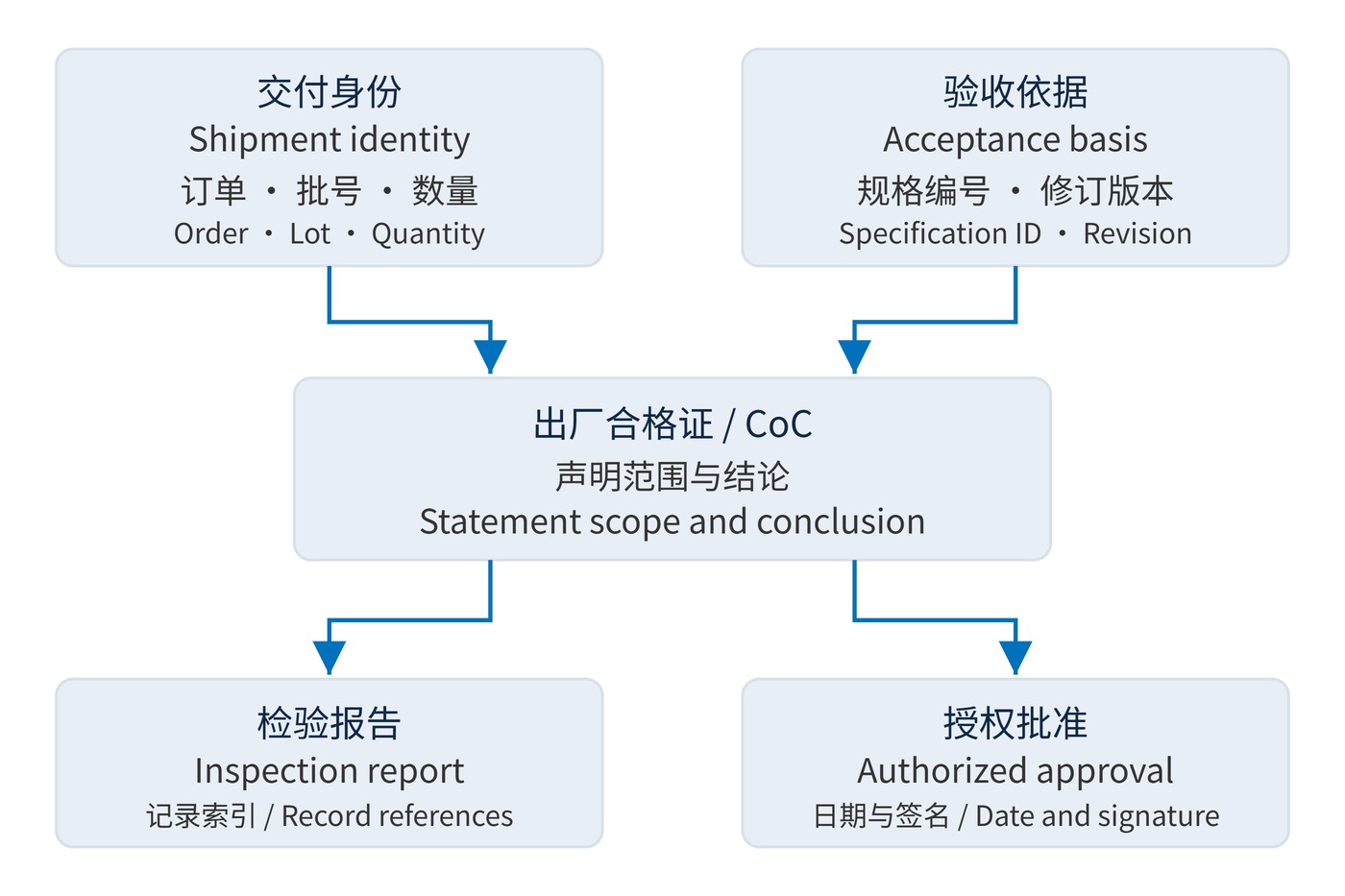
For example, a specification might require center wavelength (CWL) 780 ± 1 nm, full width at half maximum (FWHM) 20 ± 2 nm, and optical density (OD) at least 6 over 400–700 nm at an angle of incidence (AOI) of 0°. These are illustrative requirements, not product claims. An isolated “OD6” leaves the applicable wavelength range undefined.
For a released lot with no other inventory movements, reconcile quantities in pieces:
$$N_{\mathrm{released}}=N_{\mathrm{shipped}}+N_{\mathrm{remaining}}$$
Maintain cumulative shipment records. Returns, scrapping and renewed release require separate entries; the original lot quantity is not necessarily the current shipment quantity.
A routine order may accept a declaration against a named specification revision with a report reference. Incoming verification may require measured values, limits, sample identifiers, sample size and disposition. Sampled results must not imply individual inspection, and a lot average cannot represent every unit. Align field definitions with the CWL and bandwidth inspection requirements.
Agree on borderline decisions before shipment. NIST defines a decision rule in terms of how uncertainty enters a conformity statement. One possible bilateral acceptance rule, where a guard band has been agreed, is:
$$L+U\leq x\leq H-U$$
Here $x$ is the measured value, $L$ and $H$ are specification limits, and $U$ is expanded uncertainty at the agreed probability level. All share the same unit. This is an example, not a mandatory CoC rule; a value outside this acceptance interval requires disposition under the agreed rule.
The example identifier 20261028-P03-017-S02 encodes date, production unit, sequence and sublot, as shown in Fig. 2. Define what the date means, the uniqueness scope and duplicate prevention. Use the identifier to retrieve records rather than forcing all production history into the code.
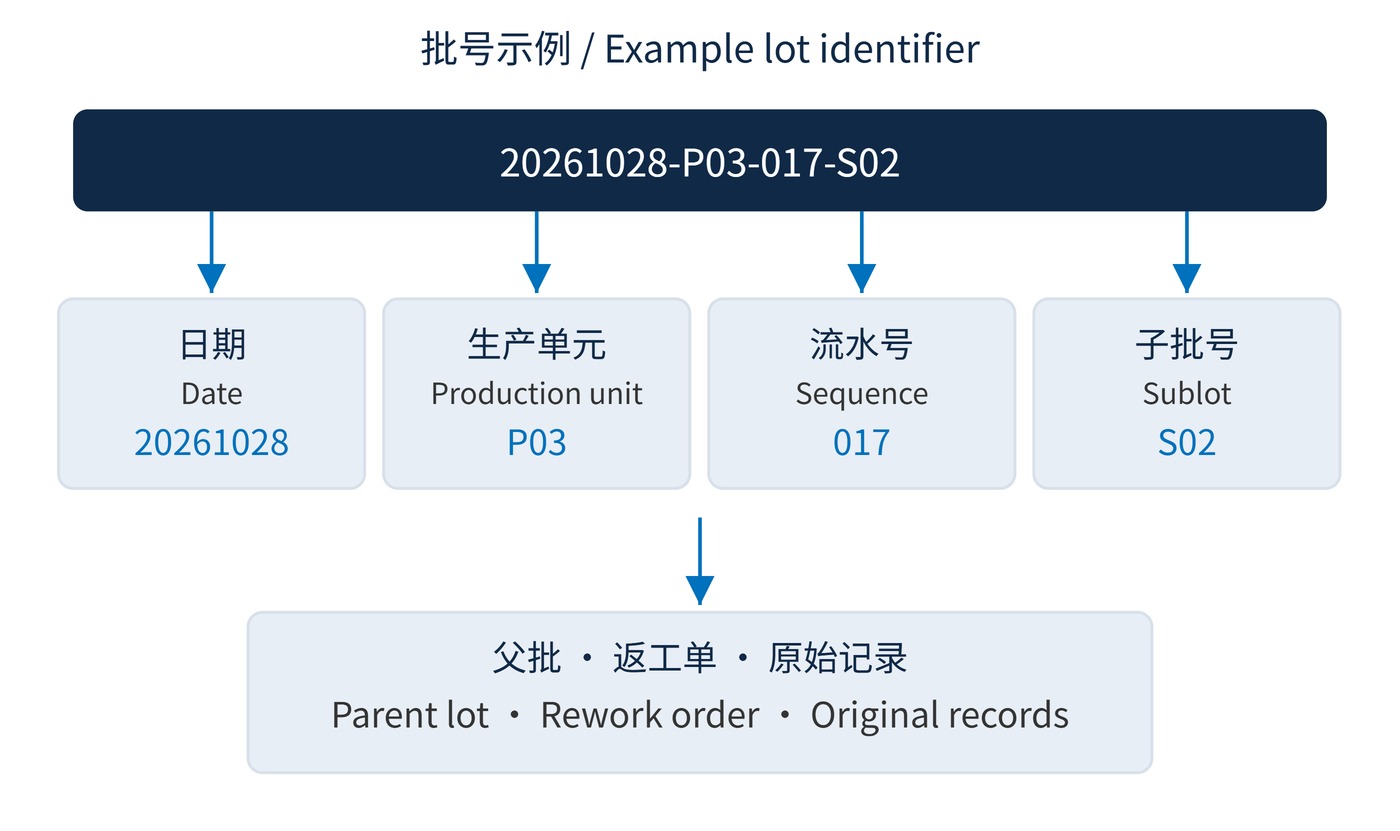
Preserve parent–child links after splitting lots. Reworked goods need a rework reference and updated inspection status. Labels, CoCs and reports must reconcile. Retain superseded certificates and identify their replacements.
Receiving teams reconcile the order, labels, quantities and specification revision before checking required attachments. Auditors request original records to reconstruct the basis for acceptance. ISO/IEC 17050-2 addresses documentation supporting supplier declarations.
Agree on access to sample identities, original data files, timestamps, equipment IDs and calibration status at inspection, method revisions, processing steps and review history. A screenshot alone rarely establishes this chain. A delivered transmission curve should carry lot and record references. Set retention, access and redaction arrangements through the contract and applicable requirements.
A defensible release connects delivered item identity, requirements effective at acceptance, supporting evidence and authorized approval. A missing connection calls for additional evidence or reassessment.
 365nm Narrow Bandpass Filter | Ø50mm | T>90%
OT-HBP3659050
365nm Narrow Bandpass Filter; FWHM 10nm; transmission >90%; blocking OD5; size Ø50mm; AOI 0°.
 450nm Narrow Bandpass Filter | Ø50mm
OT-HBP4509050
450nm Narrow Bandpass Filter; FWHM 10nm; transmission >90%; blocking OD5; size Ø50mm; AOI 0°.
 525nm Narrow Bandpass Filter | Ø50mm
OT-HBP5259050
525nm Narrow Bandpass Filter; FWHM 10nm; transmission >90%; blocking OD5; size Ø50mm; AOI 0°.
Send us your drawing and spectral targets — an engineer replies with a feasibility check and quotation within one business day.