Original content by the OOTEE Optics editorial team, drawn from first-hand production line and inspection data. Please credit the source when republishing.
Given limits in expertise and test conditions, the theories, parameters and conclusions here carry no guarantee of absolute accuracy. For technical learning and exchange only - never the sole basis for design, acceptance or selection. Corrections welcome.
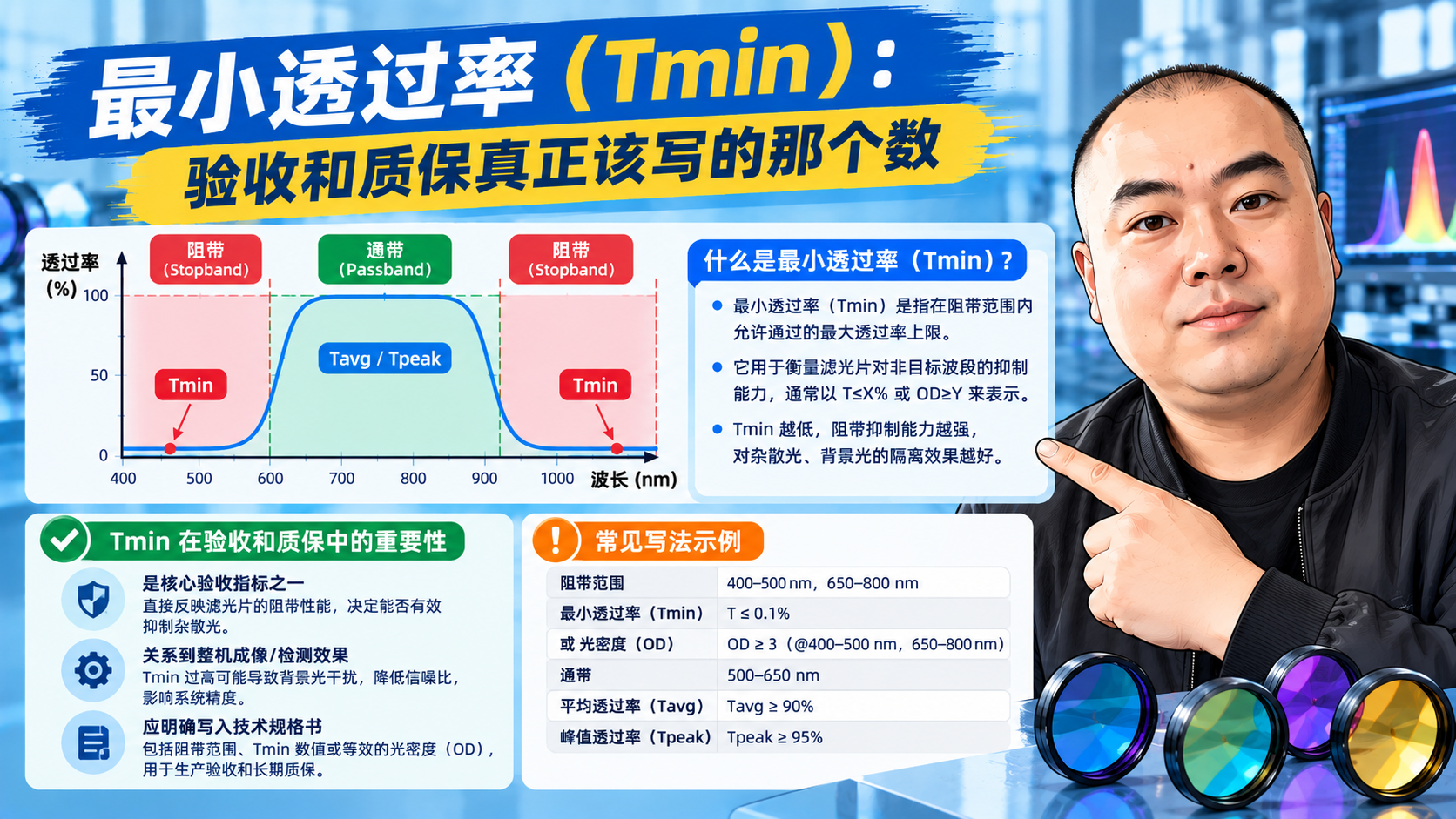
Minimum transmission (Tmin) is the lowest transmission guaranteed anywhere in the specified passband. Less flattering than peak transmission, it is the only figure that says: measure wherever you like, it must not fall below this.
Acceptance testing is about the worst case. Tpeak describes the best point, Tavg the average; only Tmin describes the floor:
| Metric | Meaning | Fit for acceptance? |
|---|---|---|
| Tpeak | Highest point of the curve | No - even a badly shaped curve can have a high peak |
| Tavg | Mean over the interval | Fair - depends on the averaging convention, easy to dispute |
| Tmin | Lowest point over the interval | Yes - unambiguous; no measurement point may fall below it |
In plain words: you are not buying "how bright at best" but "bright enough even at worst". In multi-channel instruments, one channel sitting near the curve edge ruins channel matching for the whole unit.
In production, measured Tmin often looks worse than the sample curve. Four usual reasons:
That is why one and the same filter can claim Tmin 88% under "0 degrees, CWL exact" yet only 78% under "+/-8 degrees cone, CWL +/-2 nm, -20 to +60 C". Stricter test conditions mean lower Tmin - physics, not corner-cutting.
An over-tight Tmin is one of the most common budget killers. Reference ranges:
Practical trick: ask for Tpeak first, then estimate Tmin as roughly Tpeak minus 8 to 12 percentage points. If you genuinely need a high Tmin, the two effective levers are flat-top design and a wider bandwidth.
Recommended:
"Transmission no lower than 85% (Tmin at least 85%) from 520 to 545 nm, at AOI 0 degrees, room temperature."
If the real operating condition includes an angular spread or temperature range, write it into the test condition - otherwise a number guaranteed under ideal lab conditions may not hold on your instrument.
Do not forget the sampling plan: for production orders, full-spectrum scan 3-5 pieces per batch and check only the passband minimum on the rest. Cost and risk both stay under control.
Not sure what to demand? Send your operating conditions to sales@ootee.cn and we will propose an achievable, economical Tmin range - avoiding a spec nobody can meet or one that is too loose to be useful.
 365nm Narrow Bandpass Filter | Ø50mm | T>90%
OT-HBP3659050
365nm Narrow Bandpass Filter; FWHM 10nm; transmission >90%; blocking OD5; size Ø50mm; AOI 0°.
 450nm Narrow Bandpass Filter | Ø50mm
OT-HBP4509050
450nm Narrow Bandpass Filter; FWHM 10nm; transmission >90%; blocking OD5; size Ø50mm; AOI 0°.
 525nm Narrow Bandpass Filter | Ø50mm
OT-HBP5259050
525nm Narrow Bandpass Filter; FWHM 10nm; transmission >90%; blocking OD5; size Ø50mm; AOI 0°.
Send us your drawing and spectral targets — an engineer replies with a feasibility check and quotation within one business day.