Original content by the OOTEE Optics editorial team, drawn from first-hand production line and inspection data. Please credit the source when republishing.
Given limits in expertise and test conditions, the theories, parameters and conclusions here carry no guarantee of absolute accuracy. For technical learning and exchange only - never the sole basis for design, acceptance or selection. Corrections welcome.
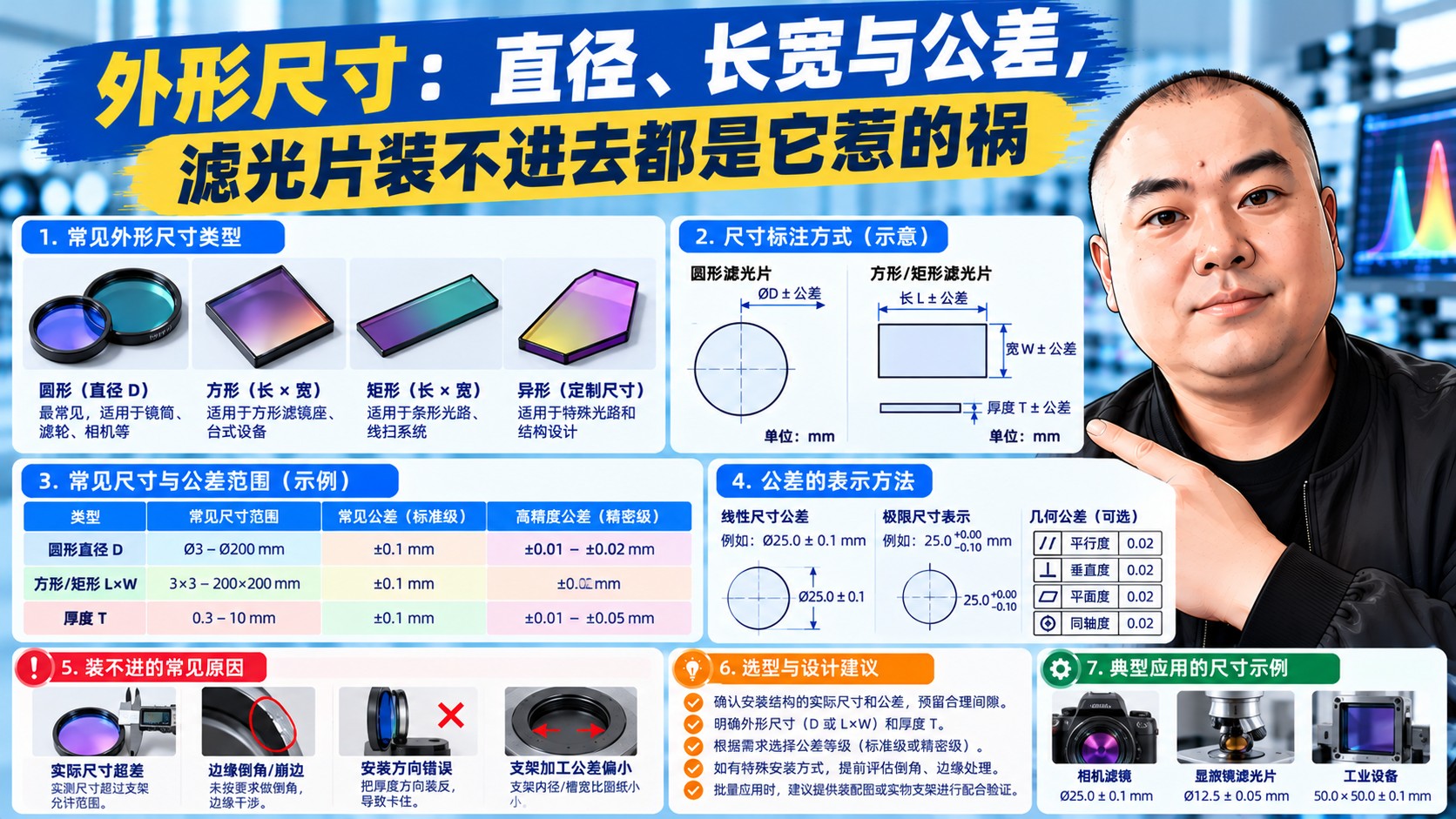
Outer dimensions are the diameter for round parts, length and width for rectangular parts, or whatever the outline happens to be, in millimeters. It is the least glamorous line on a purchase order and one of the most frequent sources of trouble on site.
| Shape | Common sizes | Notes |
|---|---|---|
| Round | 12.5, 25, 25.4 (1 inch), 50.8 mm (2 inch) diameter | Most common; produced in batches on diamond wheels, lowest cost |
| Square | 20x20, 25x25, 50x50 mm | Diced then edge ground; slightly dearer than round |
| Rectangular strips | per drawing | Common in line-scan cameras and spectrometers |
| Custom shapes (steps, notches, holes) | per drawing | Needs CNC or laser processing; cost and lead time rise sharply |
Choosing a dimensional tolerance is a balance between assembly feasibility and machining cost:
A practical approach: start from the largest gap your mount allows and work backwards. If the slot already allows 0.3 mm, demanding +/-0.02 mm buys nothing.
These two are constantly confused:
A typical marking is 25 mm diameter, CA at least 90% - performance guaranteed over the central 22.5 mm, nothing promised outside. If your beam nearly fills the part, confirm the CA is large enough or edge rays will see reduced transmission.
Where the system allows it, several smaller parts tiled together are often cheaper than one large one. For large areas, ask about a tiled approach.
An assembly drawing beats any written description. For feasibility, send drawings to sales@ootee.cn.
 365nm Narrow Bandpass Filter | Ø50mm | T>90%
OT-HBP3659050
365nm Narrow Bandpass Filter; FWHM 10nm; transmission >90%; blocking OD5; size Ø50mm; AOI 0°.
 450nm Narrow Bandpass Filter | Ø50mm
OT-HBP4509050
450nm Narrow Bandpass Filter; FWHM 10nm; transmission >90%; blocking OD5; size Ø50mm; AOI 0°.
 525nm Narrow Bandpass Filter | Ø50mm
OT-HBP5259050
525nm Narrow Bandpass Filter; FWHM 10nm; transmission >90%; blocking OD5; size Ø50mm; AOI 0°.
Send us your drawing and spectral targets — an engineer replies with a feasibility check and quotation within one business day.