Original content by the OOTEE Optics editorial team, drawn from first-hand production line and inspection data. Please credit the source when republishing.
Given limits in expertise and test conditions, the theories, parameters and conclusions here carry no guarantee of absolute accuracy. For technical learning and exchange only - never the sole basis for design, acceptance or selection. Corrections welcome.
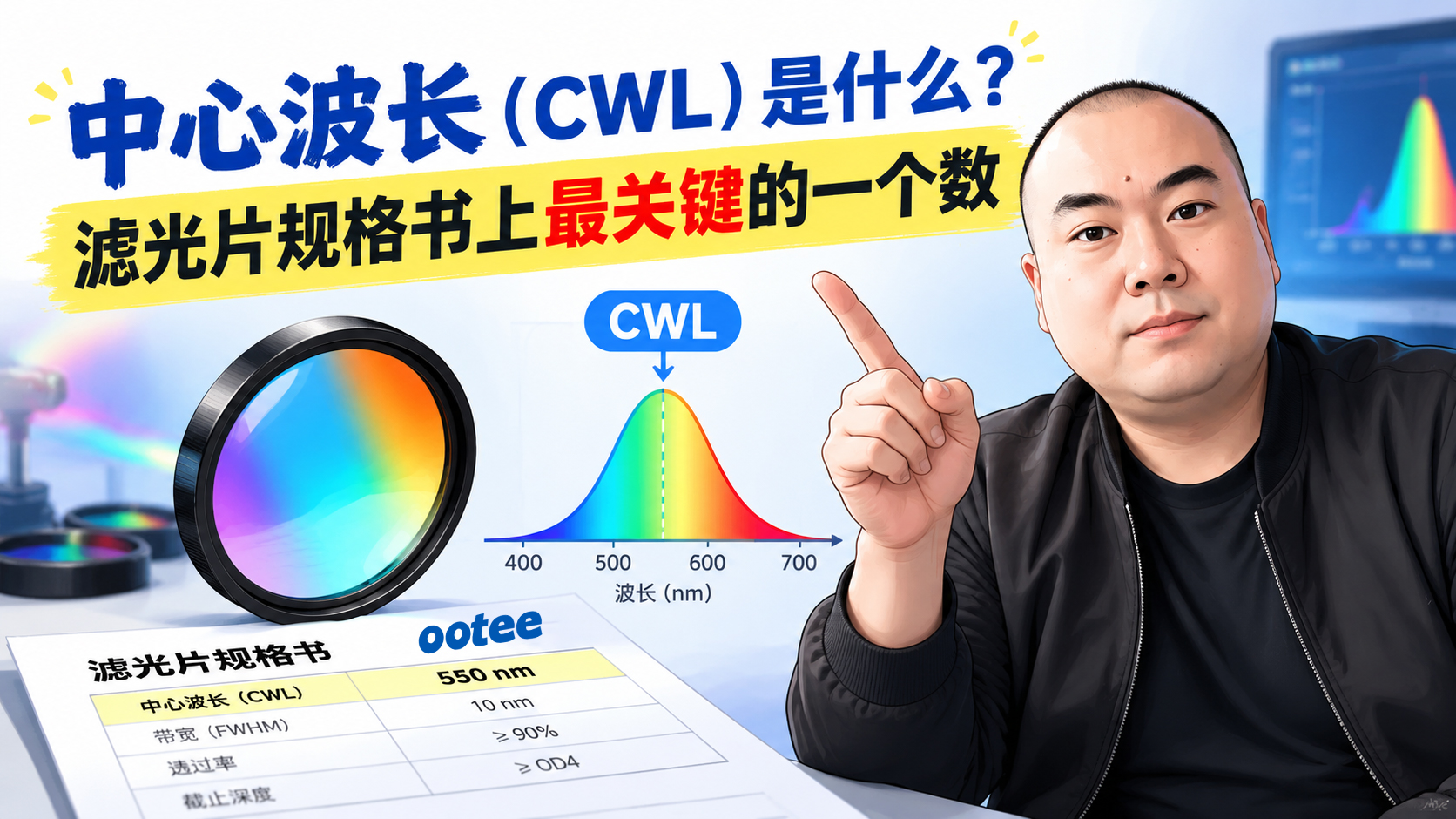
If you read only one number on a bandpass filter datasheet, make it the center wavelength (CWL). It is the wavelength at which the filter reaches its maximum transmission, usually given in nanometers. A narrowband filter marked CWL 532 nm passes light around 532 nm most efficiently, and transmission falls off as you move away from that point.
It looks simple, yet it causes more sourcing mistakes than any other parameter - because bandwidth, cutoff edges and real-world accuracy all hang off it.
Think of the filter as a door with one narrow slit. CWL is where the slit is widest. In fluorescence it is the dye emission peak; in laser cleanup it is the laser line; in machine vision it is the feature wavelength you want to keep.
Note the word "peak". CWL is the point of maximum transmission, not the geometric middle of the passband. When the curve is asymmetric - common with wide bandpass filters - the two can differ by several nanometers. By strict convention, CWL is the average of the two wavelengths where transmission drops to 50% of peak, i.e. the midpoint of the FWHM.
| Notation | Meaning | Typical use |
|---|---|---|
| CWL 532 nm | Typical value, tolerance defaults to the maker's standard (often +/-2 nm or +/-0.5% of CWL) | General vision, lighting |
| CWL 532 +/- 2 nm | Tolerance band defined, parts binned at final test | Most instruments, analyzers |
| CWL 532 +/- 1 nm at AOI 0 degrees | Tolerance and test angle both locked down | Fluorescence imaging, flow cytometry, lasers |
For wavelength-critical work, insist on the third form. With a bare "532 nm" the supplier ships to its own default tolerance, and a part measuring 3 nm off is still technically in spec.
This is the least intuitive property of interference filters. Tilt the filter and the CWL shifts toward shorter wavelengths (blue shift); raise the temperature and most filters drift toward longer wavelengths (red shift).
With a converging beam (say +/-8 degrees half-angle behind a lens), you are effectively using a whole range of angles at once: the peak rounds off and the edges soften. Tell the supplier about the real optical path instead of quoting a 0 degree curve. See angle of incidence and angular shift for the underlying physics.
Trap 1: treating the LED nominal wavelength as CWL. A "525 nm" LED may land anywhere between 515 and 535 nm within one bin, and it drifts with junction temperature. Measure the actual emission peak first, then fix the CWL.
Trap 2: specifying CWL without bandwidth. A 531 nm filter with 30 nm bandwidth and one with 3 nm bandwidth are entirely different products. Background level and required blocking depth follow from that pair.
Trap 3: ignoring part-to-part consistency. Eight filters of the same spec in one instrument, each +/-3 nm apart, will not give you eight matched channels. Multi-channel systems need an explicit batch consistency requirement.
With those four lines a supplier can quote accurately and pick the right process in one pass; without them you will be sampling back and forth. If all you have is a part number or an application, send it to sales@ootee.cn and we will derive the full parameter set for you.
 365nm Narrow Bandpass Filter | Ø50mm | T>90%
OT-HBP3659050
365nm Narrow Bandpass Filter; FWHM 10nm; transmission >90%; blocking OD5; size Ø50mm; AOI 0°.
 450nm Narrow Bandpass Filter | Ø50mm
OT-HBP4509050
450nm Narrow Bandpass Filter; FWHM 10nm; transmission >90%; blocking OD5; size Ø50mm; AOI 0°.
 525nm Narrow Bandpass Filter | Ø50mm
OT-HBP5259050
525nm Narrow Bandpass Filter; FWHM 10nm; transmission >90%; blocking OD5; size Ø50mm; AOI 0°.
Send us your drawing and spectral targets — an engineer replies with a feasibility check and quotation within one business day.