Original content by the OOTEE Optics editorial team, drawn from first-hand production line and inspection data. Please credit the source when republishing.
Given limits in expertise and test conditions, the theories, parameters and conclusions here carry no guarantee of absolute accuracy. For technical learning and exchange only - never the sole basis for design, acceptance or selection. Corrections welcome.
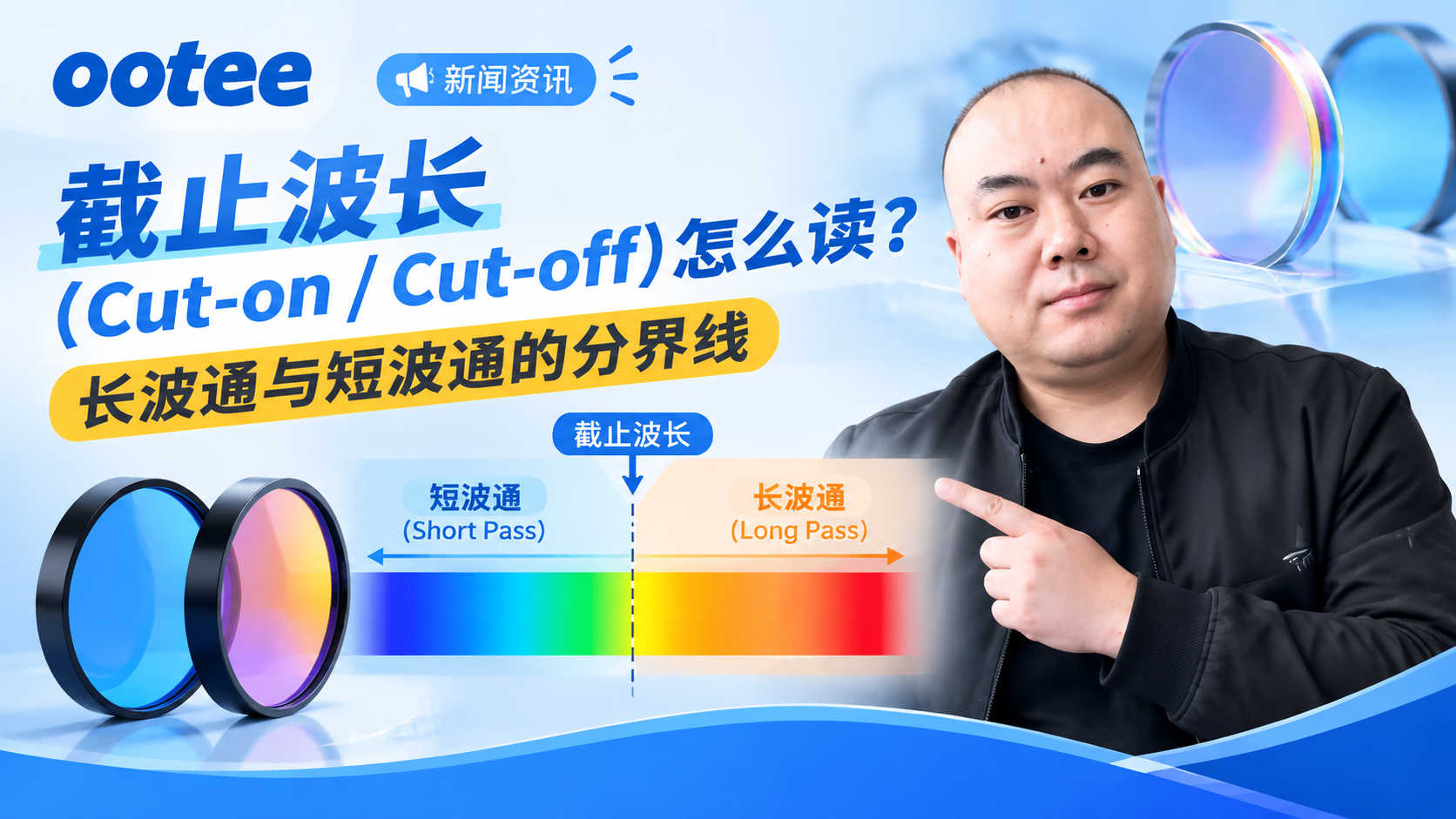
Longpass and shortpass filters have no center - they have an edge, and that edge is the cut-on or cut-off wavelength. Cut-on is the short-wavelength boundary of a longpass filter (transmission begins above it); cut-off is the long-wavelength boundary of a shortpass filter (transmission stops above it).
The catch: this "boundary" is not a point but a slope climbing from the stopband into the passband. Which height on that slope you call the marker is a matter of vendor convention.
| Definition point | Notation | Notes |
|---|---|---|
| 50% transmission | Cut-on at 50% | Most common in Western datasheets; consistent with bandpass FWHM convention |
| 5% transmission | Cut-on at 5% | Conservative; yields a shorter number that sounds like an earlier start |
| OD3 / OD4 crossing | Blocking edge at OD3 | Defined from the stopband side; common in fluorescence and Raman |
A real longpass filter reaching 5% at 490 nm, 50% at 505 nm and 90% at 520 nm can be quoted as 490, 505 or 520 nm - three numbers for one piece of glass. Before concluding that a competitor's 490 nm part beats your supplier's 505 nm part, check the convention.
Mind the phrase "blocked all the way". Cheap edge filters block well near the edge but start leaking again around 900-1100 nm, exactly where silicon sensors still respond. Always check how far the blocking range extends, not just the edge point - see stopband range.
The edge wavelength alone does not tell you whether the filter is a cliff or a ramp. Two longpass filters both quoted at cut-on 500 nm may differ completely: one climbs from 5% to 90% in 8 nm, the other needs 40 nm. In a fluorescence system the first cleanly removes excitation light while the second lets it leak straight into your signal.
Steepness is usually written as the wavelength span between 5% and 90%, or as a slope at a given point. See edge steepness for detail.
One more note: if what you need is "pass between two wavelengths, block on both sides", an edge filter is the wrong tool - go straight to passband range and bandpass filters. Confusing these two families is the biggest time sink in the quoting stage.
Replacing an imported part number with a domestic equivalent? Send the part number or a measured curve to sales@ootee.cn and we will quote against the same convention, so the numbers match in practice, not only on paper.
 365nm Narrow Bandpass Filter | Ø50mm | T>90%
OT-HBP3659050
365nm Narrow Bandpass Filter; FWHM 10nm; transmission >90%; blocking OD5; size Ø50mm; AOI 0°.
 450nm Narrow Bandpass Filter | Ø50mm
OT-HBP4509050
450nm Narrow Bandpass Filter; FWHM 10nm; transmission >90%; blocking OD5; size Ø50mm; AOI 0°.
 525nm Narrow Bandpass Filter | Ø50mm
OT-HBP5259050
525nm Narrow Bandpass Filter; FWHM 10nm; transmission >90%; blocking OD5; size Ø50mm; AOI 0°.
Send us your drawing and spectral targets — an engineer replies with a feasibility check and quotation within one business day.