Original content by the OOTEE Optics editorial team, drawn from first-hand production line and inspection data. Please credit the source when republishing.
Given limits in expertise and test conditions, the theories, parameters and conclusions here carry no guarantee of absolute accuracy. For technical learning and exchange only - never the sole basis for design, acceptance or selection. Corrections welcome.
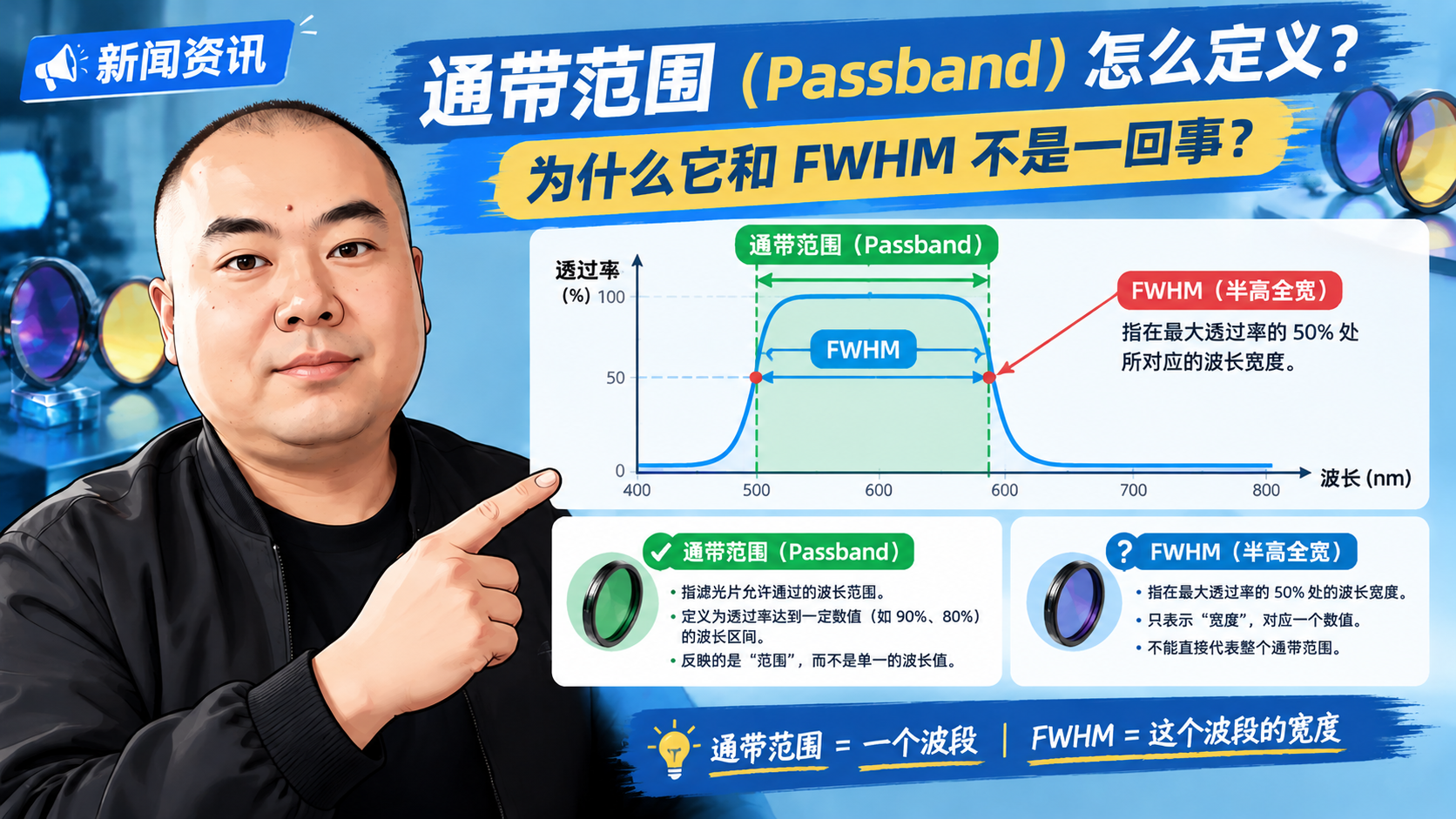
Passband describes which wavelengths pass through a filter "effectively". Plain enough - but until "effectively" is quantified, the datasheet means very little.
For one and the same filter, the passband at T greater than 50% may be 505-560 nm (55 nm wide), while at T greater than 90% it is only 515-548 nm (33 nm). Both are correct; only the threshold differs. That is exactly why passband and FWHM get confused.
| Item | Passband | FWHM |
|---|---|---|
| Reference | Absolute transmission threshold (T greater than 90%, 80%, ...) | 50% of peak (relative) |
| What it tells you | How wide the truly usable window is | Relative width of the curve |
| Affected by peak height | Yes - a lower peak narrows the passband | No - only the half-height points matter |
| Typical use | System power budget, SNR calculations | Quick comparison of filter widths |
Concrete example: two filters both have 10 nm FWHM, part A peaks at 92%, part B at 65%. At T greater than 50%, A's passband is about 10 nm while B's shrinks to 6-7 nm, because B's 50% line sits at only 32.5% and the curve has already fallen away. For power-limited systems, read the absolute passband, not FWHM.
Zoom into the curve and an ordinary narrowband filter shows a smooth hump with soft shoulders. A high-grade filter is built flat-top: nearly horizontal across the passband, then dropping almost vertically.
The benefit appears under real conditions:
That is why fluorescence and flow instruments specify flat-top narrowband filters even at higher unit cost. The related batch consistency issue grows sharper as the passband narrows.
"Passband 520-560 nm" is not enough on its own:
The usual ordering is Tpeak greater than Tavg greater than Tmin. Contracts and inspection criteria should be written against Tmin, because it is the least arguable figure. See minimum transmission.
The instinct of a first-time buyer is to widen the band for more signal. In fluorescence or Raman the opposite happens: every extra 10 nm can multiply the background, and signal-to-noise drops. The right questions are: how wide is the target signal, and how strong is the background? Hand both answers to your supplier rather than picking a round number.
Not sure what width to choose? Send your source spectrum, detector response and signal wavelength to sales@ootee.cn and we will calculate the window that maximizes signal-to-noise instead of guessing.
 365nm Narrow Bandpass Filter | Ø50mm | T>90%
OT-HBP3659050
365nm Narrow Bandpass Filter; FWHM 10nm; transmission >90%; blocking OD5; size Ø50mm; AOI 0°.
 450nm Narrow Bandpass Filter | Ø50mm
OT-HBP4509050
450nm Narrow Bandpass Filter; FWHM 10nm; transmission >90%; blocking OD5; size Ø50mm; AOI 0°.
 525nm Narrow Bandpass Filter | Ø50mm
OT-HBP5259050
525nm Narrow Bandpass Filter; FWHM 10nm; transmission >90%; blocking OD5; size Ø50mm; AOI 0°.
Send us your drawing and spectral targets — an engineer replies with a feasibility check and quotation within one business day.