
JGS1 vs JGS2 vs JGS3: Choosing Quartz Glass for Filters
Grade differences come from the melting process and hydroxyl content. Selection should rest on measured transmission, thickness loss and substrate specs.
Plain-language optics know-how for purchasing engineers, optical designers and newcomers: principles, coating process, selection rules and real applications — so you know what to pick and why.
Filter: #absorption —— 8 articles Clear
Grade differences come from the melting process and hydroxyl content. Selection should rest on measured transmission, thickness loss and substrate specs.
 Optics Basics
Understand DUV filter constraints through absorption, gas paths, exposure history and reproducible system-level acceptance tests.
 Wiki & Glossary
Understand how absorption coefficient and thickness set the long wavelength limit, and separate bulk loss from coating performance.
 Wiki & Glossary
Compare absorption and reflection, thickness trade-offs, installed conditions, and the limits of hybrid glass and thin-film filter stacks.
 Wiki & Glossary
Compare Si, Ge and ZnS through bulk absorption, surface reflection and material grade, then qualify thickness, temperature and finished-filter performance.
 Wiki & Glossary
How UV absorption, purity and thickness drive substrate choice, and what to verify when specifying fused silica or calcium fluoride filters.
 Coating Process
Compare coating families through transmission, reflection and absorption, with practical tradeoffs for spectral selection and thermal loading.
 Wiki & Glossary
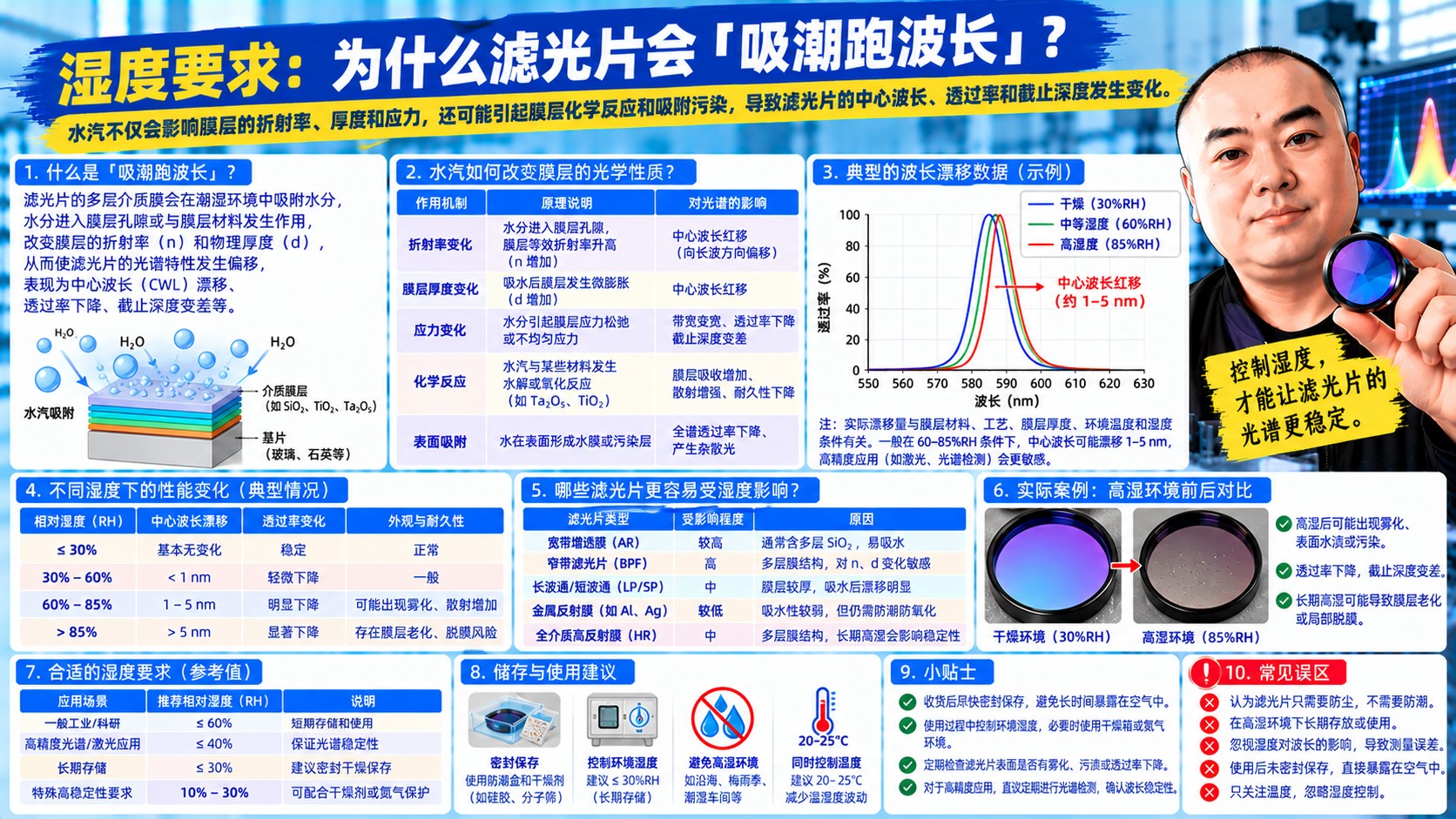
The humidity requirement states the allowable relative humidity or damp-heat rating, in %RH. For soft coatings, humidity shifts the center wavelength directly; for hard ones it is a long-term reliability issue. This article covers the mechanism, testing and how to specify it.